

What Is NCCCO Crane Certification — and Do You Need It?
NCCCO crane certification is the nationally recognized credential that proves a crane operator has the knowledge and skills to operate equipment safely and legally.
Here’s what you need to know at a glance:
- Who needs it: Anyone operating a mobile crane in construction must be certified under federal OSHA regulation 29 CFR 1926 Subpart CC
- Who issues it: The National Commission for the Certification of Crane Operators (NCCCO), accredited by the ANSI National Accreditation Board (ANAB)
- What it involves: Passing a Core written exam, at least one Specialty written exam, and a hands-on practical exam
- How long it lasts: Five years, with recertification required in the 12 months before expiration
- What it’s worth: Certified crane operators earn a median wage of over $64,000 per year
Whether you’re brand new to the industry or an experienced operator looking to formalize your credentials, NCCCO certification is the standard. It’s not just a career move — in many cases, it’s the law.
The certification process can feel complicated at first. There are multiple exam types, strict timelines, and a set of policies you need to follow. But broken down step by step, it’s very manageable.
This guide covers everything: eligibility, exam formats, crane specialties, training options, costs, and how to keep your certification current.
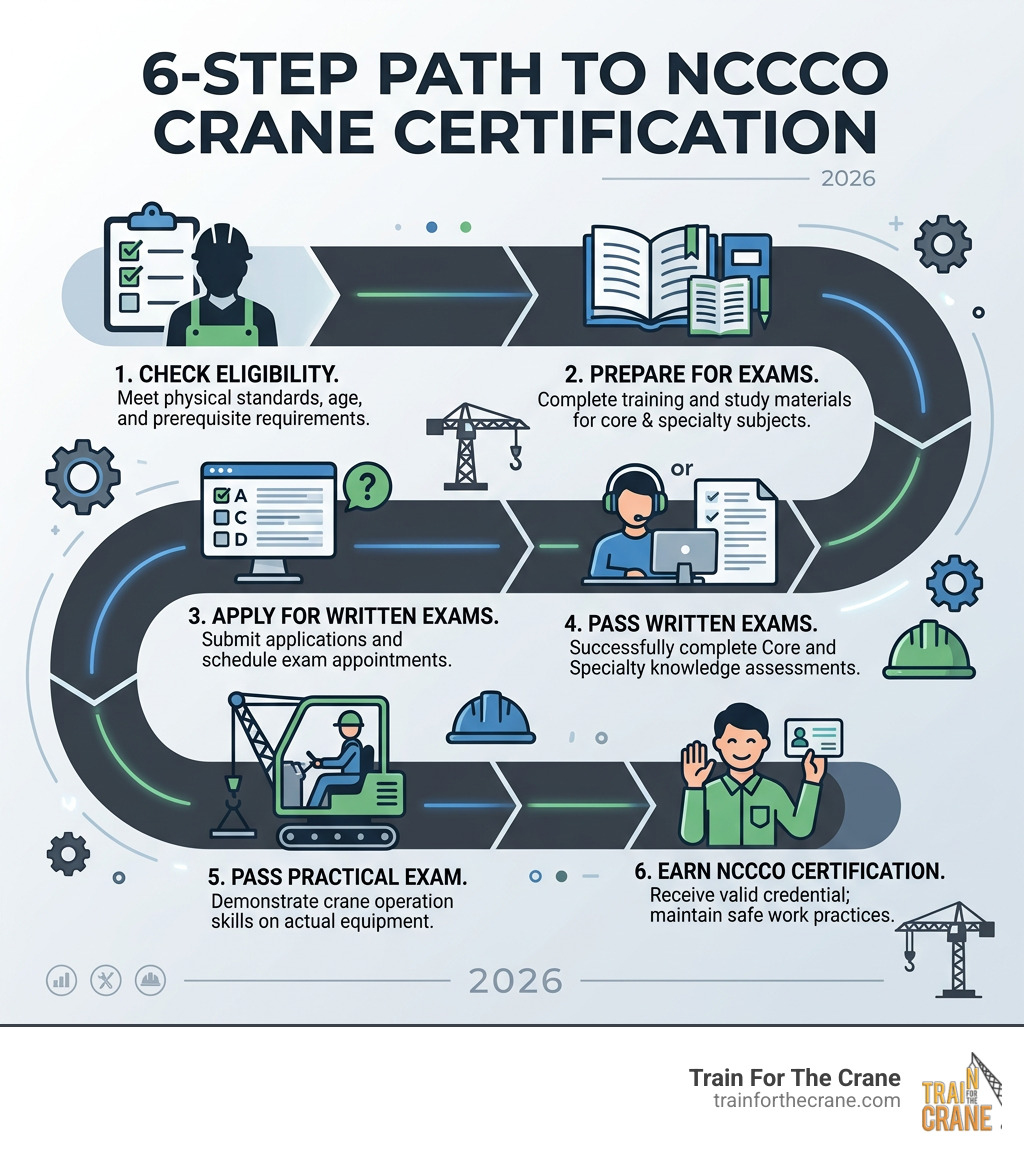
Nccco crane certification word guide:
Understanding the NCCCO Crane Certification Process
The world of heavy lifting is governed by strict safety standards, primarily driven by OSHA 29 CFR 1926 Subpart CC. This federal regulation mandates that crane operators in the construction industry be certified by an accredited testing organization. This is where the National Commission for the Certification of Crane Operators (NCCCO) comes in.
What is NCCCO certification? It is a rigorous, independent assessment designed by industry experts—including operators, trainers, and manufacturers—to ensure that anyone behind the controls of a multi-ton machine knows exactly what they are doing. The program is accredited by the ANSI National Accreditation Board (ANAB), ensuring it meets the highest international standards for personnel certification.
For employers and operators alike, the benefits of CCO training go far beyond simple compliance. Safety is the primary goal; by standardizing the knowledge required to operate these machines, the industry sees fewer accidents, reduced downtime, and lower insurance risks. Plus, with a median annual wage exceeding $64,000, becoming a certified professional is a smart financial move. We have seen how proper certification opens doors to high-paying projects that are off-limits to uncertified workers.
Eligibility for NCCCO Crane Certification
Before you can climb into the cab for your exam, you must meet specific NCCCO certification requirements. The “barrier to entry” is designed to ensure that only responsible, capable individuals are operating heavy machinery.
To be eligible, you must:
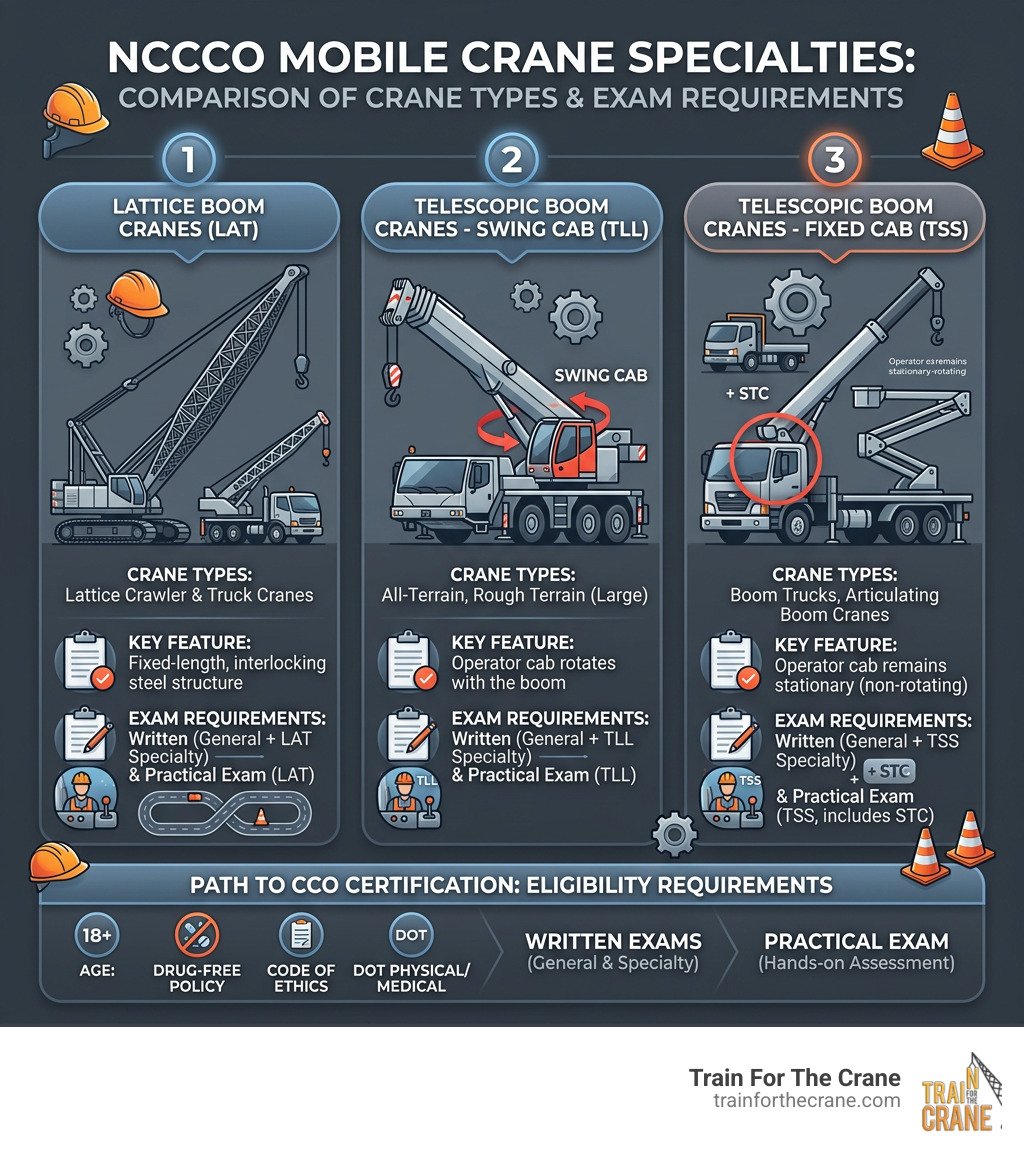
- Be at least 18 years of age.
- Comply with the NCCCO Substance Abuse Policy (which involves agreeing to remain drug-free).
- Comply with the NCCCO Code of Ethics, which governs professional conduct in the field.
- Meet medical requirements, often evidenced by a DOT physical or similar medical examiner’s certificate.
Demystifying the CCO process starts with understanding that these aren’t just “suggestions”—they are mandatory policies. Failure to comply with the Code of Ethics or Substance Abuse Policy can lead to the revocation of your credentials. At Train For The Crane, we emphasize that being a great operator starts with being a responsible professional.
Mobile Crane Specialties: LAT, TLL, and TSS
Not all cranes are the same, and neither are the certifications. When pursuing nccco crane certification, you will choose one or more “specialties” based on the equipment you intend to operate. The three primary mobile crane designations are:
- Lattice Boom Cranes (LAT): These include both truck-mounted and crawler cranes with a fixed-length lattice structure.
- Telescopic Boom Cranes—Swing Cab (TLL): These are the versatile “big rigs” where the operator’s cab rotates with the boom.
- Telescopic Boom Cranes—Fixed Cab (TSS): Often referred to as “boom trucks,” where the cab remains stationary while the boom operates. Interestingly, if you earn your TSS certification, it typically includes the Service Truck Crane (STC) designation automatically.
To help you navigate these, we’ve put together a mobile crane operator guide to help you decide which path fits your career goals.
Written and Practical Exam Breakdown
Achieving your nccco crane certification requires passing two distinct phases: the written exams and the practical exam. Think of it like getting a driver’s license, but with much higher stakes and a lot more buttons.
The Written Exams
The NCCCO written exams consist of a “Core” exam and at least one “Specialty” exam.
- Core Exam: This covers general crane knowledge applicable to all types. It consists of 95 multiple-choice questions, and you have 90 minutes to complete it.
- Specialty Exams: These focus on the specific type of crane (LAT, TLL, or TSS). Each specialty exam has 26 questions and a 60-minute time limit.
The Practical Exam
Once you’ve tackled the books, it’s time for the “hands-on” portion. The practical exam guide outlines a series of maneuvers you must perform to demonstrate proficiency. You’ll be timed as you navigate an obstacle course, demonstrating your ability to control the load, catch a swing, and place the hook with precision. You must pass the practical exam within 12 months of passing your first written exam to become fully certified.
The Cost of NCCCO Crane Certification
While we don’t list specific prices here, it is important to understand what goes into the certification cost guide. Your total investment generally covers:
- NCCCO Exam Fees: These are paid directly to the testing body for the Core, Specialty, and Practical exams.
- Training Tuition: This covers your classroom instruction and time in the seat of the crane.
- Administration: Handling the mountain of paperwork required for the myCCO portal.
If you are looking to round out your resume, you might also consider the rigger certification costs as part of a package deal, which often makes you more employable on-site.
Exam Timelines and Policies
Time is of the essence when you start this journey. After you pass your first exam (whether it’s written or practical), you have a 12-month window to complete the remaining requirements for that designation. If you miss this window, you’ll likely have to start over and retake the exams you’ve already passed.
The NCCCO exam details also mention that all operator designations will share the same expiration date. This means if you add a new specialty halfway through your five-year cycle, it will still expire at the same time as your original certification. For more on how to navigate the testing day itself, check out our practical exam tips.
Training Courses and Certification Packages
At Train For The Crane, we know that everyone learns differently. That’s why we offer various NCCCO classes tailored to your experience level.
- 3-Day Accelerated Courses: Designed for experienced operators who just need to brush up on the latest regulations and prepare for the written exams. It’s “all meat, no filler.”
- 5-Day Beginner Packages: This is the complete training guide approach. We include classroom instruction, hands-on crane familiarization, and often bundle in Rigger Level I and Signal Person certifications.
Preparing for Success
Success on the exam isn’t about luck; it’s about preparation. You need to master load chart practice, as these are a major part of the written exams. If you can’t read a load chart, you can’t operate a crane safely.
Our NCCCO study guide and various test prep strategies focus on:
- Site Setup: Identifying power lines, checking ground stability, and proper outrigger deployment.
- Hand Signals: Communicating effectively with your signal person.
- Load Dynamics: Understanding how wind and speed affect your lift.
Maintaining and Renewing Your Credentials
Your nccco crane certification is valid for five years. However, don’t wait until the last minute to think about renewal! You should begin the recertification process in the 12 months prior to your expiration date.
To recertify, you must:
- Pass the recertification written exams (which are identical in format to the initial exams).
- Meet the 1,000-hour requirement. If you can attest to at least 1,000 hours of crane-related experience (operating, maintaining, or training) during your five-year period, you can skip the practical exam for recertification.
If you let your certification lapse even by one day, there is no grace period. You will be treated as a brand-new candidate and must take all written and practical exams again. Our recertification guide provides a deeper dive into staying current, and we can help you find recertification test locations that work for your schedule.
Frequently Asked Questions about NCCCO Certification
Where are NCCCO testing locations available?
Written exams are now more flexible than ever. You can choose from Computer-Based Testing (CBT) at specialized centers, Event Online Testing (EOT) at a training facility, or even Online Proctored Testing (OPT) from your own home in some cases. For the hands-on portion, you’ll need to visit specific practical exam locations that have the approved crane types and courses set up.
What are the pass rates for training programs?
While the national average varies, top-tier programs—like those we pride ourselves on—consistently see pass rates exceeding 90%. This is largely due to having instructors with decades of real-world experience. For more on choosing the right school, see our NCCCO school guide.
How does certification relate to OSHA requirements?
OSHA 29 CFR 1926 Subpart CC requires that all mobile crane operators in construction be “qualified” or “certified.” NCCCO certification is the most widely accepted way to meet this requirement. Without it, your employer could face heavy fines, and you could be barred from the job site. Get the full scoop in our NCCCO crane operator info section.
Conclusion
Navigating nccco crane certification can feel like lifting a complex load in a high wind, but with the right team, it’s a smooth operation. At Train For The Crane, we bring over 30 years of combined experience to the table, offering on-site training that meets you where you are—literally. We serve the Danville, Indiana area and beyond, providing the proven methods you need to pass your exams the first time.
Ready to take the next step in your career? Start your NCCCO crane certification today and join the ranks of the elite, certified operators keeping our job sites safe.