

The Foundation of Safe Lifting: Your Introduction to Rigger Certification
Rigger certification is your official proof of skill and knowledge in the critical task of safely moving heavy loads. It shows you understand how to handle complex lifting operations. For anyone working with cranes or heavy equipment, this certification is more than just a credential. It’s a commitment to safety and a major step forward in your career.
Here’s what rigger certification generally involves:
- Formal Training: You learn essential rigging techniques and safety rules.
- Knowledge Assessment: You pass written exams to show what you’ve learned.
- Practical Skills Evaluation: You demonstrate hands-on rigging tasks.
- Safety Compliance: Your skills meet strict industry and government safety standards.
- Career Growth: It opens doors to more opportunities and higher pay.
Working with heavy loads is risky. Each year, improper safety protocols lead to dozens of crane-related deaths and hundreds of injuries. This highlights why having properly trained and certified riggers is so important. It protects workers, equipment, and projects.
This guide will walk you through everything about rigger certification. We’ll cover what it is, why it’s crucial for safety and your career, and how to get certified.
Key rigger certification vocabulary:
Qualified vs. Certified: Navigating OSHA and ASME Standards
In lifting and hoisting, words like “qualified” and “certified” get tossed around like beanbags. However, in the eyes of OSHA (Occupational Safety and Health Administration) and ASME (American Society of Mechanical Engineers), these terms have very specific meanings. Understanding the difference is the first step toward true safety compliance and risk mitigation.
A qualified rigger is defined by OSHA 1926.1404 as someone who possesses a recognized degree, certificate, or professional standing, or who by extensive knowledge, training, and experience, has successfully demonstrated the ability to solve or resolve problems related to rigging. Crucially, the employer is the one who determines if a person is “qualified” for a specific job.
A certified rigger, on the other hand, has gone through a rigorous testing process by an independent, third-party accredited organization like the NCCCO (National Commission for the Certification of Crane Operators). While OSHA requires riggers to be qualified, many job sites and contracts—especially in high-stakes industries—mandate that riggers also be certified to ensure a uniform national standard of excellence.
| Feature | Qualified Rigger | Certified Rigger |
|---|---|---|
| Who Decides? | The Employer | Third-Party Accredited Body (e.g., NCCCO) |
| Standard | Job-specific / Employer standards | National industry standards |
| Testing | Employer-verified performance | Standardized written & practical exams |
| Portability | May not transfer between companies | Recognized nationwide |
| Compliance | Meets minimum OSHA requirements | Exceeds OSHA; meets ASME B30 |
By ensuring your team holds a certified rigger credential, you aren’t just checking a box for a regulator; you’re building a culture of safety that significantly reduces the likelihood of accidents.
Who Needs to be Certified?
If your job involves attaching a load to a crane, you’re in the rigging game. While many people think only dedicated “riggers” need this, the reality is that several construction, manufacturing, and maritime roles require these skills. Iron workers, millwrights, electricians, and even some crane operators find that having a rigger certification is a career game-changer. Whether you are in Danville, IN or anywhere else in the Midwest, if you are responsible for the safety of a multi-ton lift, you need a solid guide to rigger training.
OSHA and ASME Requirements
OSHA’s 29 CFR 1926 Subpart CC is the “bible” for cranes and derricks in construction. It mandates that whenever workers are within the fall zone and hooking, unhooking, or guiding a load, they must be qualified. Furthermore, ASME B30 standards provide the technical meat on the bones, detailing exactly how slings should be inspected and how signalperson protocols should be handled. We help teams meet these high bars through our certified rigger and signal person training.
Major Certification Bodies and Rigger Levels
When it comes to the “Gold Standard” of rigger certification, the NCCCO is the most widely recognized name in the United States. They offer a tiered approach that allows professionals to grow from basic competency to advanced mastery. Other organizations like NCCER also provide valuable training, but the NCCCO’s specific focus on crane-related activities makes it a favorite for many industrial employers. You can explore the full landscape in our NCCCO rigger certification guide.
NCCCO Rigger Level I vs. Level II
The jump from Level I to Level II is all about the level of supervision and the complexity of the lift.
- Rigger Level I: These professionals are trained to handle simple, repetitive rigging tasks. They work under supervision and generally handle loads where the weight, center of gravity, and rigging configuration are already known or provided.
- Rigger Level II: This is for the “unsupervised” pro. A Level II rigger can estimate load weights, locate the center of gravity, select the specific rigging components based on capacity, and understand complex load dynamics.
Many of our students choose to tackle Rigger Level I and II training simultaneously to accelerate their career path.
The Examination Process: Written and Practical Requirements
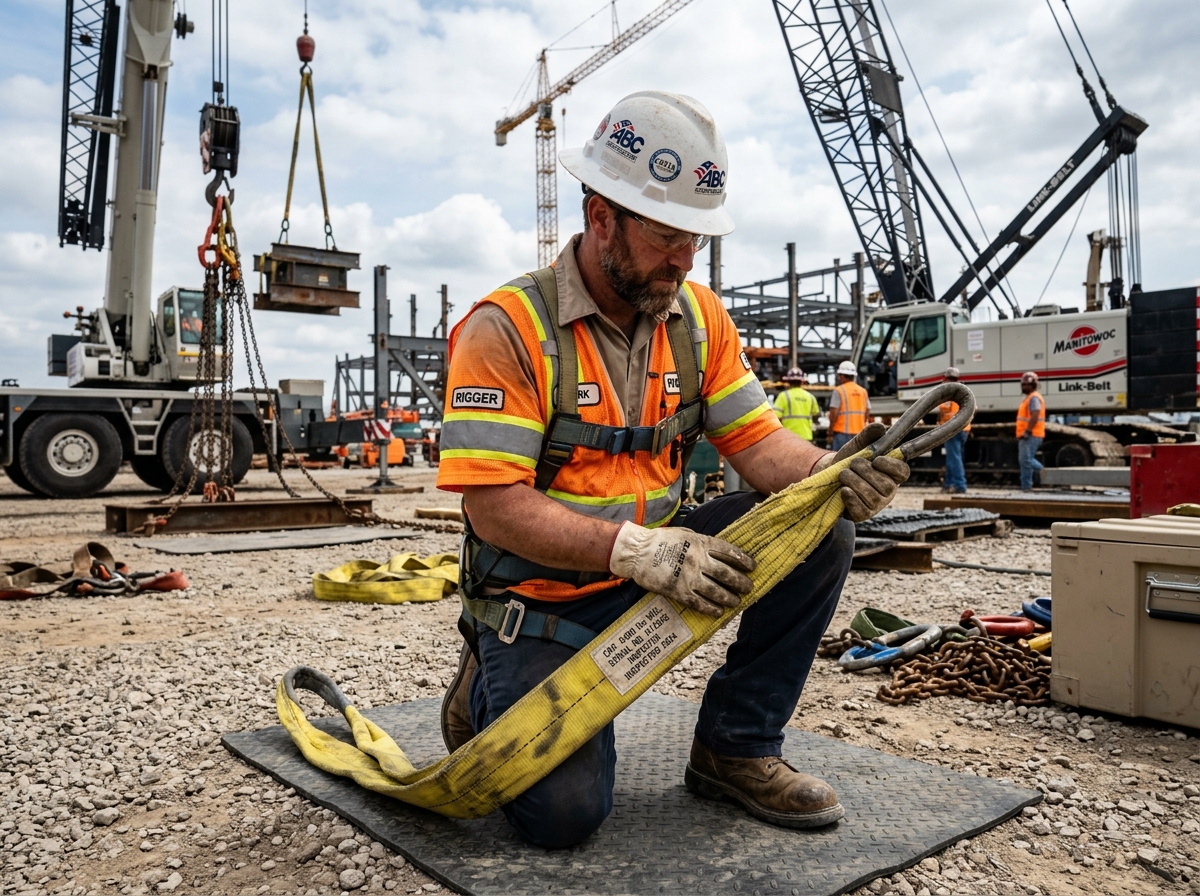
To earn your rigger certification, you have to prove you know your stuff both on paper and in the field. The NCCCO exams are designed to be challenging because the stakes on a job site are incredibly high.
The Written Exam for Level I typically consists of 60 multiple-choice questions with a 60-minute time limit. For Level II, it’s 50 questions in 60 minutes. These aren’t just “common sense” questions; they cover technical knowledge, inspection procedures, and the execution of rigging activities.
The Practical Exam is where the rubber meets the road. You’ll be asked to perform specific tasks, such as:
- Pre-use Rigging Inspection: Identifying defects in slings or hardware.
- Rigging Hitches: Demonstrating proper vertical, choker, and basket hitches.
- Rigging Connections: Using shackles and hooks correctly.
- Basic Knots: Tying essential knots like the bowline or sheet bend.
You can find more details on what to expect in our Rigger Level 1 training overview.
Step-by-Step Path to Rigger Certification
Becoming a pro doesn’t happen overnight, but the process is straightforward:
- Eligibility: You must be at least 18 years old.
- Compliance: You must agree to the NCCCO Substance Abuse Policy and Code of Ethics.
- Preparation: Attend a certified rigger course to sharpen your skills.
- The Written Exam: Pass the computer-based or paper-and-pencil test.
- The Practical Exam: Pass the hands-on assessment within 12 months of passing your written exam.
Core Skills Tested for Rigger Certification
What exactly do you need to know? The exams dive deep into synthetic slings, wire rope, and chain slings. You’ll need to master hitch configurations and understand how angles affect sling tension. Load weight estimation is also a huge part of the curriculum. If you can’t calculate the weight of a steel beam or a concrete slab, you aren’t ready for the hook. Our crane rigging course covers all these bases to ensure you’re prepared for any scenario.
Maintaining Your Rigger Certification: Validity and Costs
Once you have that laminated card in your wallet, the work isn’t over. An NCCCO rigger certification is valid for five years. This ensures that riggers stay up to date with the latest safety standards and equipment technologies.
Recertification Procedures
To keep your credentials active, you must complete the recertification process within the 12 months before your current certification expires. The good news? You generally only need to pass a recertification written exam. There is usually no practical exam required for renewal, provided your certification hasn’t already lapsed. Staying on top of this window is vital—there is no grace period! If you miss the deadline, you start from scratch. Learn more about earning and keeping your NCCCO credential.
Training and Exam Fees
While we don’t list specific current prices here as they can fluctuate based on location and testing center fees, it’s important to budget for the investment. Generally, a comprehensive training program including exams for Level I will be in the ballpark of $1,600 to $1,700, while Level II programs are slightly more, often around $2,000 to $2,100. There are also smaller fees for application processing and replacement cards. For a more detailed look, check out our rigger certification cost breakdown and the NCCCO-specific cost details. Think of it as an investment in a career that can pay dividends for decades.
Career Advancement and Workplace Safety Benefits
Why go through all this trouble? Because it pays—literally. In the construction and industrial sectors, certified professionals are in high demand. Research shows that about 93% of students transition into full-time jobs after completing high-quality rigging and crane training.
Why Employers Prioritize Rigger Certification
Employers love rigger certification for several reasons:
- Lower Insurance Premiums: Many insurance providers offer better rates to companies with a 100% certified workforce.
- Bid Eligibility: For many government and large-scale industrial projects, having certified riggers is a requirement to even submit a bid.
- Accident Reduction: Better training equals fewer mistakes, which means fewer injuries and less damaged equipment.
- Site Credibility: It shows clients that you take safety seriously.
A certified rigger often starts at around $30 per hour, with experienced professionals earning significantly more. It’s a clear path to a stable, high-paying career. You can read more about the impact of these credentials on our crane and rigging certification page.
Frequently Asked Questions about Rigger Certification
What is the difference between a Rigger Level I and Level II?
Rigger Level I is for supervised, simple, and repetitive lifts where all load data is provided. Rigger Level II is for unsupervised professionals who can calculate load weights, find the center of gravity, and select the appropriate rigging hardware independently.
How long does it take to get NCCCO rigger certified?
Most prep courses last between 2 to 5 days, depending on whether you are doing Level I, Level II, or both. Once you pass your exams, processing usually takes a few weeks, but you must pass both the written and practical portions within a 12-month window.
Is a practical exam required for rigger recertification?
No. For standard NCCCO recertification within the five-year validity period, only the written recertification exam is required. However, if you let your certification expire, you will likely have to take both the written and practical exams again.
Conclusion
At Train For The Crane, we know that rigger certification is the backbone of a safe job site. With over 30 years of combined experience, our instructors provide on-site training that doesn’t just help you pass a test—it helps you stay safe for a lifetime. We focus on the practical, real-world skills that matter when a multi-ton load is hanging over the deck.
Whether you’re looking to start a new career or you’re an employer wanting to bring your team up to OSHA standards, we are here to help. Our proven methods lead to high pass rates and, more importantly, safer work environments in Indiana and beyond.
Start your Rigger Level I & II training today and take the first step toward a more professional, profitable, and safer future.