

What Is Crane Inspection Certification — and How Do You Get It?
Crane inspection certification is a formal credential that proves you have the knowledge and skills to safely inspect cranes and identify hazards before they cause accidents.
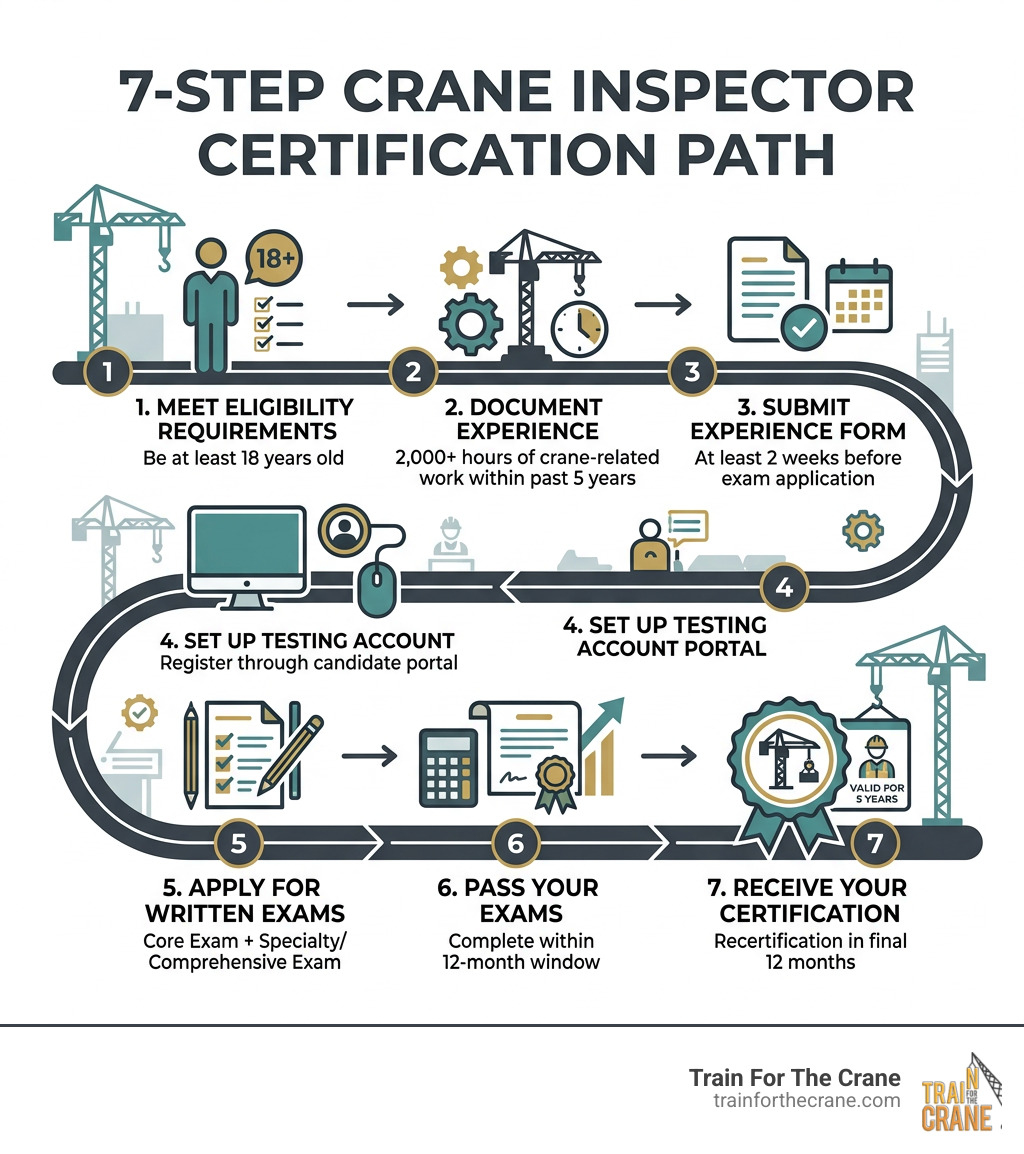
Here’s how to get certified as a crane inspector in 7 steps:
- Meet the eligibility requirements — be at least 18 years old
- Document your experience — 2,000+ hours of crane-related work within the past 5 years
- Submit your Experience Form — at least 2 weeks before applying for exams
- Set up your testing account — register through the certifying body’s candidate portal
- Apply for your written exams — Core Exam plus the relevant Specialty or Comprehensive Exam
- Pass your exams — all exams must be completed within a 12-month window
- Receive your certification — valid for 5 years, with recertification required in the final 12 months
If you work around cranes — as an operator, mechanic, foreman, or inspector — getting certified isn’t just a career move. It’s a safety responsibility.
Crane failures injure and kill workers every year. Most of those incidents are preventable. A certified inspector knows exactly what to look for and how to document it correctly.
The good news? The path to certification is clear and well-defined. You need the right experience, the right preparation, and the right training program.
That’s exactly what this guide walks you through.
Must-know crane inspection certification terms:
Understanding the Importance of Crane Inspection Certification
In heavy lifting, “good enough” is never actually enough. When we talk about crane inspection certification, we are talking about the thin line between a productive workday and a catastrophic site failure.
For those of us operating in Indiana and across the country, federal regulations under OSHA 29 CFR 1926 Subpart CC mandate that cranes must be inspected by “qualified” personnel. But what does “qualified” really mean? It means having the documented expertise to spot a hairline crack in a boom or a frayed strand in a wire rope that an untrained eye would miss.
The importance of this certification boils down to three main pillars:
- Safety and Accident Prevention: Since 1996, organizations like the NCCCO have administered over 700,000 exams to help standardize safety. Certified inspectors are the front line in reducing accidents, injuries, and fatalities.
- Liability Reduction: For employers, having a certified inspector on staff (or hiring a certified third party) is a massive win for risk management. It demonstrates a commitment to industry best practices and provides a solid paper trail if an incident ever does occur.
- Regulatory Compliance: Standards like the ASME B30 series and OSHA requirements aren’t just suggestions. They are the law. A certified inspector ensures your equipment meets these rigorous benchmarks, helping you avoid heavy fines and improved safety records.
To understand what these inspectors are looking for, we have to look at the frequency of the work. OSHA and ASME distinguish between different levels of scrutiny.
Frequent vs. Periodic Inspection Requirements
| Feature | Frequent Inspection | Periodic Inspection |
|---|---|---|
| Interval | Daily to Monthly | 1 to 12 Month Intervals |
| Focus | Operating mechanisms, hooks, wire rope, hydraulic leaks | Structural bolts, cracked/worn sheaves, braking systems, power plants |
| Documentation | Records of defects often required | Written records of structural/mechanical condition required |
| Performed By | Designated/Competent Person | Qualified Person (Certified Inspector) |
If you want to dive deeper into the actual process of the job, check out our page on crane-inspection.
Eligibility and Experience Requirements for Candidates
You can’t just walk off the street and decide to become a certified crane inspector tomorrow. The industry demands “grease under the fingernails” experience.
To be eligible for crane inspection certification, specifically through the NCCCO, you must meet the following criteria:
- Age Requirement: You must be at least 18 years old.
- Documented Experience: This is the big one. You need a minimum of 2,000 hours of documented work experience within a five-year period.
- Relevant Roles: This experience must be related to maintaining, inspecting, servicing, repairing, or modifying cranes. This includes time spent as a crane operator, mechanic, shop foreman, or even a trainee inspector.
We always tell our students in Danville: be as detailed as possible on your Experience Form. Don’t just say you “worked on cranes.” Specify the types of cranes (Mobile, Tower, Overhead), the specific maintenance tasks you performed, and the number of hours dedicated to each. You’ll need to provide proof, which can include letters from employers, transcripts, or a detailed resume.
This experience ensures that when you sit for the exam, you aren’t just memorizing facts—you’re applying years of practical knowledge. If you’re looking for a roadmap to get started, our crane-inspector-training-ultimate-guide is a great place to begin.
Navigating the Crane Inspection Certification Exam Process
Once your experience is approved (usually a two-week process after you pay the processing fee), it’s time to face the exams. The testing process is designed to be rigorous because the stakes are so high.
The Core and Specialty Exam Structure
The crane inspection certification path is modular. You don’t just take one generic “crane test.” Instead, you tackle a Core Exam and then add “Specialties” based on the equipment you intend to inspect.
- Crane Inspector Core Exam: This is a 50-question, 60-minute exam. It covers universal inspection principles that apply across the board. Note: No calculators are allowed for the core portion!
- Mobile Crane Inspector Specialty: This exam has 50 questions and gives you 90 minutes. Because of the complex load charts involved, a calculator is permitted here.
- Tower Crane Inspector Specialty: A 40-question, 60-minute exam focusing on the unique structural and electrical needs of tower cranes.
- Overhead Crane Inspector Comprehensive: This is a more robust 70-question, 90-minute exam. It covers everything from top-running bridges to underhung monorails.
We recommend not scheduling more than six hours of testing in a single day. Trust us—your brain will thank you. To help you prepare for what these exams actually look for, we’ve put together a crane-inspection-checklist-ultimate-guide that mirrors many of the exam domains.
Preparing for Your Crane Inspection Certification
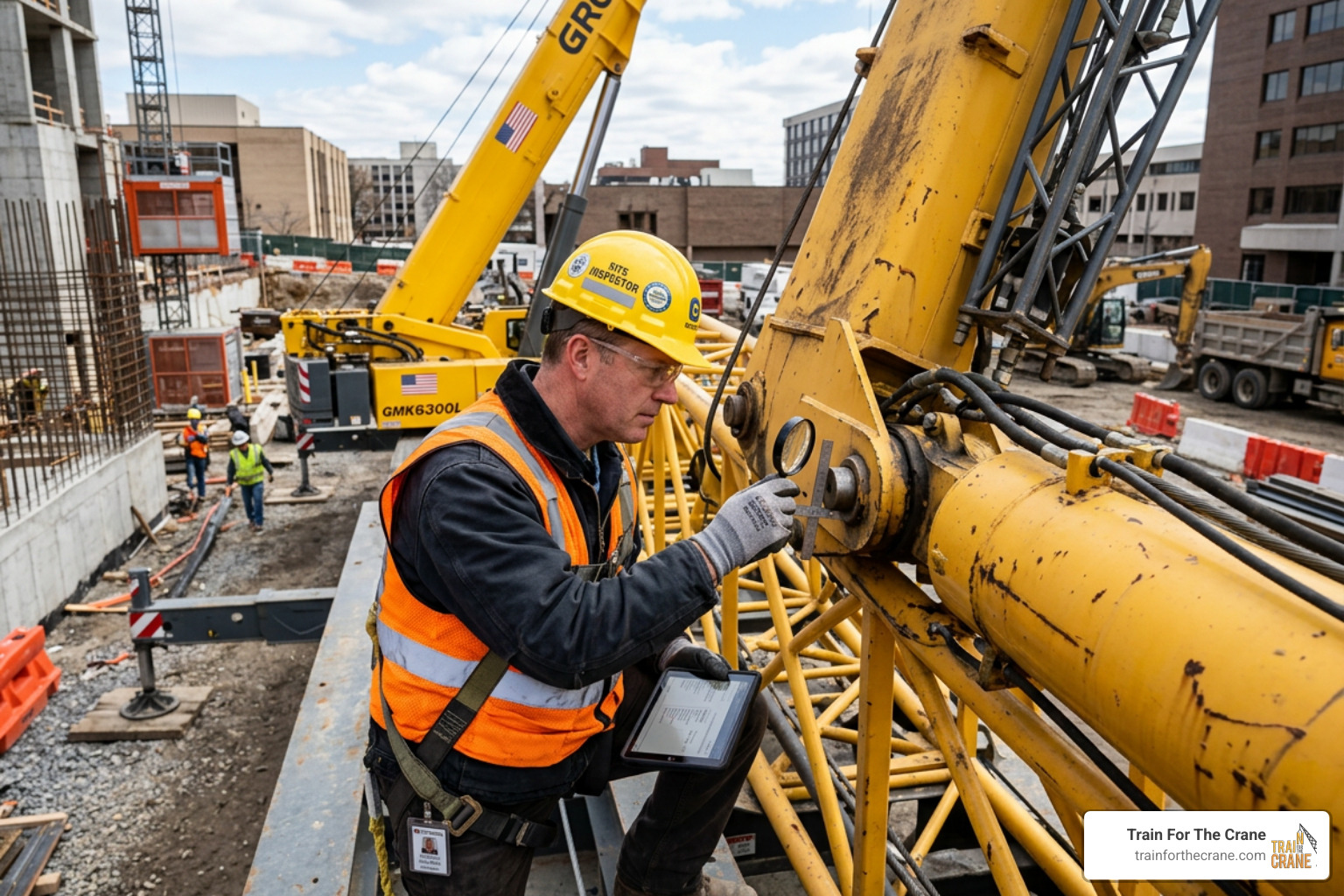
One of the most unique parts of the crane inspection certification exam is the “Practical” component. Unlike operator exams, there is no hands-on practical test where you walk around a crane. Instead, the “practical” is integrated into the written exam through pictorial questions.
You will be shown real-life images of crane components—some in good repair and some with dangerous deficiencies. Your job is to identify the hazards.
The exams cover six core domains:
- Pre-Inspection Survey: Researching the crane’s history and site conditions.
- Records Review: Checking past maintenance logs and wire rope reports.
- Visual Inspection: Looking for structural cracks, wear, and corrosion. (This makes up 40-66% of specialty exams!)
- Operational Testing: Ensuring limit switches and safety devices function.
- Load Testing and Load Charts: Verifying the crane can safely handle its rated capacity.
- Post-Inspection: Documenting findings and applying decals.
If you want to sharpen your eye for the visual portion, specifically regarding the boom, check out our crane-boom-inspection guide.
Leading Organizations and Regulatory Standards
When you earn your crane inspection certification, you aren’t just getting a piece of paper; you are aligning yourself with the highest standards in the industry.
OSHA and ASME Crane Inspection Certification Standards
The NCCCO (National Commission for the Certification of Crane Operators) is the gold standard here. Formed in 1995 as a non-profit, it was created specifically to develop performance standards for safe operation. Today, their programs are accredited by ANSI to the ISO 17024 standard.
Other key standards you’ll need to master include:
- OSHA 29 CFR 1910.179: The federal mandate for overhead and gantry cranes.
- ASME B30 Series: The “bible” of crane safety, covering everything from mobile cranes (B30.5) to jacks and hoists.
- CMAA Specification 78: Specifically for overhead crane service and inspection.
Maintaining Your Credentials and Recertification
Getting certified is a huge achievement, but you have to keep those skills sharp. Your crane inspection certification is valid for five years.
To stay certified, you must go through the recertification process during the 12 months prior to your expiration date. If you wait until the day after it expires, you might have to start the whole process over—and nobody wants that!
Recertification typically involves:
- Passing the current recertification exams.
- Maintaining a clean record regarding the CCO Ethics and Substance Abuse policies.
- Updating your information in the Crane Inspector Directory.
Once you pass, you’ll receive a new wallet card and decals. These are your “badges of honor” that prove to every site supervisor in Indiana that you are the real deal.
Frequently Asked Questions about Crane Inspector Certification
Is a practical exam required for crane inspectors?
No, there is no hands-on practical exam where you physically touch a crane. Instead, the NCCCO uses scenario-based testing within the written exams. These use pictorial questions with real-life images of crane deficiencies. You must be able to identify hazards and “red flags” visually on the screen.
What are the different types of inspector designations?
There are four primary designations you can earn:
- Mobile Crane Inspector (MCI)
- Tower Crane Inspector (TCI)
- Overhead Crane Inspector (OCI)
- Articulating Crane Inspector (ACI)
How much experience is needed to become certified?
You need at least five years of crane-related experience. Within that five-year window, you must document at least 2,000 hours of work. This work can be as an inspector, operator, mechanic, or shop foreman.
Conclusion
Becoming a certified crane inspector is one of the most rewarding paths you can take in the construction and manufacturing industries. It places you in a position of authority and responsibility, ensuring that every worker goes home safe at the end of the shift.
At Train For The Crane, we’ve seen how the right preparation makes all the difference. Based in Danville, Indiana, our instructors bring over 30 years of combined experience to the table. We don’t just teach you how to pass a test; we teach you how to be an expert in the field. Our proven methods lead to high pass rates, helping you get your credentials faster and with more confidence.
Ready to take the next step in your career? Get started with NCCCO certification information today and join the ranks of the industry’s most trusted safety professionals.