

Your First Step to a High-Flying Career
Crane operator training schools near me offer pathways to a high-demand career in construction, manufacturing, and industrial work. Here’s how to find the right program:
Quick Answer: Finding Crane Operator Training Schools Near You
- Search for NCCCO-accredited schools – National certification is essential for most employers
- Check local community colleges – Many offer 5-8 day intensive programs
- Contact industry training providers – Companies like Train For The Crane offer on-site and regional training
- Verify hands-on training – Ensure programs include real equipment operation, not just classroom work
- Compare certification options – Mobile crane, overhead crane, and tower crane require different certifications
Imagine standing high above a busy construction site, commanding a massive machine that shapes skylines and builds the future. That’s the reality for certified crane operators—professionals who earn competitive wages in a field that’s always in demand.
But here’s the thing: getting certified isn’t as simple as taking a quick online course. The crane operation industry requires serious training, practical skills, and nationally recognized certification to ensure both your safety and career success.
The good news? Quality training programs exist across North America, from week-long intensive courses to comprehensive apprenticeships. The challenge is knowing what to look for and which program fits your experience level, schedule, and career goals.
Whether you’re completely new to the field or an experienced operator seeking recertification, this guide will walk you through everything you need to know about selecting the right crane operator training school. You’ll learn about different program types, certification requirements, what separates excellent schools from mediocre ones, and how to launch a rewarding career in this essential skilled trade.
What to Expect from Crane Operator Training Programs
When you start looking for crane operator training schools near me, you’ll find various programs for different experience levels. The core goal is always the same: to equip you with the knowledge and skills to operate cranes safely and efficiently.
Common program types include:
- Mobile Crane Operator Training: Focuses on movable cranes like hydraulic and lattice boom types, critical for construction. We offer comprehensive Mobile Crane Operator Training.
- Tower Crane Training: Specialized training for the stationary giants used in high-rise construction, requiring unique skills in stability and lift planning.
- Overhead Crane Training: Covers fixed bridge cranes used in manufacturing and warehouses, including remote and cab-operated models.
- Articulating Crane Training: For knuckle boom cranes common on delivery trucks. Our articulating crane training covers their unique controls.
- Digger Derrick Training: For utility work, combining digging, lifting, and setting capabilities.
The Importance of Blended Learning
Effective training is not just about reading a manual; it requires a blend of classroom theory and hands-on practice. This combination is non-negotiable for safe and proficient crane operation.
- Classroom Knowledge: This provides the foundation, covering OSHA regulations, physics principles of load dynamics, and critical safety laws. Without this theoretical background, practical skills alone are insufficient.
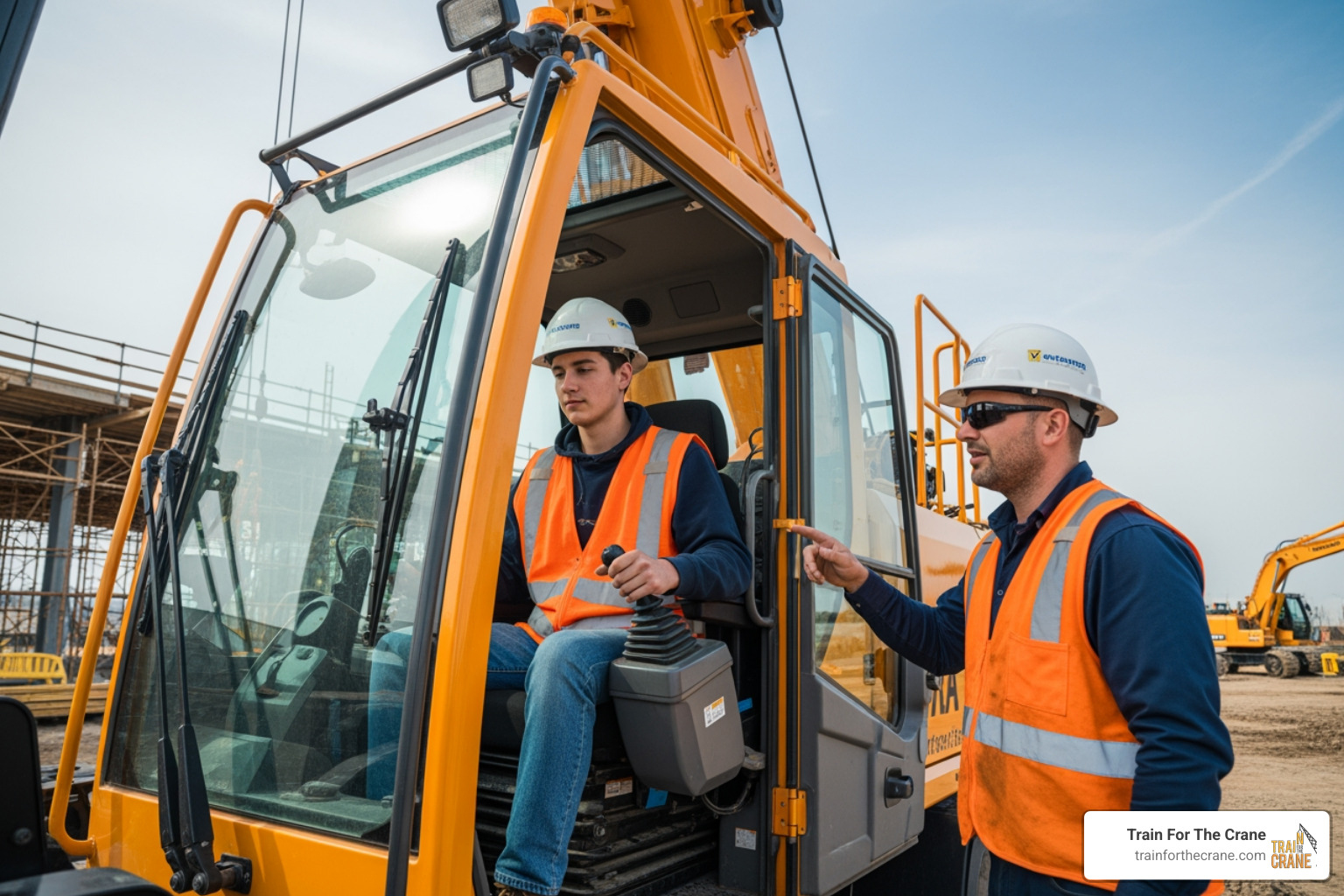
- Hands-On Training: This is where you build muscle memory and confidence by operating real machinery under expert guidance. Our training emphasizes extensive in-cab instruction to ensure you are comfortable with the controls.
Our crane operator classes are designed to seamlessly integrate these two vital components. Modern programs may also use simulators, allowing students to practice complex maneuvers in a safe, controlled environment.
Core Skills Taught in Crane Courses
Becoming a certified operator means mastering a diverse skill set. Our crane courses cover these essential competencies:
- Load Calculations & Chart Interpretation: Calculating load weights and using load charts to operate within safe limits.
- Rigging and Inspection: Selecting, inspecting, and applying rigging gear correctly. Our Rigger Level I & II training covers this in-depth.
- Site Management & Hazard ID: Assessing the job site for hazards like power lines or unstable ground and planning safe crane setup.
- Equipment Checks: Performing pre-operational inspections and routine maintenance to identify potential issues.
- Communication: Mastering standardized hand signals and radio protocols. Our Signal Person training is vital for this.
Program duration varies. Intensive courses can be completed in 3 to 7 days, while comprehensive programs may take longer. Train For The Crane specializes in providing custom, on-site training to fit your company’s specific needs.
The Path to Certification: Requirements, Costs, and Benefits
Starting on a career as a crane operator involves a clear path, especially regarding certification. Understanding the prerequisites, costs, and benefits will help you steer this journey.
Prerequisites for Crane Operator Training
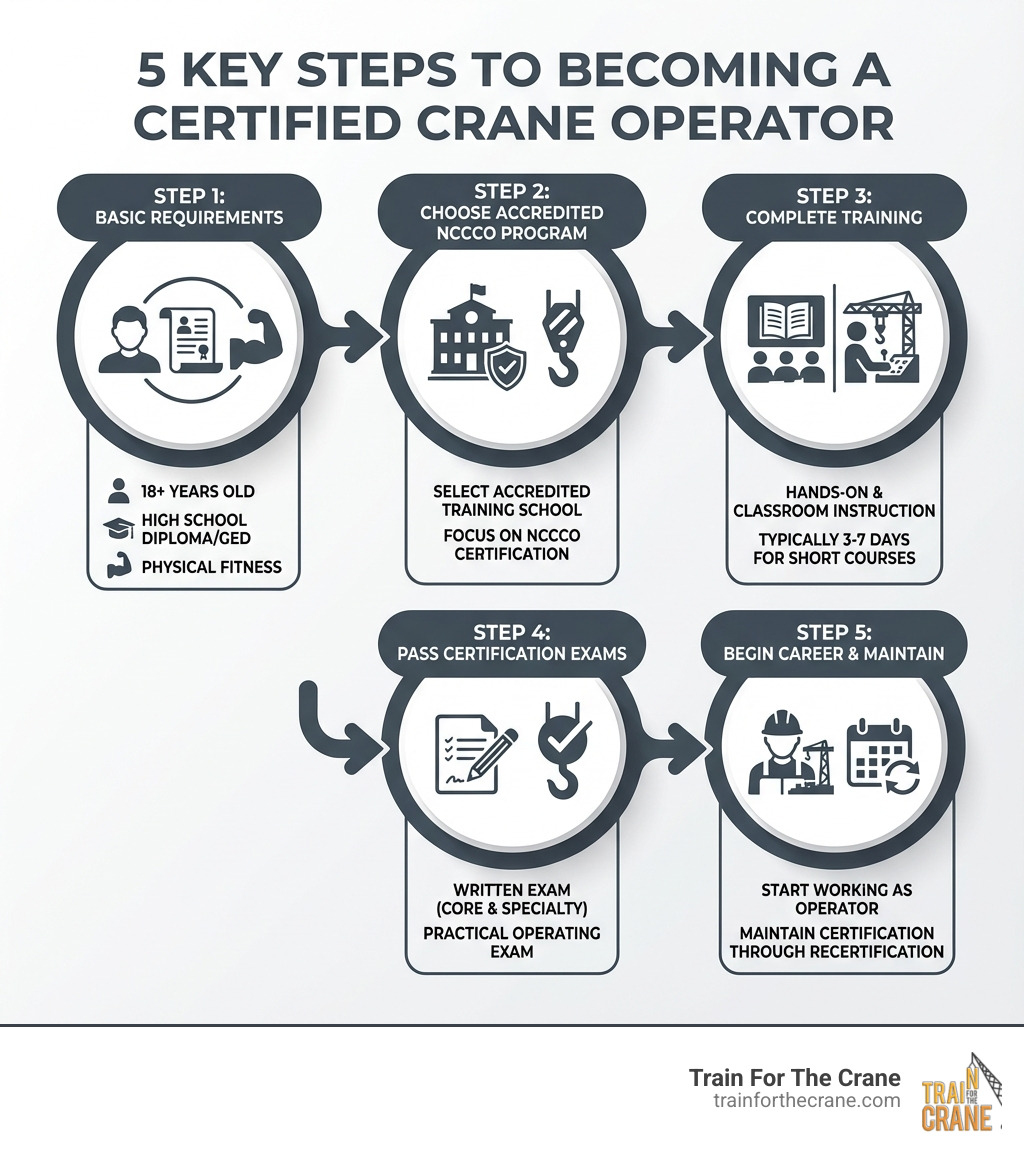
Before you begin, you’ll need to meet some fundamental requirements:
- Age: You must be at least 18 years old.
- Education: A high school diploma or GED is typically required.
- Physical Fitness: The job demands good vision (including depth perception), hand-eye coordination, and comfort with heights.
- Drug-Free: Passing drug and alcohol screenings is standard for training and employment.
- Communication Skills: The ability to communicate clearly with the team is crucial for safety.
How to Become a Crane Operator
The path to becoming a certified operator generally involves these steps:
- Meet the basic prerequisites.
- Choose an accredited training program for your desired crane type.
- Complete the classroom and hands-on training.
- Pass written and practical certification exams from a recognized body like NCCCO.
- Gain experience through entry-level positions or apprenticeships.
Regulatory Bodies and Certification
In the U.S., crane operation is governed by key organizations:
- OSHA (Occupational Safety and Health Administration): Sets federal safety standards and mandates operator certification.
- ANSI (American National Standards Institute): Develops voluntary safety standards often referenced by OSHA.
- NCCCO (National Commission for the Certification of Crane Operators): The leading, nationally recognized certification body. NCCCO certification is often required for state licensing.
Our Accredited Crane Training programs prepare you for NCCCO certification, which is vital for working across the country.
Costs and Benefits of Certification
While training is an investment covering tuition and exam fees, the returns are significant. Certified operators enjoy:
- Increased Earning Potential: Certified operators command higher wages.
- Improved Job Security: Nationally recognized certification makes you a more valuable asset.
- Improved Safety: Certification proves you meet industry safety standards, reducing accident risks.
- Portability: NCCCO certification is recognized across state lines, offering career flexibility.
Understanding Crane Operator Certification
Certification is your proof of competence. In the United States, NCCCO certification is the gold standard and involves a rigorous assessment:

- Written Exams: These cover theoretical knowledge, including crane types, load charts, and safety regulations.
- Practical Exams: These hands-on assessments evaluate your ability to safely operate a specific crane type.
- Recertification: Certifications expire (e.g., every five years for NCCCO), requiring operators to recertify to stay current.
Our crane certification and testing services are designed to prepare you for these exams. For more information, explore our guide on how to get crane certified.
How to Find the Best Crane Operator Training Schools Near Me
With many options available, knowing what to look for will help you choose the right crane operator training schools near me.
Here’s a comparison of common program features:
| Feature | Beginner-Friendly Program (e.g., Boot Camp) | Experienced Operator Course | On-Site Corporate Training |
|---|---|---|---|
| Target Audience | Individuals with no experience | Certified/experienced operators | Companies needing employee certification |
| Accreditation | NCCCO-focused | NCCCO-focused | NCCCO-focused |
| Instructor Experience | High importance for foundational skills | High importance for advanced techniques | High importance for custom content |
| Hands-on vs. Simulator | Mix of both, heavy on hands-on | Primarily hands-on | Can be custom, often hands-on |
| On-site Option | Less common | Possible | Primary mode of delivery |
| Pass Rate Focus | Strong emphasis on first-time pass | Focus on successful recertification | Guaranteed pass rates for written exams (some providers) |
| Duration | Longer (e.g., 7 days) | Shorter (e.g., 3-5 days) | Flexible (e.g., 2-6 days) |
Key Factors for Choosing a School
When evaluating schools, prioritize these critical factors:
- Accreditation: Ensure the school is accredited by or prepares you for NCCCO certification. This is the national standard and ensures your certification will be widely recognized.
- Instructor Experience: Quality training comes from instructors with extensive, real-world field knowledge. Our instructors at Train For The Crane bring over 30 years of combined experience to your training.
- Training Equipment: The school should provide modern, well-maintained cranes for hands-on practice.
- On-site Training Options: For companies, on-site training minimizes downtime and allows for instruction on your specific equipment. This is a core offering of Train For The Crane.
- Student Reviews: Look for positive feedback about teaching methods and program effectiveness.
- High Pass Rates: A school’s pass rate for certification exams speaks to the quality of its instruction. Our proven methods contribute to high pass rates.
What Differentiates Top Schools?
Beyond the basics, look for unique advantages:
- Customized Programs: Providers like us can tailor courses to meet specific company or individual needs.
- Varied Course Levels: Many schools offer different programs based on experience, such as beginner “boot camps” and shorter courses for experienced operators. Our offerings include training for both new and seasoned operators.
- Personalized Attention: Smaller class sizes often mean more one-on-one time with instructors, which is invaluable for mastering complex skills.
- Unique Offerings from Train For The Crane: We specialize in on-site NCCCO crane operator training, bringing our expert instructors and proven methods directly to your team. We focus on practical application to achieve high pass rates.
Whether you’re looking for crane operator training in Indiana or a crane school Indianapolis, these factors will help you find the best fit.
Launching Your Career as a Certified Crane Operator
Once you’ve successfully completed your training and earned your certification, a world of opportunity opens up. Becoming a certified crane operator means stepping into a role that is crucial to the infrastructure and economy, offering a rewarding career path.
Career Opportunities
The demand for skilled crane operators spans across various sectors:
- Construction Sector: This is perhaps the most obvious, with cranes being indispensable for building everything from residential homes to towering skyscrapers, bridges, and highways.
- Manufacturing: Factories and industrial plants rely on overhead cranes and mobile cranes for moving heavy machinery, raw materials, and finished products.
- Warehousing: Large warehouses and distribution centers use cranes and specialized lifting equipment to manage inventory.
- Transportation: Ports, shipyards, and rail yards employ crane operators for loading and unloading cargo.
Job Roles
Your certification can lead to several specialized job roles:
- Mobile Crane Operator: Operating hydraulic, lattice boom, or rough terrain cranes on construction sites and industrial projects.
- Tower Crane Operator: Commanding the stationary cranes used in high-rise construction.
- Rigger: Responsible for selecting, inspecting, and attaching loads to the crane’s hook, and communicating with the operator. Explore our Rigger Level I & II certification.
- Signalperson: Providing hand and voice signals to guide the crane operator, especially when the operator’s view of the load or landing area is obstructed. Our Signal Person training is essential for this vital role.
- Lift Director: Overseeing the entire lifting operation, ensuring safety protocols are followed, and coordinating all personnel involved. Consider becoming a certified Lift Director.
Career Progression
The crane operating field offers clear paths for career advancement:
- Lead Operator: Taking on more complex lifts and mentoring junior operators.
- Site Supervisor: Managing crane operations and personnel on a job site.
- Lift Director: Planning and executing critical lifts, a role requiring extensive experience and specialized certification.
- Instructor: Sharing your expertise by becoming a crane operator trainer, a path our experienced instructors have taken.
The journey to becoming a crane operator is an investment in time and effort, but the robust career opportunities and the satisfaction of contributing to major projects make it a truly high-flying profession. To begin your journey, learn how to become a crane operator with our comprehensive guide.
Frequently Asked Questions about Crane Operator Training
Here are answers to some of the most common inquiries about crane operator training.
How long does it take to get crane certified?
The time varies based on your experience. Comprehensive programs for beginners can last about 7 days, while shorter, intensive courses for experienced operators seeking certification are often 3 to 5 days. This timeframe covers the training needed to prepare for the written and practical exams.
Is being a crane operator a good career choice?
Yes, it is an excellent career choice. Key benefits include:
- High Demand: Strong job prospects in construction, manufacturing, and industrial sectors.
- Competitive Salary: Certified operators are well-compensated for their specialized skills.
- Job Security: Essential role on major projects leads to stable employment.
- Career Growth: Clear paths for advancement to supervisor, lift director, or instructor.
It’s a challenging but rewarding profession. Learn more in our article on how to become a crane operator.
Do I need experience to enroll in crane operator training schools near me?
Not necessarily. Many crane operator training schools near me offer beginner programs or “boot camps” for individuals with no prior experience. There are also specialized courses for experienced operators seeking certification or recertification. At Train For The Crane, we offer solutions for all skill levels.
Conclusion: Take the Next Step in Your Career
Choosing the right crane operator training schools near me is the first step toward a secure and rewarding career. By prioritizing accredited programs with experienced instructors and comprehensive hands-on training, you invest in your skill, safety, and future success.
Your journey to becoming a certified crane operator starts here. To ensure you receive top-tier, on-site NCCCO training from instructors with over 30 years of combined experience, trust Train For The Crane. We are dedicated to equipping you with the practical skills needed to pass your certification exams and launch a successful career.
Ready to take the next step? Explore our crane schools and training programs today!