

Why Crane Operation Basics Matter for Your Career
Crane operation basics are the foundation for a skilled, safe, and successful career in construction, manufacturing, and industrial sectors. Safely controlling a machine that lifts thousands of pounds, maneuvers heavy loads, and protects workers requires knowledge, training, and unwavering attention to detail.
Essential Crane Operation Basics You Need to Know:
- Crane Components – Understanding the carrier, boom, outriggers, hoist, and counterweights
- Core Principles – Mastering leverage, balance, weight distribution, and load charts
- Step-by-Step Procedures – Pre-operational checks, setup, lifting, moving, and shutdown
- Safety Protocols – PPE requirements, communication signals, hazard identification, and regulatory compliance
- Career Path – Educational requirements, training programs, certification, and advancement opportunities
A crane operator’s role is crucial for major construction and industrial projects. Cranes are the backbone of development, lifting materials for skyscrapers, bridges, and other infrastructure. However, operating a mobile crane is a complex task with significant safety risks, requiring seamless teamwork between operators, riggers, spotters, and managers.
This means that before you ever touch a control lever, you need to understand the machine itself, the physics that govern it, the procedures that keep everyone safe, and the qualifications that prove you’re ready for the responsibility.
Whether you’re exploring this career for the first time or seeking to formalize your skills with certification, this guide breaks down everything you need to know about crane operation basics—from the fundamental components of the machine to the unbreakable safety rules that protect lives on every job site.
Understanding the Machine: Crane Components and Types
Mobile cranes are essential for safety and productivity in sectors from construction to port operations, lifting and moving massive loads. To grasp crane operation basics, you must first understand the machine.
Basic Components of a Mobile Crane
A mobile crane is an engineering marvel designed to move heavy loads safely. Understanding its core components is fundamental to its operation:
- Carrier or Base: This is the lower portion of the crane, essentially its chassis, that allows it to move. It houses the engine, wheels (or tracks for crawler cranes), and the operator’s cab for driving.
- Boom: The “arm” of the crane, responsible for lifting and extending.
- Telescopic Boom: Found on most mobile cranes, this boom consists of several sections that extend and retract hydraulically, offering great versatility in reach and height.
- Lattice Boom: Composed of a steel lattice structure, these booms are typically lighter for their strength and are often seen on larger crawler cranes.
- Counterweights: These heavy blocks are strategically placed on the crane’s superstructure to provide stability and counterbalance the weight of the load being lifted. Without them, the crane would simply tip over.
- Hoist and Hook Block: The hoist is the mechanism that winds the wire rope, raising or lowering the load. The hook block is the assembly that contains the hook and sheaves, through which the wire rope runs.
- Outriggers: These extendable legs, deployed from the crane’s chassis, provide a wider and more stable base of support during lifting operations. They lift the crane’s wheels off the ground, transferring the load to the outrigger pads.
- Jib: An extension attached to the end of the main boom, providing additional reach and height for lighter loads.
Understanding these components is the first step in mastering Mobile Crane Operator Training.
Common Types of Cranes and Their Uses
The world of cranes is diverse, with each type designed for specific tasks and environments. Here are some common types, especially mobile ones:
- Telescopic Cranes: Known for their versatility, these cranes feature a hydraulic telescopic boom, allowing for quick setup and adjustment of reach. They are widely used in construction projects, utility work, and general lifting tasks where adaptability is key.
- Rough Terrain Cranes: Designed for challenging, unpaved job sites, these cranes have robust tires and four-wheel drive, making them ideal for off-road construction.
- Truck-Mounted Cranes: Combining the mobility of a truck with lifting capabilities, these cranes can quickly travel between job sites on public roads. They are excellent for jobs requiring frequent relocation and moderate lifting capacities.
- Crawler Cranes: These heavy-duty cranes move on tracks (crawlers) instead of wheels, providing exceptional stability and mobility on soft or uneven ground. They can lift extremely heavy loads but are slower to transport.
- Tower Cranes: Primarily used in the construction of tall buildings, these fixed cranes offer immense height and reach, often dominating city skylines.
- Overhead Cranes: Also known as bridge cranes, these are found in industrial settings like factories and warehouses. They typically run on rails along the length of a building, moving heavy materials with precision. For more specialized knowledge, consider Overhead Crane Training.
The Core Principles of Crane Operation Basics
Crane operation is applied physics. Understanding leverage, balance, and weight distribution is paramount for safety and efficiency, as these principles govern load behavior and crane stability. A crane’s lifting ability depends more on balance than engine power.
Every lift requires us to consider:
- Leverage: The principle by which a small force applied over a long distance can move a large load over a short distance. Cranes use their boom as a lever, with the fulcrum often being the center of rotation or the outriggers.
- Balance: Maintaining the crane’s equilibrium to prevent tipping. This involves correctly configuring counterweights and extending outriggers.
- Weight Distribution: Ensuring the load’s weight, combined with the crane’s own weight, is distributed safely across the ground bearing area. This is why proper ground preparation and outrigger setup are so critical.
Mastering these concepts is central to developing strong Crane Operator Skills.
Rigging and Lifting Fundamentals
Rigging is the art and science of preparing a load for lifting. It involves selecting the right equipment and attaching it securely to the load and the crane hook.
- Center of Gravity (COG): The single point where the entire weight of an object appears to act. When rigging a load, we must always aim to position the hook directly above the load’s COG. If the hook is not directly above the COG, the load will swing, creating an unstable and dangerous lifting environment. A suspended object will always move so that its COG is directly below its point of support.
- Sling Angle and Effective Weight: The angle at which a sling is attached to a load significantly affects the tension (effective weight) on that sling. As the sling angle decreases (becomes flatter), the tension on each leg of the sling increases dramatically, even if the total load weight remains the same. For example, lifting a 1000-pound load with two slings at a 30-degree horizontal angle means each sling is effectively bearing 1000 pounds, not 500! This is a critical safety consideration, especially for lifts close to the sling’s weight limit. We strive for horizontal sling angles of 60 degrees or more.
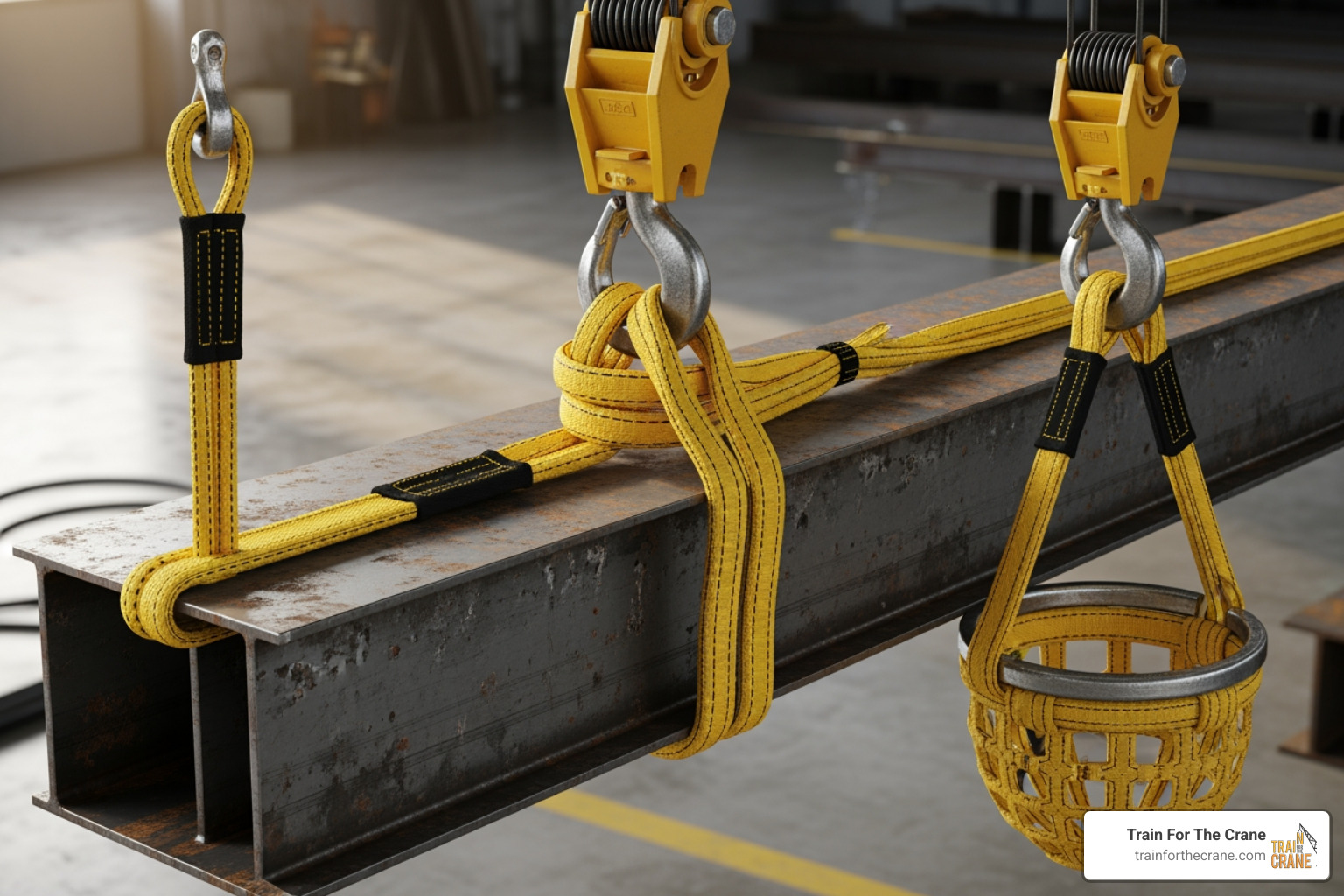
- Sling Positions and Load Capacity: The way a sling is configured around a load impacts its rated capacity:
- Vertical Hitch: The sling is attached directly to the load and hook. This uses the sling’s full rated capacity.
- Choker Hitch: The sling wraps around the load and one end passes through the eye of the other. This significantly reduces the sling’s capacity (often by 20-25%) because of the choking action.
- Basket Hitch: The sling passes under the load, with both ends attached to the hook. This configuration offers the highest rated capacity, often roughly twice that of a vertical hitch, as the load is distributed across two legs.
For hands-on experience and in-depth knowledge, our Basic Rigging Training programs cover these critical details.
Understanding Load Charts and Capacity
A crane’s load chart is its bible, an indispensable guide detailing its safe lifting capacity under various configurations.
- Rated Capacity vs. Lifting Load: The “lifting load” is the total weight the crane can handle, including all hoisting accessories. The “rated load” is the lifting load minus the weight of the hook block, slings, and any other lifting devices. This is the maximum net load that can be safely hung on the hook.
- Key Factors: The load chart considers several factors:
- Boom Angle: The angle of the boom relative to the ground.
- Boom Length: The extended length of the boom.
- Working Radius: The horizontal distance from the crane’s center of rotation to the center of the load.
- Counterweight Configuration: The amount and placement of counterweights.
- Outrigger Spread: How wide the outriggers are extended.
- Subtracting Rigging Weight: A common mistake is to forget to subtract the weight of the hook block, slings, and other rigging from the crane’s gross capacity. Always account for everything below the boom tip.
- Overloading Risks: Exceeding the load chart’s limits is one of the most dangerous mistakes an operator can make. An overloaded crane can experience structural failure or overturn, leading to catastrophic accidents. Never lift a load over the rated capacity.
We always consult the load chart for every lift, ensuring we understand how capacity varies with radius and boom extension. For a comprehensive overview, refer to the General Guide for Cranes.
The Operator’s Playbook: Step-by-Step Procedures
Operating a crane safely is a methodical process that leaves no room for shortcuts. From the moment we approach the machine to the final shutdown, every step is crucial. This systematic approach forms the backbone of effective Mobile Crane Operator Training.
Essential Crane Operation Basics: Pre-Operational Checks
Thorough pre-operational checks before any lift are a critical safety requirement, not just a recommendation.
- Daily Inspections: A visual walk-around check is performed daily before operation. We look for any visible damage, wear, or loose components.
- Fluid Levels: Check engine oil, hydraulic fluid, coolant, and fuel levels.
- Tire/Track Inspection: For mobile cranes, inspect tires for proper inflation and damage, or tracks for wear and tension.
- Wire Rope Inspection: Look for broken wires (more than five broken wires in one strand or ten randomly distributed in one lay means removal from service), kinks, crushing, birdcaging, or severe corrosion.
- Hook and Safety Latch: Inspect the hook for distortion (stretch, twist, increased throat opening) and ensure the safety latch functions correctly.
- Limit Switches: Crucial safety devices that automatically stop movement when a crane reaches its operational limits (e.g., upper hoist limit, boom angle limits). We test these without any weight attached to ensure they are functioning properly. Proper testing and maintenance of these are key, as discussed in Checking Limit Switch.
- Operating Environment: Inspect the job site for hazards like uneven terrain, obstacles, power lines, and clear pathways.
Activating and Setting Up the Crane
After pre-operational checks, we activate and set up the crane.
- Positioning: Carefully position the crane on a stable, firm, and level ground. We assess the ground bearing capacity to ensure it can support the crane’s weight and the load.
- Outrigger Deployment: Fully extend all outriggers according to the manufacturer’s guidelines, ensuring they are firmly positioned on solid surfaces, often with crane mats or blocking beneath the pads to distribute the load.
- Leveling the Crane: Use the crane’s leveling indicators to ensure the machine is perfectly level. This is vital for stability and accurate load chart readings.
- Starting the Engine: Follow manufacturer procedures to start the crane’s engine.
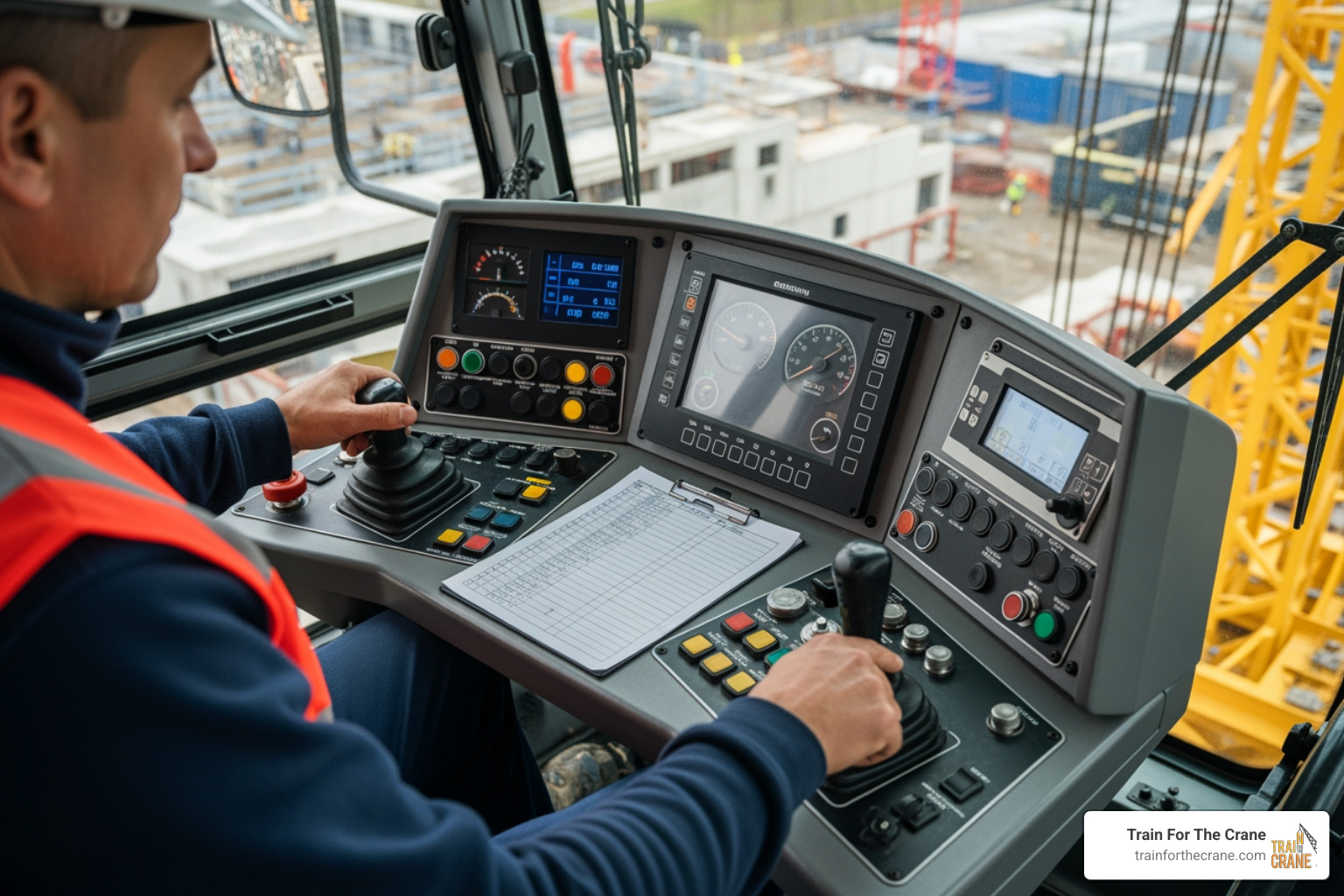
- Functional Control Check: From the operator’s cab, we perform a functional check of all controls (hoist, boom, swing, brakes) to ensure smooth and responsive operation.
- Safety Briefing: A quick safety briefing with the ground crew, riggers, and signal persons ensures everyone is on the same page regarding the day’s tasks, potential hazards, and communication protocols.
- Securing the Area: Establish an exclusion zone around the crane’s operating radius using barriers and warning signs to keep unauthorized personnel clear.
Safely Lifting, Moving, and Lowering Loads
This phase requires extreme precision and adherence to safety.
- Attaching the Load: The rigger attaches the load securely using appropriate slings and rigging hardware, ensuring the hook is directly over the load’s center of gravity. Tag lines are often attached to help control load swing.
- Taking Up Slack: We slowly take up slack in the hoist line until the rigging is taut.
- Slow and Smooth Lifting: Lift the load a few inches off the ground to test its balance and the rigging’s security. If everything looks good, we proceed with a slow, smooth lift, avoiding sudden movements or “shock loading.”
- Avoiding Side Loading: The hoist line must remain vertical. Side loading—pulling the load at an angle—can damage the boom structure or cause instability.
- Moving the Load: With the load just high enough to clear obstructions, we move it smoothly to its destination, constantly monitoring the crane’s stability and the load’s behavior. We never carry suspended loads over personnel.
- Precise Lowering: Lower the load slowly and precisely, ensuring the landing area is clear and prepared.
Common mistakes to avoid include overloading, skipping pre-operational checks, neglecting communication, and operating too close to power lines (maintain at least 10 feet clearance from energized high voltage lines up to 50,000 volts, and more for higher voltages or windy conditions).
Here are common hand signals we use for crane operations:
- Hoist: Arm extended, thumb pointing up, move hand up and down.
- Lower: Arm extended, thumb pointing down, move hand up and down.
- Stop: Arm extended, palm down, hold position.
- Emergency Stop: Both arms extended, palms down, move hands rapidly back and forth.
- Swing: Arm extended, point in direction of swing, move hand in circle.
- Trolley Travel: Palm up, fingers closed, thumb pointing in direction of travel, jerk hand horizontally.
- Boom Up: Arm extended, fingers open, thumb pointing up, move hand up.
- Boom Down: Arm extended, fingers open, thumb pointing down, move hand down.
- Extend Boom: Both fists in front of body, thumbs pointing out.
- Retract Boom: Both fists in front of body, thumbs pointing in.
Essential Crane Operation Basics: Shutdown and Securing
Properly shutting down and securing the crane is as important as starting up.
- Completing the Final Lift: Ensure all lifting operations are finished.
- Returning to Neutral: Retract the boom and outriggers, and return all crane controls to their neutral or off positions.
- Powering Down Systems: Turn off hydraulic systems and the main engine.
- Stowing the Hook: Raise the hook block to a safe, stowed position, typically near the upper limit switch, to prevent it from hitting obstacles.
- Post-Operational Inspection: Conduct a quick visual inspection to check for any new damage or issues that may have occurred during operation.
- Lockout/Tagout Procedures: If the crane is to be left unattended for an extended period, implement Lockout/Tagout procedures to prevent unauthorized use. Remove keys and secure the cab.
- Securing the Site: Ensure the work area is left clear of debris and safe for other personnel.
The Unbreakable Rules: Crane Safety and Regulations
In crane operation, safety is the absolute foundation, not just a priority. The complexity of these machines and their heavy loads means accidents can be catastrophic. A commitment to crane operation basics must always begin and end with safety.
Critical Safety Practices: Do’s and Don’ts
Adherence to safety protocols is non-negotiable. Here are some critical do’s and don’ts:
Do’s:
- Perform regular pre-operation checks: Thoroughly inspect the crane, rigging, and work environment.
- Wear proper Personal Protective Equipment (PPE): Always wear a hard hat, safety vest, boots, safety glasses, and gloves. This is non-negotiable on any heavy equipment job site. OSHA provides comprehensive guidelines on Personal Protective Equipment.
- Maintain awareness of surroundings: Constantly scan for personnel, obstacles, and potential hazards.
- Know your load limits: Never exceed the crane’s rated capacity as indicated on the load chart.
- Maintain safe power line clearance: Always keep at least 10 feet away from power lines, and more for higher voltages or windy conditions. Assume all power lines are energized.
- Monitor weather conditions: High winds, heavy rain, or lightning can severely compromise crane stability and visibility. Stop operations when conditions are unsafe.
- Establish exclusion zones: Keep all unauthorized personnel clear of the crane’s operating radius.
- Ensure proper training and certification: Only trained and certified operators should operate cranes.
Don’ts:
- Don’t overload the crane: This is a leading cause of crane accidents.
- Don’t skip pre-operational checks: These checks identify potential failures before they cause an accident.
- Don’t neglect communication: Clear communication prevents misunderstandings.
- Don’t operate under the influence: Alcohol or drugs impair judgment and reaction time.
- Don’t allow personnel under suspended loads: This is a fundamental safety rule.
- Don’t make sudden movements: Smooth, controlled operation is key to stability.
- Don’t rely solely on safety devices: They are backup systems, not substitutes for safe operating practices.
Communication and Team Responsibilities
Safe crane operations are a team effort. Clear, consistent communication among all personnel is vital to prevent accidents.
- Clear Communication: The crane operator, riggers, and signal persons must communicate effectively using agreed-upon methods. This can be via standard hand signals, voice signals (often via radio), or a combination.
- Standard Hand Signals: These are universally recognized gestures that convey specific instructions to the operator. We ensure all team members are trained and proficient in these signals.
- Radio Protocols: For long distances or poor visibility, radios are used. Voice signals must be clear, concise, and follow a specific format (e.g., “Function and Direction,” “Distance and/or Speed,” “Function Stop”).
- Operator Responsibilities: The operator is ultimately responsible for the safe operation of the crane. They must understand the crane’s capabilities, the load chart, and respond to signals. If there is any doubt about safety, the operator must stop the lift.
- Rigger Qualifications: Riggers are responsible for selecting, inspecting, and attaching the rigging gear to the load. They must be qualified and understand the principles of rigging and load dynamics.
- Spotter/Signaler Duties: Signal persons (or spotters) guide the operator, especially when the operator’s view is obstructed. They must be qualified, maintain continuous visual contact with the load and the operator, and give clear, consistent signals. Our Crane Signal Person Training ensures proficiency in these critical roles.
Understanding Safety Devices and Legal Requirements
Modern cranes have numerous safety devices, and their operation is governed by strict legal and regulatory requirements to protect workers.
- Limit Switches: As mentioned, these prevent over-hoisting, over-lowering, or over-travel of the crane’s components, stopping motion when limits are reached.
- Load Moment Indicators (LMI) / Rated Capacity Indicators (RCI): These electronic systems provide the operator with real-time data on the crane’s configuration, the load’s weight, and its proximity to the crane’s rated capacity. They often include alarms to warn of approaching overload conditions.
- Anti-Two-Blocking Devices: These prevent the hook block from colliding with the boom tip sheaves, a dangerous condition known as “two-blocking” that can damage the crane or cause cable failure.
In the United States, the Occupational Safety and Health Administration (OSHA) sets the standards for crane safety. Their Crane, Derrick and Hoist Safety – Overview provides comprehensive information. Additionally, industry standards, such as those from the National Commission for the Certification of Crane Operators (NCCCO), play a crucial role in ensuring operators are competent and safe. We ensure our training aligns with these rigorous standards, covering Industry Standards for Crane Operation and detailing Crane Operator Responsibilities.
Building Your Career as a Crane Operator
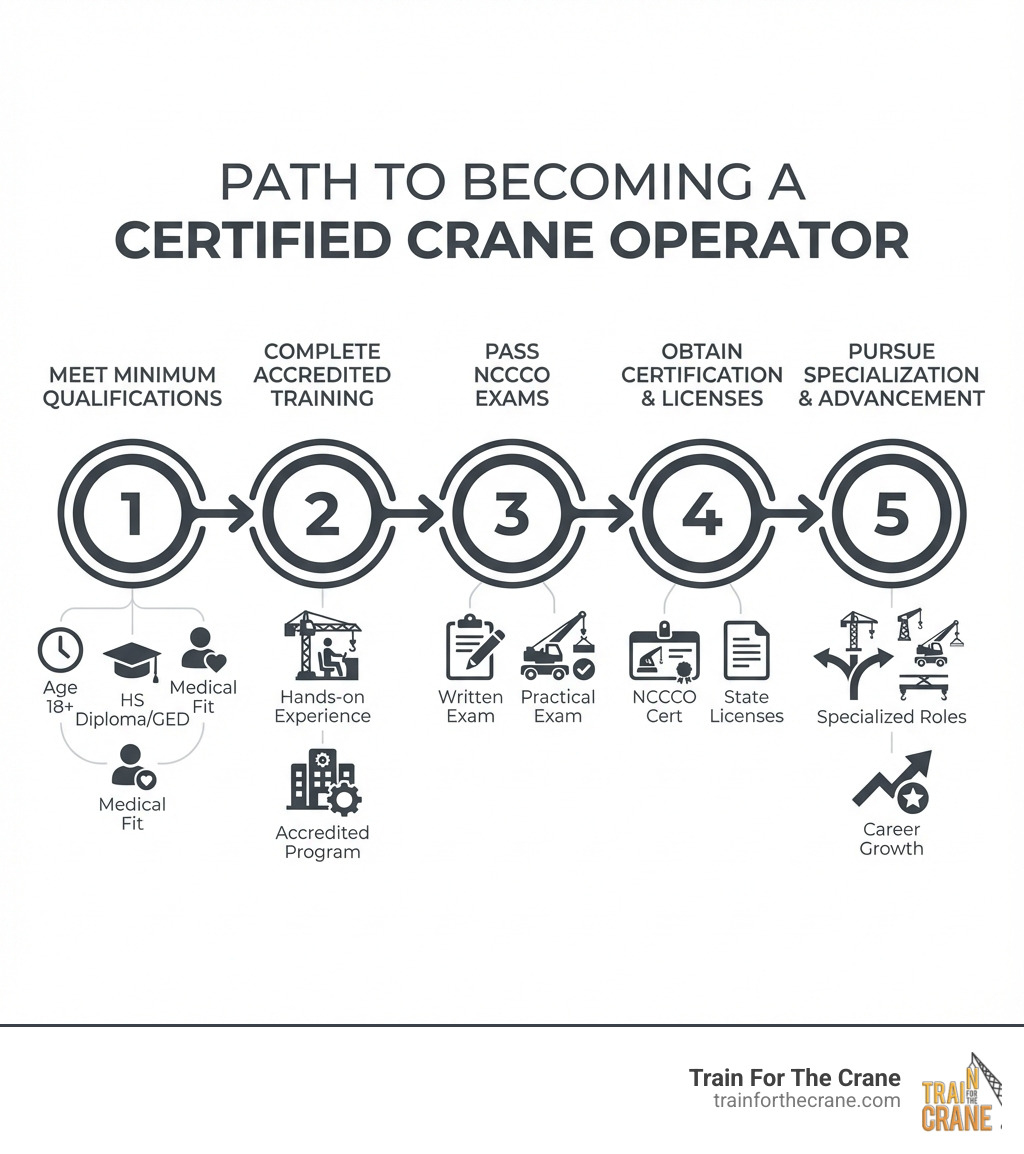
Demand for skilled crane operators is high, especially with infrastructure projects in Indiana and nationwide. This rewarding career path offers significant growth. If you’re wondering How to Become a Crane Operator, we can guide you.
Qualifications and Educational Requirements
Becoming a crane operator requires a combination of education, physical fitness, and specialized training:
- Educational Foundation: A high school diploma or GED is typically the minimum educational requirement.
- Minimum Age: Operators must generally be at least 18 years old.
- Physical Condition: Crane operation demands good physical health, including:
- Good Vision: At least 20/30 in one eye and 20/50 in the other, with or without corrective lenses.
- Normal Depth Perception and Field of Vision: Essential for judging distances and spatial relationships.
- Adequate Hearing: To hear signals and alarms.
- Sufficient Strength, Endurance, Agility, and Coordination: For operating controls and navigating the work environment.
- Emotional Stability: Operators must be emotionally stable and not prone to sudden loss of ability to react.
- No Health Conditions: No health conditions that might cause sudden loss of ability to react (e.g., seizures).
These requirements ensure operators can safely handle the complexities of the job. You can find more detailed information on Requirements for Crane Operator.
How to Choose the Right Crane Operator Training Program
Choosing the right training program is a pivotal step in your career journey. Here’s what to look for:
- Accreditation: Ensure the program is accredited and recognized by industry bodies. This validates the quality of the curriculum and instruction.
- Comprehensive Curriculum: The program should cover all essential crane operation basics, safety protocols, rigging, load charts, and regulatory requirements.
- Hands-On Training: Practical experience is invaluable. Look for programs that offer extensive time operating actual cranes.
- Instructor Experience: Experienced instructors, like our team with 30+ years of combined expertise, provide invaluable insights and guidance.
- Pass Rates: A strong track record of students successfully passing certification exams indicates an effective program.
At Train For The Crane, our Accredited Crane Training program meets these criteria, leading to high certification pass rates. Our Crane Operator Training Program in Indiana is designed to equip you with the necessary skills.
Your Path to Certification and Advancement
Certification is your gateway to a professional career in crane operation.
- NCCCO Certification: In the United States, NCCCO Certification is widely recognized and often required. It involves passing both written and practical exams specific to the type of crane you wish to operate (e.g., mobile, tower, overhead).
- Written Exams: These test your knowledge of safety regulations, load charts, crane components, and operational procedures.
- Practical Exams: These assess your ability to safely and skillfully operate a crane through a series of maneuvers and lifts.
- Specialization: As you gain experience, you can specialize in operating specific crane types (e.g., large crawler cranes, specialized industrial cranes) or in particular industries.
- Supervisory Roles: With experience, you can advance to roles such as lift director, safety supervisor, or crane operations manager.
- Instructor Opportunities: Highly experienced operators can become instructors, sharing their knowledge and shaping the next generation of crane professionals.
Explore your Crane Operator Career Path and see where your skills can take you.
Conclusion: Reaching New Heights in Your Career
Mastering crane operation basics is the first step toward a fulfilling career. This skilled profession demands a commitment to safety, continuous learning, and precision. The role of a crane operator, from understanding mechanics to executing complex lifts, is indispensable in building our world.
At Train For The Crane, we provide the highest quality training to ensure our students in Indiana become certified, confident, and capable operators. We believe the right training and a commitment to safety leads to progress for our communities and your career.
Ready to start your journey? Explore our Crane Operator Certification programs and get certified!