

Why Consider a Career as a Crane Operator?
Crane operator careers offer a unique blend of skilled craftsmanship, technical expertise, and impressive earning potential, making it a path worth serious consideration in the construction or industrial trades.
Quick Overview: What You Need to Know About Crane Operator Careers
- Job Description: Operate cranes to lift, move, and position heavy materials at construction sites, ports, mines, and industrial facilities
- Training Required: 1-3 year apprenticeship or industry courses, plus certification
- Median Salary: $32.90-$41.00/hour CAD ($64,690-$66,370 USD annually)
- Job Outlook: Steady growth (3-5% projected) with strong demand due to retiring workers
- Work Environment: Construction sites, ports, railway yards, mining operations – often outdoors
- Key Requirements: High school diploma, math skills, physical fitness, NCCCO or provincial certification
Imagine sitting in a crane cab 300 feet in the air, precisely placing a steel beam. Years later, you can drive past buildings and bridges knowing you helped build them.
Crane operators are among the highest-paid construction workers, according to The Wall Street Journal. Beyond the financial rewards, this career offers a tangible legacy, as the structures you help erect serve communities for decades.
The demand is real. With hundreds of job openings forecasted across North America, crane operators are needed everywhere from urban construction to remote mining. Most openings come from replacing retiring workers, creating opportunities for newcomers to enter this essential trade.
Whether you’re starting your career or seeking a stable, well-paying field, becoming a crane operator provides a clear path forward, combining technical skill with the satisfaction of building the world around us.
What Does a Crane Operator Do?
If you’re considering crane operator careers, the day-to-day work is anything but boring, combining precision, vigilance, and problem-solving. At its core, a crane operator’s job is to use mechanical equipment to lift, move, and position loads that can weigh several tons.
Every day starts with pre-operational inspections. This is a thorough check of the crane’s mechanisms, cables, hydraulics, and safety systems. A worn cable or faulty brake could be disastrous, so this step is non-negotiable.
Next, you move on to calculating load capacities. This involves determining the weight of the lift and ensuring the crane can handle it safely by consulting load charts and factoring in boom angle and ground conditions. It’s critical math that keeps everyone safe.
Then comes the actual work: rigging and hoisting. You coordinate with riggers to attach the load and execute the lift. Throughout the day, you’ll also perform routine maintenance like cleaning and lubricating to keep your equipment in top shape.
Perhaps the most underrated part of the job is communication with your ground crew. You’re constantly talking via radio and watching for hand signals. A good crane operator knows they’re only as effective as their team; the signal person is your eyes where you can’t see. This teamwork makes impossible lifts routine. For more on safe practices, check out our guide on Crane Lifting Safety.
The Different Types of Cranes
One thing that keeps crane operator careers interesting is the variety of equipment. Many operators specialize in one or two types.
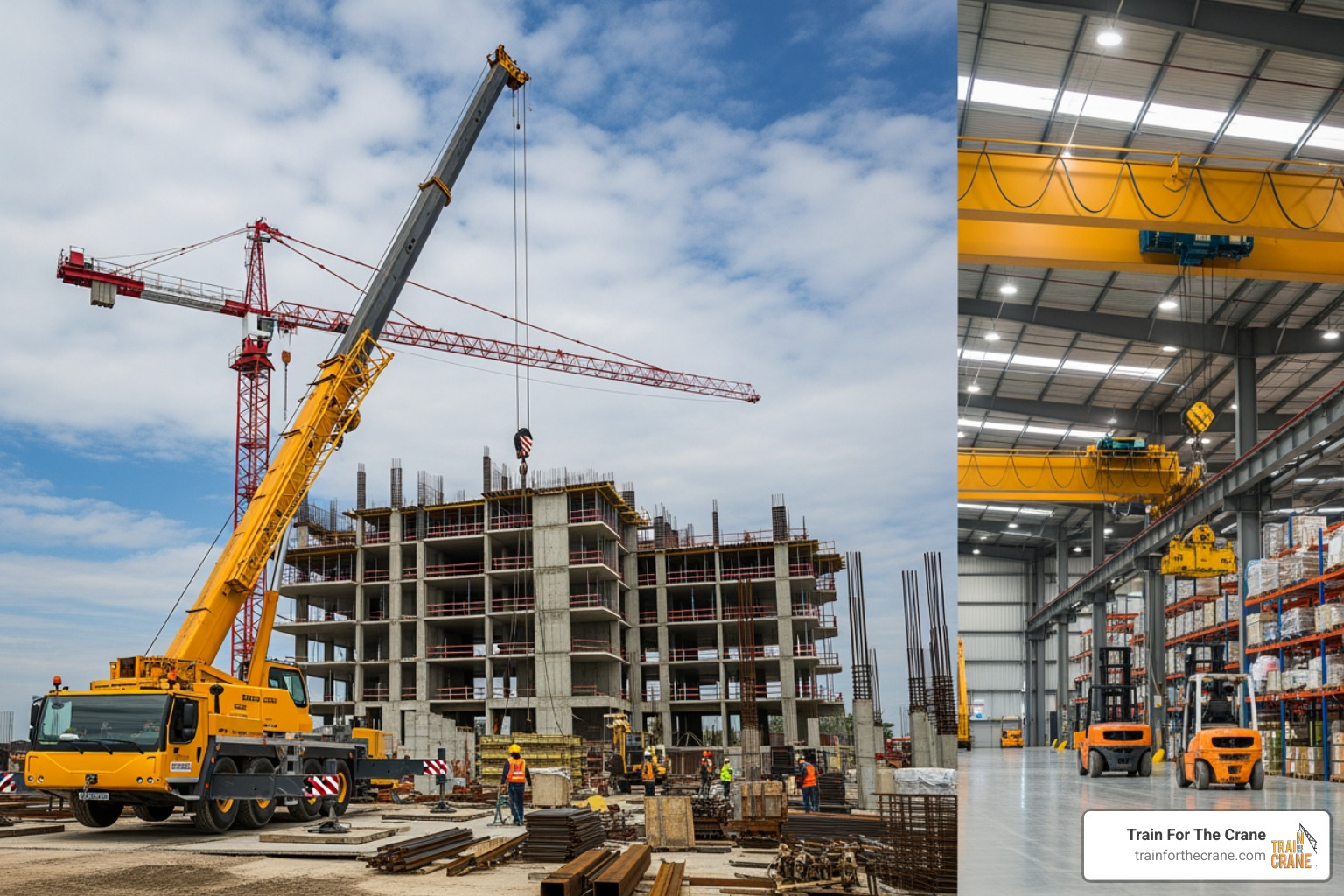
- Mobile cranes are mounted on a truck or crawler chassis, allowing them to drive to job sites. They are versatile and common on building and highway projects. Explore becoming a Mobile Crane Operator.
- Tower cranes are the giants fixed to the ground on major construction projects, lifting enormous loads to incredible heights. Getting your Tower Crane Certification opens doors to these high-profile jobs.
- Overhead cranes (or bridge cranes) are found indoors in factories and warehouses, running on rails to move materials in a confined space. Learn more about Overhead Crane Training if this environment appeals to you.
- Gantry cranes are similar to overhead cranes but run on legs at ground level, often seen in shipyards moving containers.
- Boom trucks are smaller, truck-mounted cranes for lighter loads and jobs requiring flexibility, like delivering materials or utility work. Many feature an Articulating Crane boom.
A Day in the Life
After your morning safety briefing and inspection, you climb into the cab—your office for the day. Once in position, you’re operating an array of levers and pedals that control the crane’s every move. With training, these controls become second nature as you make micro-adjustments for smooth, controlled movements.
Throughout the day, you’re performing site inspections, watching for changes in weather, ground conditions, or new obstacles. You’ll be following lift plans, which are detailed outlines for how each lift should happen. You don’t improvise when moving a 15-ton HVAC unit. For guidance, see our article on How to Create Critical Lift Plan.
Above all, you’re adhering to safety protocols every moment, like maintaining safe distances from power lines and verifying load weights. The best operators stay calm and focused, ensuring everyone goes home safe. The Job description Crane Operator in Canada | Job Bank provides a good overview that aligns with the role throughout North America.
Work Environment and Physical Demands
Working as a crane operator means embracing diverse and often challenging environments. You’ll be found on towering construction sites, busy ports, sprawling railway yards, and rugged mining operations.

These work sites have potential hazards to manage. Working at heights is a daily reality for many, and weather exposure is a constant, from summer heat to winter cold. Noise levels can be intense, requiring proper hearing protection.
While much of the day is seated, crane operator careers are physically demanding. The job requires exceptional hand-eye coordination and depth perception for precise lifts. Stamina is crucial for maintaining intense focus during long shifts, which often exceed 40 hours per week. The work also involves climbing, bending, and handling equipment during inspections and maintenance.
Safety is Paramount
In this line of work, safety keeps everyone alive. There is no room for cutting corners when moving multi-ton loads. We operate under strict regulations, particularly from OSHA (Occupational Safety and Health Administration), which are based on lessons learned over decades.
Personal protective equipment (PPE)—hard hats, safety glasses, high-visibility clothing, and steel-toed boots—is non-negotiable. Hazard awareness becomes second nature. We constantly scan for dangers like electrical lines, maintaining strict clearance, and monitor ground stability, as a crane is only as stable as its foundation.
Communication is the invisible safety net. We rely on standardized hand signals and radio communication to coordinate every movement. When your view is blocked, you depend completely on your signal person, which is why proper Crane Signal Person Training is so vital. Clear communication prevents accidents.
For those in Canada, resources like Safety Tips|Provincial Government Careers|Crown Corporations|Other Job Links offer regional guidance, though OSHA standards are the benchmark across North America. The bottom line is that safety is about constant vigilance and proper training.
How to Become a Crane Operator
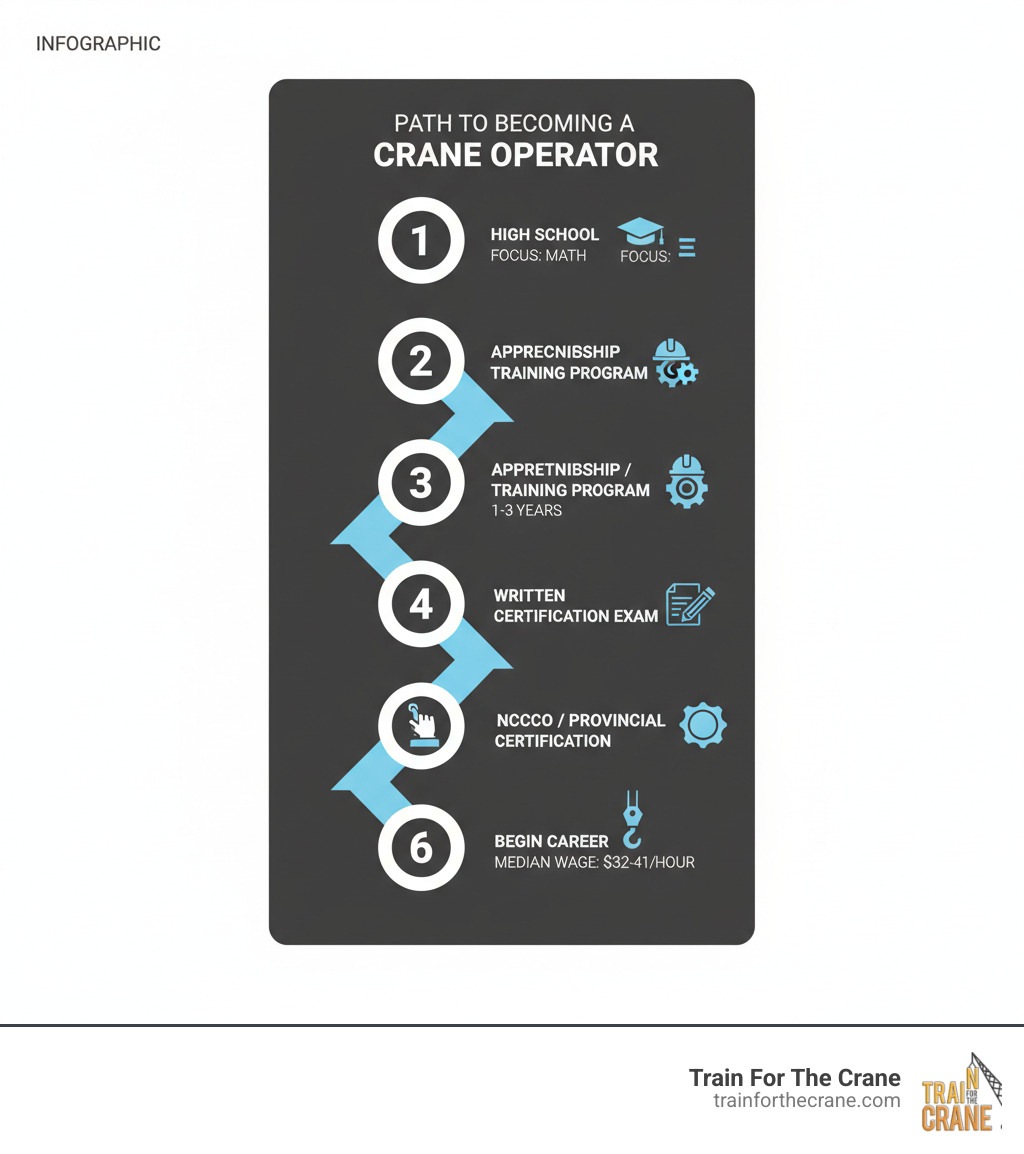
Starting your journey into crane operator careers typically begins with a high school diploma or equivalent. Strong math skills are a real advantage for calculating weights, load capacities, and distances.
The path from beginner to certified operator usually takes 1 to 3 years. Our guide on How to Become a Crane Operator walks you through the process, and you can learn about the timeline in How Long Does It Take to Become a Crane Operator.
There are several paths to entry. Some learn through apprenticeship programs that combine paid on-the-job training with classroom instruction. Others attend specialized industry courses at schools like ours for intensive exam preparation. Invaluable on-the-job training alongside experienced operators teaches real-world lessons no classroom can. Some also start at vocational schools offering heavy equipment programs. You can explore options at a Crane Operator School in your area.
Education and Training Programs
At Train For The Crane, we have over 30 years of combined experience helping people enter this field. Our comprehensive Crane Operator Training Program covers everything from crane mechanics to reading load charts and implementing life-saving safety protocols.
Our proven methods prepare you for real-world challenges, which is why our students consistently achieve high pass rates. We offer various Crane Courses custom to different crane types and skill levels, providing hands-on training at your site.
Getting Your Crane Operator Certification
Certification isn’t optional for most crane operator careers in the United States; it’s your professional credential. The gold standard is NCCCO certification from the National Commission for the Certification of Crane Operators, which is recognized nationwide. Getting your NCCCO Certification involves passing two exams.
First is the written exam, which tests your knowledge of operation principles, safety regulations, and load charts. Our NCCCO Written Exam prep ensures you walk in confident.
Second is the practical exam, where you operate a crane under observation to demonstrate your real-world competence. Our hands-on preparation will have you ready for the Crane Practical Exam.
While Canada has its Red Seal Program, NCCCO certification is the US national standard. Some states and cities may have additional licensing requirements, so always check local regulations. Our mission is to give you the best chance at passing these exams on your first try. For a complete roadmap, visit our guide on How to Get Crane Certified.
Exploring Crane Operator Careers: Job Outlook, Salary, and Advancement
If you’re considering crane operator careers, you’re looking at a profession with genuine staying power. The construction, manufacturing, and logistics industries aren’t slowing down, and neither is the demand for skilled operators.

The numbers tell an encouraging story. The Bureau of Labor Statistics projects 4% growth for crane operators from 2023 to 2033, translating to about 4,100 annual job openings nationwide. Many of these openings are from replacing retiring workers, creating opportunities for newcomers. This makes crane operation a high-demand trade for certified operators. The 2023-2033 employment projections provide more detail on this data.
Salary Expectations for Crane Operators
Crane operator careers offer impressive earning potential that reflects the job’s skill and responsibility. In the United States, the median annual wage for crane operators was $64,690 as of May 2023, or $31.10 per hour.
Experienced operators specializing in complex cranes or working in high-demand markets can earn even more. The top 10% of operators earned over $98,820 annually.
Here’s how the wage breakdown looks:
| Wage Level | Annual Salary | Hourly Wage |
|---|---|---|
| Median | $64,690 | $31.10 |
| Top 10% | $98,820+ | $47.51+ |
| Bottom 10% | $39,200 | $18.85 |
Source: 2024 wage data from the Bureau of Labor Statistics
While Canadian wage data, such as from Crane operators | WorkBC, shows similar trends, these US figures give a clear picture of what you can expect in Indiana and across the United States. Your actual wage will depend on location, crane type, certification, and experience.
Advancement in Crane Operator Careers
Becoming an operator isn’t the end of your professional journey; it’s the beginning. With experience and additional training, you can lift your career to new heights.
Many experienced operators move into supervisory roles, managing teams and overseeing site-wide crane operations. Others become a lift director, a specialized role responsible for planning and directing critical lifts. If this challenge excites you, explore Lift Director Jobs.
Some leverage their knowledge to transition into site management or even become crane company owners. Another rewarding path is becoming a trainer or instructor, sharing your knowledge with the next generation of professionals. Understanding these pathways helps you plan your professional development. For a detailed look, check our guide on the Crane Operator Career Path. This isn’t just a job—it’s a career with room to grow.
Key Skills for a Successful Operator
To excel in crane operator careers, you need a blend of technical know-how and people skills. The best operators understand this profession demands both technical competence and the soft skills to work effectively as a team and make sound decisions under pressure. For a comprehensive overview, see our article on Crane Operator Skills.
Technical Competencies
These are the fundamental abilities for safely handling massive loads.
- Operation and control: The precise manipulation of levers, joysticks, and pedals to move the crane and its load smoothly.
- Equipment maintenance: Understanding your crane’s mechanics to perform inspections, spot issues, and keep it in top working condition. This requires solid mechanical knowledge.
- Reading load charts: This is a critical skill. Accurately interpreting these charts is paramount for preventing overloads and ensuring site safety.
- Rigging knowledge: Knowing how to properly select, inspect, and attach rigging gear is fundamental. We offer specialized training in our Basic Rigging Training program.
Essential Soft Skills
While technical skills get you into the cab, soft skills make you an exceptional operator.
- Critical thinking & Problem-solving: You’ll constantly evaluate situations, anticipate problems, and make quick, sound decisions when unexpected challenges arise.
- Clear communication: Coordinating with ground crews and signal persons is crucial for safety and efficiency on every lift.
- Attention to detail: In our profession, even the smallest oversight can have significant consequences. Meticulous attention is non-negotiable.
- Patience: Complex lifts require slow, deliberate movements. Rushing leads to mistakes, so patience is a virtue.
- Spatial awareness: A strong understanding of space, distance, and depth perception allows you to guide loads through tight areas and place them with precision.
This combination of technical mastery and soft skills separates good operators from great ones.
Conclusion
If you’ve made it this far, you’re serious about exploring crane operator careers. This isn’t just another job; it’s a career offering a rare combination of genuine stability and excellent earning potential.
While many careers feel uncertain, crane operators remain in steady demand. The structures we help build—bridges, skyscrapers, and factories—aren’t going anywhere, and neither is the need for skilled professionals.
The financial rewards are real, with median wages over $64,000 annually in the US and room to grow. Beyond the paycheck, there’s deep satisfaction in this work. Years from now, you’ll drive past buildings and know you were part of creating them.
The journey to becoming a certified operator is clear and typically achievable within 1-3 years with the right commitment to training and certification.
At Train For The Crane, our instructors bring over 30 years of combined experience, and our proven training methods lead to high pass rates. We don’t just teach you to pass a test; we prepare you for a successful, long-term career.
Whether you’re seeking a career change or better job security, crane operator careers offer a solid foundation to build your future on. The industry needs skilled operators, and with the right training, that could be you.
Ready to get started? Learn everything you need to know at How to Get Crane Operator Certification. Your future in the crane operator’s cab is closer than you think.