

Understanding What It Takes to Operate Cranes Legally in Indiana
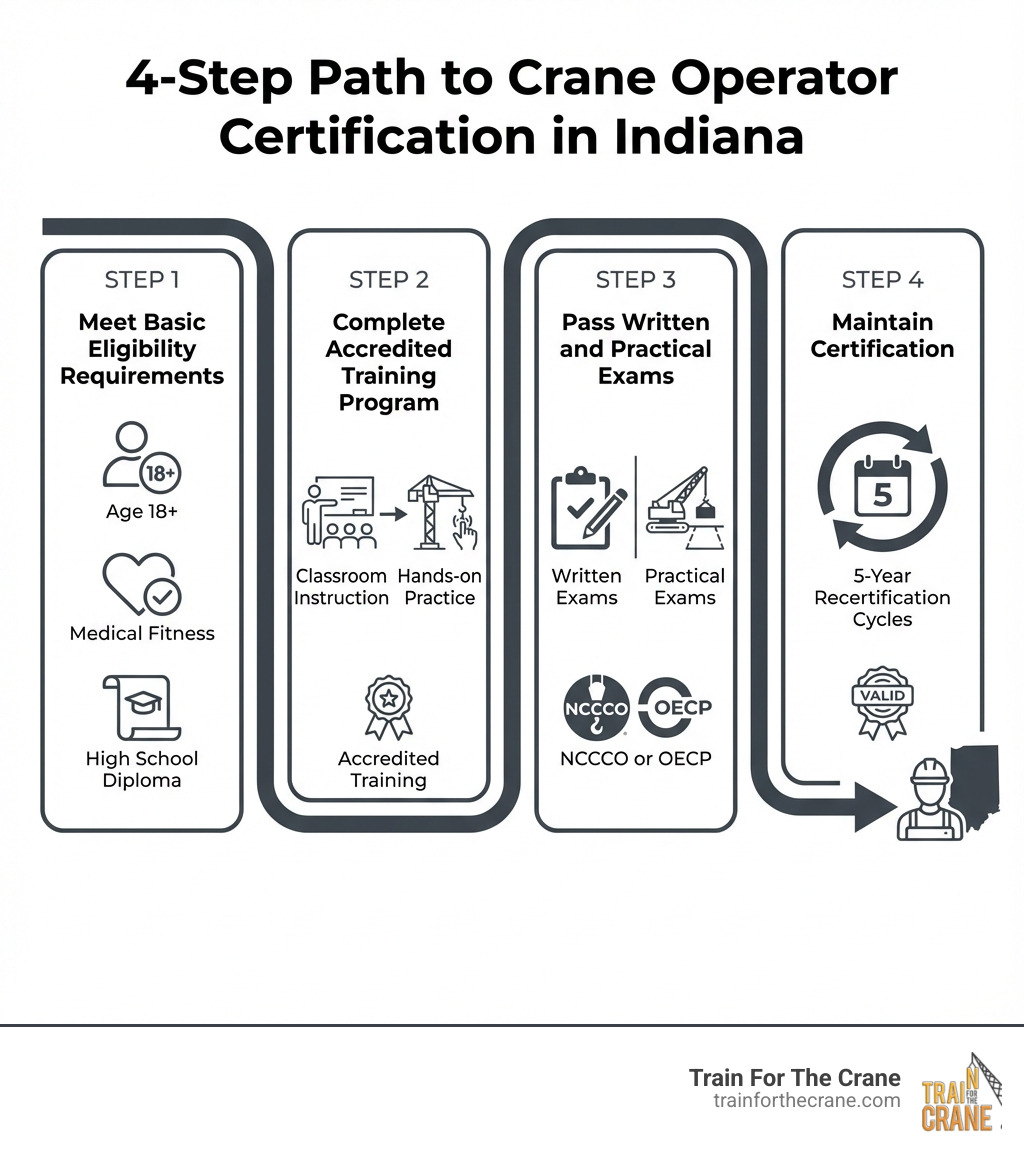
Crane operator requirements indiana boil down to meeting federal OSHA standards, as Indiana has no additional state-level licensing beyond national mandates. Here’s what you need to know:
Quick Answer: Indiana Crane Operator Requirements
- Be at least 18 years old
- Obtain a nationally accredited certification (NCCCO or OECP)
- Pass written and practical exams for your crane type
- Meet medical fitness standards (DOT Medical Card)
- Comply with substance abuse policies (drug screening required)
- Maintain certification through recertification every 5 years
Indiana’s construction industry is booming. From Indianapolis high-rises to manufacturing facilities in Gary, certified crane operators are in high demand. But before you can command one of these powerful machines, you need to steer both federal regulations and understand what Indiana specifically requires.
The good news? Indiana keeps it straightforward. The state follows OSHA’s federal standards without adding extra layers of state-specific licensing. This means once you earn your nationally accredited certification, you’re qualified to work anywhere in Indiana—and across the entire United States.
This guide walks you through every step of becoming a certified crane operator in the Hoosier State. You’ll learn about eligibility requirements, which certifications employers want most, where to find training programs, what the exams involve, and how to maintain your credentials for a long, successful career.
The Foundation: Federal OSHA vs. Indiana State Regulations
When we talk about crane operator requirements indiana, the first and most crucial thing to understand is the role of the Occupational Safety and Health Administration (OSHA). OSHA is a federal agency that sets and enforces protective workplace safety and health standards. For crane operators, their regulations are the bedrock of what’s required nationwide.
Specifically, OSHA mandates that all crane operators must obtain a nationally accredited license or otherwise meet the conditions of Federal standard 29 CFR 1926 Subpart CC. This rule, which took effect on November 10, 2018, means that no matter where you operate a crane in the United States, you must possess this national certification. It’s a game-changer for safety and professionalism in our industry.
Now, here’s where Indiana comes into play: Indiana is a state that operates with an OSHA State Plan. This means that while Indiana maintains its own occupational safety and health program, it must be at least as effective as federal OSHA. Our research confirms that Indiana currently has no specific state-level requirements for crane operator licensure or certification beyond these federal OSHA regulations. This is great news for operators, as it simplifies the compliance landscape. Unlike some other states that might have additional licensing hoops to jump through, Indiana relies on the nationally recognized certifications to ensure operators are qualified.
The Indiana Department of Labor (IOSHA) oversees workplace safety and health within the state, ensuring that businesses and workers comply with these standards. While they don’t add extra layers of certification, they are the authority for enforcement. This means that adhering to federal OSHA’s Subpart CC is paramount for working legally and safely in the Hoosier State.
What about public projects or government entities in Indiana? Our findings indicate that at this time, there are no additional state requirements for crane operator licensure in Indiana, even for these types of projects. This could change, of course, but for now, meeting the federal OSHA mandate through a nationally accredited certification is the universal key to operating cranes across the state, whether on private or public works. So, when we discuss crane operator requirements indiana, we’re primarily talking about those federal standards.
Your Path to Certification: Eligibility and Accredited Bodies
Starting on a career as a crane operator in Indiana is an exciting journey, and we’re here to guide you. The first step involves understanding who can even apply for certification and which organizations provide the gold standard credentials.
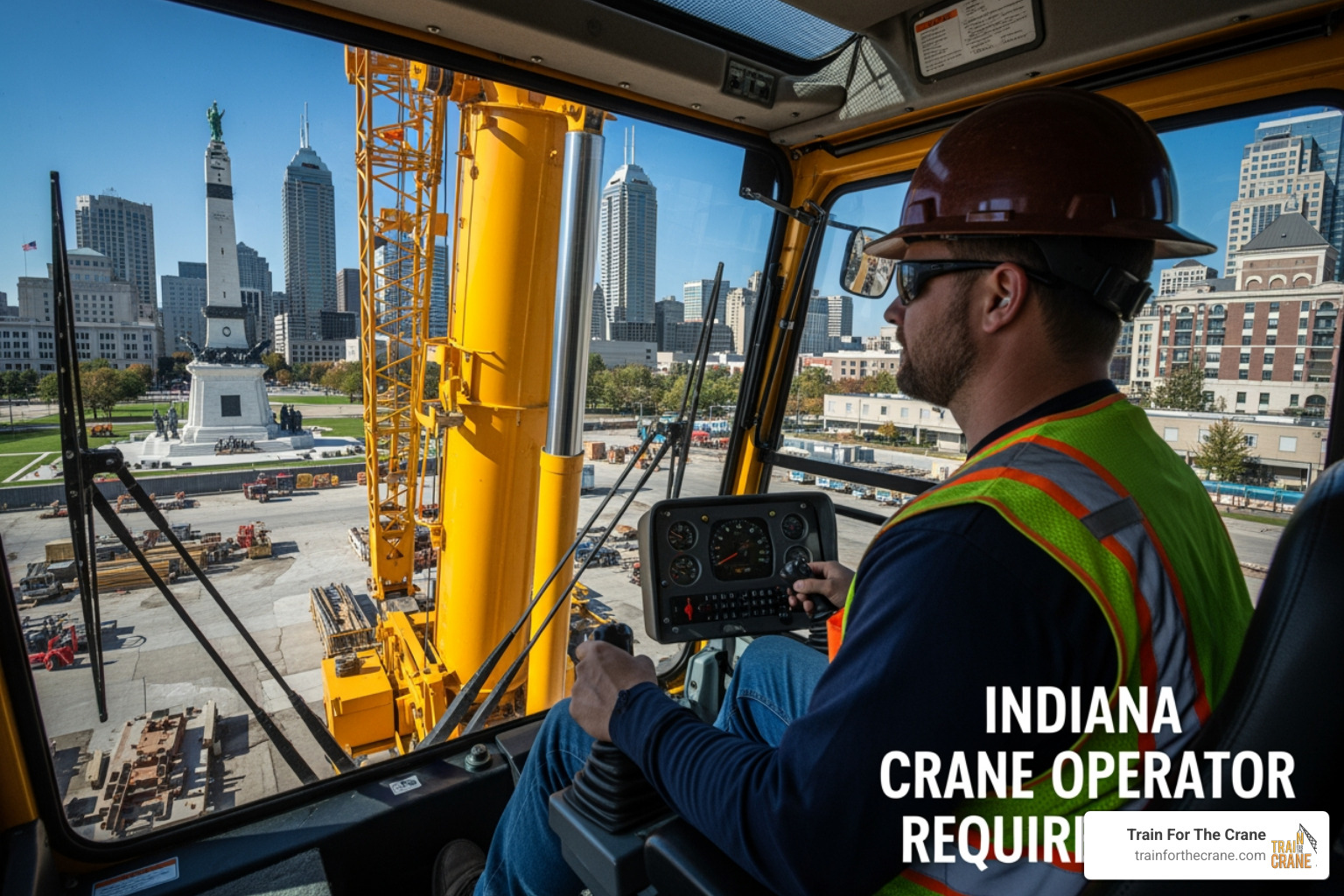
The importance of national accreditation cannot be overstated. It’s not just a piece of paper; it’s a testament to your skills, knowledge, and commitment to safety, recognized across the nation. This is what employers in Indiana and beyond are looking for.
Meeting the Basic Crane Operator Requirements in Indiana
Before you even think about which crane type you want to master, you need to ensure you meet the fundamental eligibility criteria. These are generally consistent across nationally accredited certification bodies like NCCCO (National Commission for the Certification of Crane Operators) and OECP (Operating Engineers Certification Program), which are the most widely recognized.
Here’s what you’ll typically need:
- Minimum Age of 18: You must be at least 18 years old to begin the certification process. This ensures you have the maturity and legal standing required for such a responsible role.
- Medical Fitness: This is a big one. Operating a crane demands physical and mental alertness. You’ll need a current U.S. Department of Transportation (DOT) Medical Card/Certificate or a state-issued Department of Motor Vehicles (DMV) Medical Card/Certificate. These cards verify that you meet the physical requirements, including vision (e.g., 20/30 in one eye, 20/50 in the other, with or without corrective lenses), hearing, and overall physical condition, aligning with standards like ASME B30.5. These medical cards typically need to be renewed every two years.
- Substance Abuse Policy: Safety is paramount, and that includes ensuring operators are unimpaired. You must comply with strict substance abuse policies, which includes passing a drug screening. For instance, the OECP requires a negative result for a substance abuse test from a recognized laboratory or medical review officer conducted within 90 days of application receipt.
- High School Diploma or Equivalent: Most certification programs and employers will require you to have at least a high school diploma or a General Education Development (GED) equivalent. This demonstrates a foundational level of education necessary for understanding complex instructions and safety manuals.
- Basic Arithmetic Skills: Don’t worry, we’re not asking you to solve advanced calculus! But you will need to be able to do basic arithmetic (adding, subtraction, multiplication, and knowing times tables up to 9s). Why? Because calculators are often not permitted during written exams, especially when dealing with load charts.
- English Literacy: The ability to read, write, and understand English at an eighth-grade reading level is typically required. This is essential for comprehending safety manuals, crane operation instructions, and communicating effectively on a job site.
Meeting these basic requirements sets the stage for a successful certification journey. They ensure that you, and your future colleagues, are operating under the safest possible conditions.
Choosing a Nationally Accredited Certification Body
Once you meet the prerequisites, your next step is to choose a nationally accredited certification body. As we’ve learned, federal OSHA mandates national accreditation, and in Indiana, this is the standard.
The two most prominent and widely recognized organizations that provide nationally accredited crane operator certifications are:
- NCCCO (National Commission for the Certification of Crane Operators): This is arguably the most common and widely accepted certification in the United States. NCCCO offers certifications for a vast array of crane types and specialized roles. Our research highlights that NCCCO certification is a key differentiator for well-paying jobs, and their programs are designed to meet OSHA compliance, precision, and safety.
- OECP (Operating Engineers Certification Program): This is a joint labor/management program primarily for members of the International Union of Operating Engineers (IUOE). OECP certification is also nationally accredited and Fed OSHA recognized. It evaluates knowledge and skills in crane operations, procedures, safety, and government regulations through written and practical examinations.
Both NCCCO and OECP are OSHA-recognized and will fulfill your federal certification requirements in Indiana. The choice often depends on whether you are part of the IUOE or if your employer has a preference. Regardless of which you choose, pursuing certification through one of these bodies is the definitive way to meet the crane operator requirements indiana.
A Deep Dive into Crane Operator Requirements in Indiana
Now that we’ve covered the foundational eligibility and the role of nationally accredited bodies, let’s zoom in on the actual process of becoming certified and the types of credentials that will make you a hot commodity in the Hoosier State.
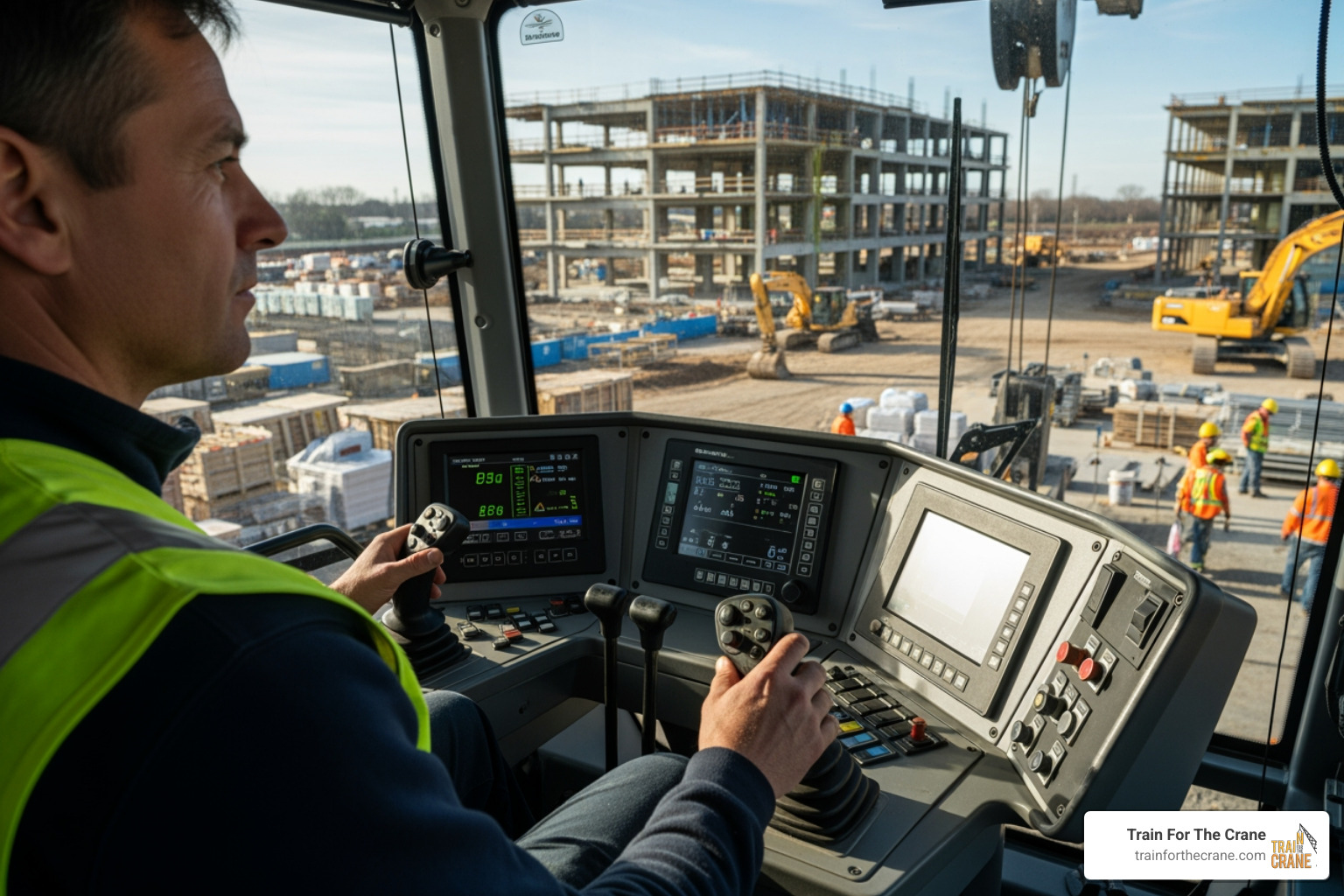
The journey to becoming a certified crane operator involves a combination of rigorous training, theoretical knowledge (written exams), and hands-on practical skill demonstration (practical exams). It’s a comprehensive process designed to ensure you’re not just a good operator, but a safe and highly competent one.
In-Demand Crane Certifications for the Indiana Job Market
Indiana’s busy construction, manufacturing, and warehousing sectors create a significant demand for operators skilled in various crane types. While a “general” crane operator certification doesn’t exist, specific certifications align with the types of cranes you’ll encounter most often. Here are some of the most in-demand for the Indiana job market:
- Mobile Crane Operator: This is a broad category, but it’s essential. Mobile cranes are the workhorses of most construction sites. NCCCO Mobile Crane Operator certification requires passing a Core Examination and at least one Specialty Examination. These specialties often include:
- Telescopic Boom Cranes (Fixed Cab and Swing Cab): These are extremely common, used for everything from lifting materials on a residential build to setting steel beams on commercial projects.
- Lattice Boom Cranes: Often seen on larger, longer-term construction sites, these cranes offer significant reach and lifting capacity.
- Tower Crane Operator: With the ongoing development in urban centers like Indianapolis, tower cranes are a fixture on high-rise construction projects. OECP and NCCCO both offer Tower Crane Operator certifications, which are crucial for this specialized work.
- Articulating Crane Operator: Also known as knuckleboom cranes, these are versatile and widely used in delivery, utility work, and material handling. NCCCO offers a specific certification for these, and they are increasingly in demand.
- Overhead Crane Operator: While not always requiring the same level of certification as mobile cranes, competence and often certification for overhead cranes are vital in manufacturing plants, steel mills, and large warehouses across Indiana. OECP, for instance, offers an Overhead Crane Operator certification.
The job market needs in Indianapolis and Gary are particularly strong. Indianapolis, as the capital, is experiencing a construction boom across housing developments, business centers, and essential infrastructure initiatives. Projects connected to educational complexes, medical facilities, and municipal developments are increasing the demand for proficient crane operators. Similarly, industrial areas like Gary require skilled operators for manufacturing and heavy industry. Becoming certified in these common crane types ensures you’re ready to meet Indiana’s evolving workforce needs.
Finding Crane Operator Training and Testing in Indiana
Once you know which certifications are right for you, the next step is finding quality training. We believe in providing the best preparation possible, and our programs are designed with your success in mind.
At Train For The Crane, we provide crane operator training in Indiana that focuses on on-site NCCCO crane operator training for construction, manufacturing, and warehousing. Our experienced instructors, with over 30 years combined experience, use proven methods to achieve high pass rates for certification exams.
One of the significant benefits of on-site training is convenience. Instead of traveling to a distant facility, we bring the training directly to your team or job site. This minimizes work disruption, allows for a curriculum custom to your specific equipment and work environment, and can even accommodate operators working long shifts, overnights, or graveyard shifts with flexible scheduling options.
Our training programs combine crucial theoretical knowledge with practical operational skills. You’ll get the “book learning” in a classroom setting, covering regulations, load charts, crane dynamics, and safety protocols. But just as important is the hands-on learning, where you’ll get to operate the equipment under expert supervision, practicing the maneuvers and skills needed for the practical exam and real-world scenarios. This combination ensures you’re not just prepared for the exam, but for the job itself.
When it comes to testing, while training providers like us prepare you, the actual certification testing is conducted by the nationally accredited bodies (NCCCO or OECP) or their authorized testing centers. We work closely with these organizations to help you locate accredited testing centers in or near Indiana. For example, while some NCCCO testing might be conducted at facilities outside the state, training programs are readily available locally in Indianapolis and other areas to prepare you. If you’re looking for crane training Indianapolis, we’re here to help you get connected with the resources you need.
Understanding the Costs of Certification
Investing in your crane operator certification is an investment in your career, but it’s natural to wonder about the costs involved. While we can’t provide specific pricing, we can outline the typical financial aspects you might encounter.
Generally, you’ll need to account for:
- Training Program Fees: This is the cost of attending a preparatory course, which includes classroom instruction, study materials, and practical operating time. The fees can vary based on the length of the program, the type of crane certification, and whether it’s an on-site or open-enrollment course.
- Examination Fees: The nationally accredited bodies (NCCCO, OECP) charge separate fees for their written and practical examinations. These fees cover the administration and scoring of the tests.
- Medical Exam Costs: Obtaining and renewing your DOT or DMV Medical Card will involve the cost of a physical examination from a certified medical examiner.
- Renewal Fees: As certifications need to be renewed periodically (typically every five years), there will be associated recertification fees.
However, there are ways to potentially offset these costs:
- GI Bill®️ Eligibility: If you’re a veteran, you may be eligible for education benefits through the GI Bill®️. More information about education benefits offered by VA is available at the official U.S. government website: https://www.benefits.va.gov/gibill. We encourage veterans to explore these options!
- Employer-Sponsored Training: Many companies recognize the value of certified operators and are willing to invest in their workforce. It’s common for employers to offer to pay for or subsidize training and certification costs, especially given the high demand for skilled operators in Indiana. If you’re currently employed, it’s always worth discussing this with your employer.
While there’s an upfront investment, the long-term career benefits, increased earning potential, and job security that come with being a certified crane operator in Indiana make it a worthwhile endeavor.
Maintaining Your Credentials and Staying Compliant
Getting certified is a huge accomplishment, but it’s not a one-and-done deal. To ensure continued safety and compliance, crane operator certifications require ongoing maintenance. Think of it like a driver’s license; you don’t just get it once and never look back.
Maintaining your credentials is a critical part of your professional responsibility. It demonstrates your ongoing commitment to safety, staying current with industry best practices, and upholding the high standards expected of crane operators. This commitment is not just good for you; it’s essential for the safety of everyone on the job site.
Navigating the Crane Operator Recertification Process in Indiana
Nationally accredited crane operator certifications, like those from NCCCO and OECP, are typically valid for five years. This means that every half-decade, you’ll need to go through a recertification process to keep your credentials current.
Here’s a general overview of what the recertification process entails:
- Recertification Window: Don’t wait until the last minute! Most certification bodies recommend starting the recertification process during the 12 months prior to your certification’s expiration date. This gives you ample time to complete all requirements and avoid any lapse in your certification.
- Written Exam Requirement: For recertification, you will generally need to pass a written examination for each crane type you wish to recertify. These exams ensure your theoretical knowledge remains sharp and up-to-date.
- 1,000-Hour Experience Rule & Waiving the Practical Exam: This is a fantastic benefit for experienced operators. If you can document at least 1,000 hours of safe operating experience in the specific crane type during your preceding certification period, you may be initially exempt from the practical examination requirement for recertification. This recognizes your continuous, hands-on expertise. If you can’t meet this hour requirement, or if you’re recertifying a specific crane type for the first time, you might need to take a practical exam.
- Continuing Education: While not always a formal requirement in the same way as initial training, staying informed about new regulations, equipment, and safety procedures is an ongoing expectation. Many operators achieve this through workplace safety meetings, industry publications, and refresher courses.
The recertification process is designed to be straightforward for active operators, acknowledging their real-world experience while ensuring their knowledge base remains current. Keep track of your certification expiration date, and plan ahead to ensure a seamless renewal.
The Risks of Operating Without Certification
We’ve talked a lot about what you should do to become a certified crane operator in Indiana. Now, let’s briefly discuss what happens if you don’t. Operating a crane without the required certification or licensure carries significant potential consequences, not just for you but for your employer and everyone on the job site.
-
Consequences for Operators:
- Fines and Penalties: If caught operating without proper certification, you could face substantial fines from IOSHA or federal OSHA. These penalties are designed to deter non-compliance and can be quite costly.
- Job Loss: Most reputable employers in Indiana will not (and legally cannot) allow you to operate a crane without the necessary certification. Operating without it will almost certainly lead to immediate termination.
- Legal Action: In the event of an accident, operating without certification can lead to severe legal repercussions, including criminal charges, especially if negligence is proven.
- Increased Accident Risk: The most critical consequence is the increased risk of accidents. Crane operation is inherently dangerous, and certification programs are designed to instill the knowledge and skills needed to prevent mishaps. Without it, you’re putting yourself and others in grave danger.
-
Employer Liability:
- Fines and Penalties: Employers are ultimately responsible for ensuring their workers are properly certified. They can face massive fines from OSHA for allowing uncertified operators to work.
- Legal Action: If an accident occurs with an uncertified operator, the employer faces significant legal liability, including lawsuits, compensation claims, and potentially criminal charges.
- Reputational Damage: Beyond legal and financial penalties, an employer’s reputation can be severely damaged, impacting their ability to secure future contracts and attract skilled workers.
In short, operating a crane in Indiana without the required national certification is simply not an option. It’s illegal, unsafe, and professionally irresponsible. Always ensure your credentials are current and in good standing.
Conclusion
Navigating the crane operator requirements indiana might seem like a lot of information, but we hope this extensive guide has made it clear and manageable. The key takeaway is simple: Indiana aligns with federal OSHA mandates, meaning that a nationally accredited certification is your golden ticket to a thriving career in the Hoosier State.
We’ve covered everything from the foundational federal rules (thanks, OSHA Subpart CC!), to the fact that Indiana doesn’t add extra state-level hoops. We’ve walked through the eligibility requirements—age, medical fitness, substance abuse compliance, education, and basic skills—that ensure you’re ready for the responsibility. You now know about the leading national certification bodies like NCCCO and OECP, and the in-demand certifications for mobile, tower, and articulating cranes that are fueling Indiana’s booming construction and industrial sectors.
The journey involves comprehensive training, passing rigorous written and practical exams, and then diligently maintaining your credentials through a five-year recertification cycle. The risks of operating without certification are far too great to ignore, making compliance not just a legal necessity, but a moral imperative for safety.
At Train For The Crane, we’re passionate about helping you achieve your career goals. Our on-site NCCCO crane operator training programs are specifically designed to meet the demands of Indiana’s construction, manufacturing, and warehousing industries. With our experienced instructors and proven methods, we’re committed to delivering high pass rates and equipping you with the confidence and expertise to excel.
Ready to lift your career? Take the first step towards becoming a certified crane operator in the Hoosier State. Get started with your crane operator training in Indiana today, and let us help you build a safe and successful future.