

Crane Training Costs and Financing: How Indianapolis Employers Can Compare Two-Person Quotes
When an Indianapolis employer is arranging crane training for two employees, the first quote is rarely the full decision. One provider may list tuition only, while another may include course materials, certification preparation, practical equipment access, or coordination around exam scheduling. A lower headline number can be useful, but it does not automatically represent the lower total cost or the better fit for the employees’ actual job duties.
This guide helps Indiana employers, supervisors, safety coordinators, and employees compare a crane training cost for employees on equal terms. The goal is not to assume that every course has the same format or that one type of training fits every role. The goal is to ask for an itemized, two-person quote, understand what is and is not included, and plan a training path that supports safe work and realistic certification preparation.
Why Two-Person Crane Training Quotes Are Hard to Compare
A two-person training request sounds straightforward: identify a course, reserve two seats, and pay the invoice. In practice, the two employees may have different experience levels, need different credentials, or require different levels of practical preparation. The quote may also leave important expenses outside the tuition amount.
For example, an Indianapolis contractor may have one employee who will operate a mobile crane and another who will serve primarily as a rigger or signal person. Sending both workers through the exact same operator course may not be the best use of the company’s training budget. On the other hand, two prospective mobile crane operators may both need a course that addresses the same equipment category and certification-preparation path, but one may need more familiarization with controls or hands-on practice before an exam.
Quotes become difficult to compare when they use different descriptions for similar items. A provider may advertise a “certification course,” but an employer should still confirm whether the price includes exam registration, whether written and practical components are separate, what role or equipment category is addressed, and whether practical training is part of the course plan.
There can also be a major difference between:
- Classroom instruction and practical preparation;
- Training tuition and third-party examination fees;
- Access to equipment during a scheduled practical session and unrestricted equipment time;
- A course designed for experienced operators and one suitable for employees building foundational knowledge;
- A local Indianapolis class and a program that requires travel, lodging, or significant drive time;
- A quote for operator training alone and a quote that also addresses rigger or signal person training.
Those differences do not make one quote wrong. They make the quotes non-comparable until the employer knows exactly what each one covers. Before approving employer-paid crane training in Indiana, request enough detail to calculate the full company cost and determine whether the course is aligned with the employees’ intended responsibilities.
For a broader breakdown of training-related budget questions, review this mobile crane operator training cost and planning guide. It is also helpful to understand why crane license costs can differ between schools before treating any single advertised amount as a final total.
Start With the Same Training Goal for Both Employees
A useful two-person crane training quote starts with a clear description of what each employee needs to do after training. Price comparisons are more meaningful when both providers are being asked to quote the same intended scope.
Define each employee’s expected role
Before asking for pricing, write down the expected work role for each participant. Avoid broad labels such as “crane worker” if the employees will perform substantially different tasks. A clearer request might identify one employee as a mobile crane operator candidate and the other as a signal person who will communicate with the operator and support site operations.
Common course-planning distinctions include:
- Mobile crane operator training: Intended for workers who will pursue operator responsibilities and need training that relates to the crane type or equipment category relevant to their work.
- Tower crane training: A separate planning question from mobile crane training, with its own equipment context and job requirements.
- Rigger training: Appropriate when employees need to understand load-handling, rigging practices, inspections, and related responsibilities within the scope of their work.
- Signal person training: Focused on the communication and signaling responsibilities that support safe crane operations.
- Practical crane equipment training: Particularly important to discuss when employees need structured hands-on preparation, familiarization, or practice related to their training goals.
An employer does not need to make a certification determination alone. The key is to describe the work accurately and ask the provider how the available course options fit. The guide to choosing crane courses for operator, rigger, and signal person goals can help supervisors separate those roles before requesting quotes.
Decide whether the employees need the same course
Two employees do not automatically mean two seats in one identical class. They may need the same program when they share the same operator responsibilities and equipment-related goals. But separate training paths can be more appropriate when one person is moving into operation and the other is assigned rigging or signaling duties.
Employers should be especially careful about bundling roles simply because it seems convenient. The shortest schedule is not always the most efficient schedule if an employee spends time in content unrelated to the assigned job role, while a critical role-specific topic is not adequately addressed.
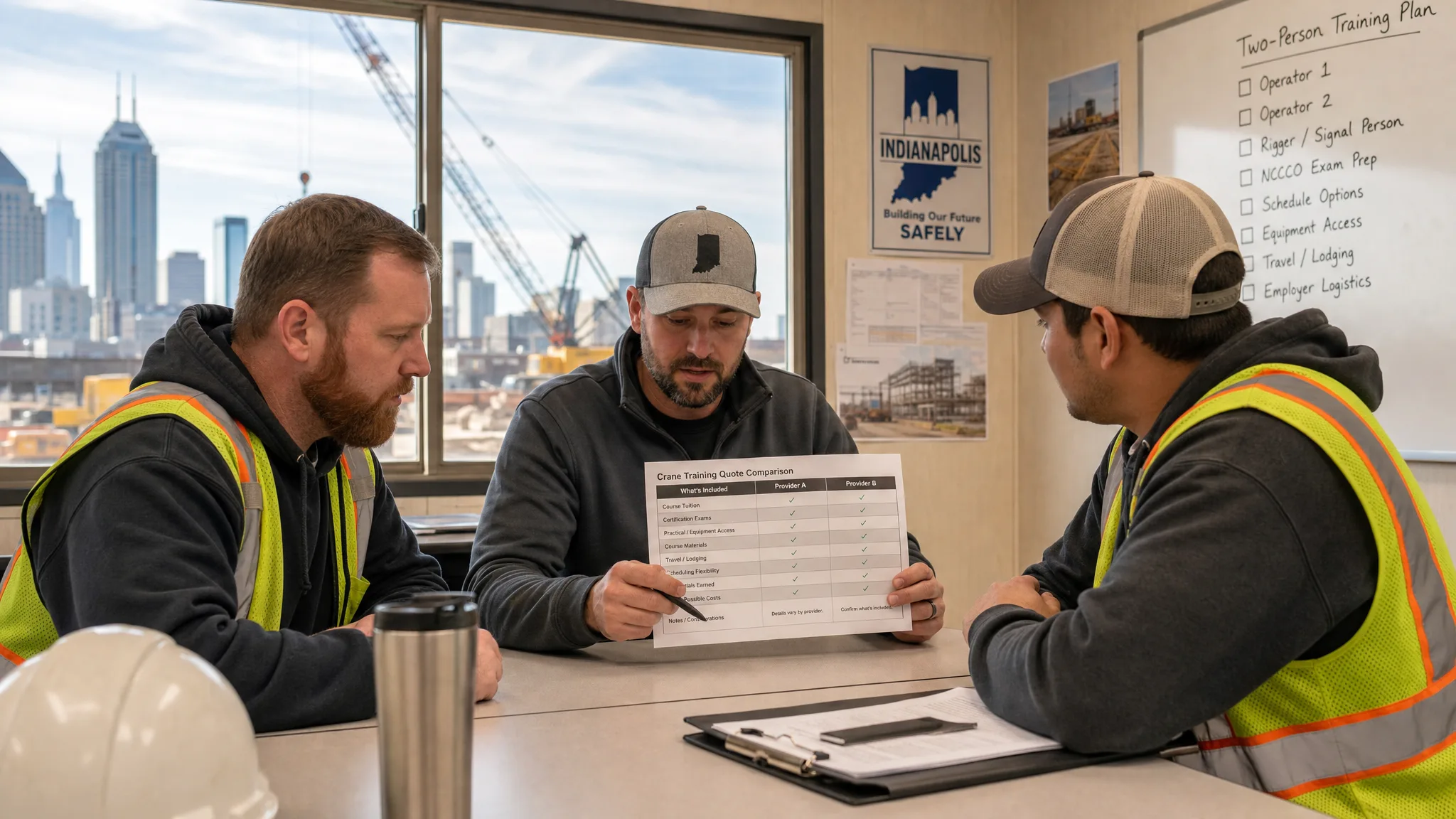
When discussing options, provide the training provider with:
- Each employee’s current job title and expected duties;
- Any relevant operating, rigging, signaling, construction, or material-handling experience;
- The types of projects where the employees will work;
- The crane types or categories encountered on those projects, when known;
- Whether the company is planning for operator, rigger, signal person, or multiple role-specific training needs;
- The employer’s target timeframe and whether both employees must attend together.
Giving the same information to every provider is one of the simplest ways to compare a group crane operator training cost fairly. It prevents a situation where one provider quotes an operator course and another quotes only general introductory instruction, even though the descriptions initially appear similar.
What a Fair Group Quote Should Itemize
Ask for a written quote that separates major cost categories. An itemized quote does not have to be complicated, but it should let a supervisor or safety coordinator see whether the company is paying for the same scope from each provider.
Do not rely only on a “per person” number. A per-person tuition figure is useful, but it does not answer whether exam fees, equipment access, course materials, travel, or rescheduling conditions are included.
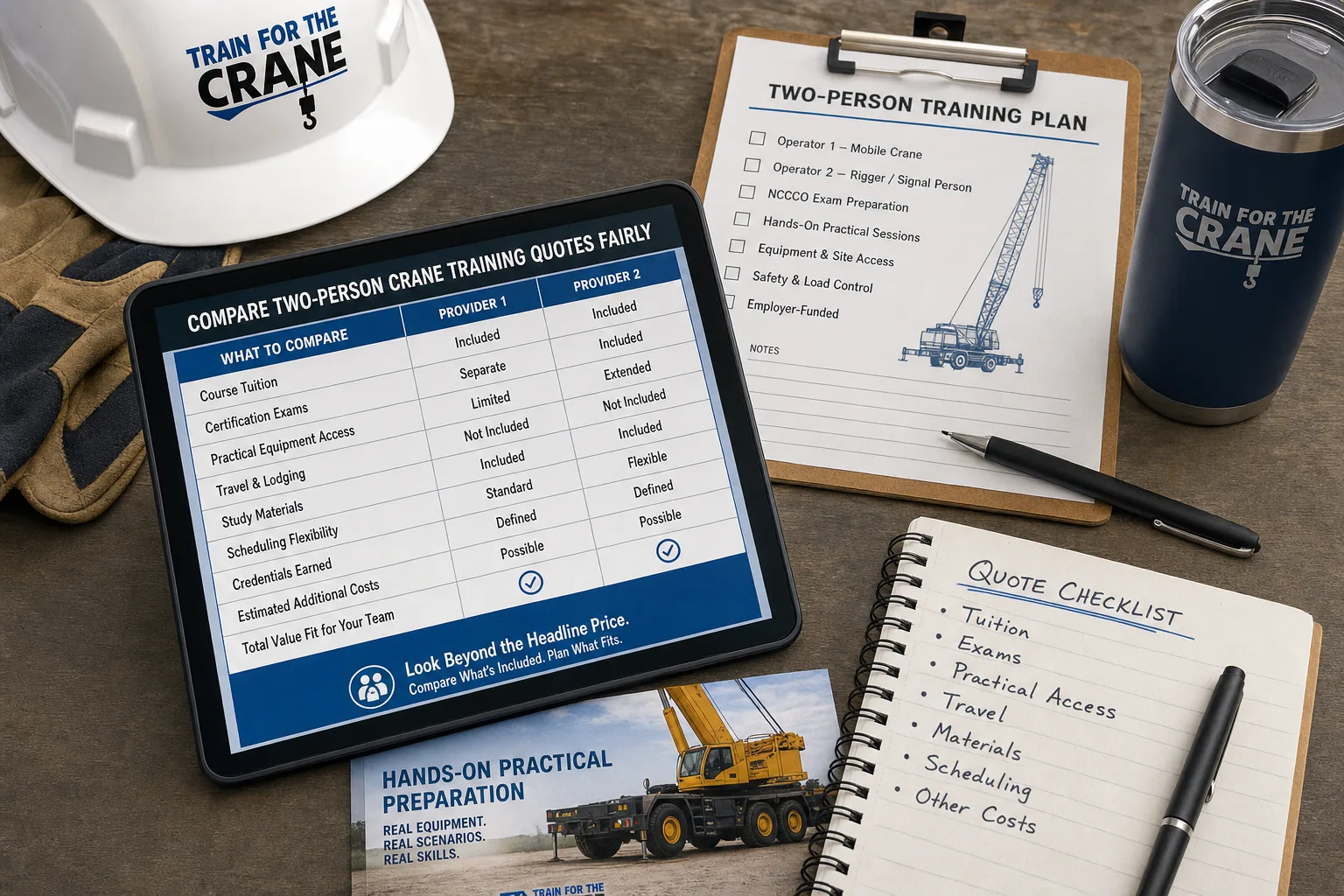
| Quote Item | What the Employer Should Confirm | Why It Matters for Two Employees |
|---|---|---|
| Per-person tuition | Course title, role covered, instruction format, training dates, and whether the quoted tuition applies to each participant. | Shows the base training cost, but should not be treated as the complete cost. |
| Two-person or group pricing terms | Whether a different rate applies at two attendees, whether there is a minimum enrollment requirement, and whether any price adjustment is conditional. | Employers should confirm terms rather than assume a two-person group discount is available. |
| Certification exam fees | Whether written and practical exam fees are included, excluded, estimated separately, or paid directly to an examination organization. | Exam-related costs may be a material portion of the total certification-preparation budget. |
| Course materials | Whether manuals, study guides, practice materials, or required course resources are included. | Prevents two quotes from appearing equal when one requires additional purchases. |
| Practical training and equipment access | Whether practical training is included, where it occurs, what equipment access is planned, and whether there are limits or scheduling conditions. | Hands-on access affects preparation and should be compared directly, not assumed. |
| Instructor-led certification preparation | Which written knowledge areas and practical expectations are addressed, and whether the course includes structured exam-preparation guidance. | Helps employers distinguish training scope from a simple promise of “test prep.” |
| Travel and location | Course location, expected employee travel, parking, lodging if needed, and whether off-site instruction carries added costs. | Two employees double some travel-related expenses and time away from the jobsite. |
| Scheduling and rescheduling | Upcoming dates, attendance requirements, deadline for payment, cancellation terms, and rescheduling policies. | A rigid schedule can create operational costs if both employees must be removed from active work at once. |
| Additional credentials | Whether rigger, signal person, tower crane, or other training is included or priced separately. | Prevents role-specific needs from becoming unplanned add-ons after the operator course is booked. |
| Payment terms | Deposit expectations, invoice timing, accepted payment methods, and what must be paid before seats are reserved. | Lets the employer align course commitments with internal approval and purchasing processes. |
Use this table as a request template. Send the same list to each provider and ask for “included,” “not included,” or “priced separately” next to every line. That approach is more reliable than trying to infer details from course names.
It is also reasonable to ask what changes if a scheduled class does not meet a stated minimum enrollment. Will the date move? Will the format change? Are the two employees able to transfer to another session? A quote that is attractive on paper may not suit a project schedule if its class dates depend on enrollment that has not yet been confirmed.
Do two employees usually receive a group discount for crane training in Indiana?
Employers should not assume that two attendees automatically create a group discount. Pricing approaches differ by provider, course format, schedule, location, and whether the training is open enrollment or arranged specifically for an employer. Some providers may have a stated multi-attendee rate, while others may quote the same per-person tuition for two seats. The practical question is not whether a discount has a particular label; it is whether the final quote clearly states the per-person and total company cost, including the items that are outside tuition.
Compare Practical Training, Equipment Access, and Certification Preparation
For employers evaluating Indianapolis crane training for employees, practical preparation deserves direct attention. It is easy to compare classroom dates and tuition totals. It is harder, but more important, to understand what practical activity is planned and how it relates to the employees’ work and certification-preparation goals.
Ask specific questions about practical crane training time
“Hands-on training included” is not enough detail for a safety coordinator planning training for two people. Ask the provider to explain the course format in practical terms.
- Is practical instruction included in the stated tuition?
- Is there a separate practical session, a separate fee, or a different location?
- What type of equipment access is planned for the course?
- How are multiple participants scheduled for practical portions of the program?
- Is practical time instructor-led, observed, or structured around particular learning objectives?
- What preparation is expected from participants before practical instruction?
- If an employee needs additional preparation, what options are available and what costs may apply?
- Are practical training arrangements dependent on weather, equipment availability, site conditions, or other scheduling factors?
There is no universal number of practical hours that fits every worker, equipment category, course design, or level of prior experience. Rather than asking a provider for a vague promise of “enough” equipment time, employers should ask how practical instruction is organized and how the course handles two participants with different experience levels.
A worker with substantial supervised equipment familiarity may approach practical preparation differently from a worker who is newer to crane operation. That does not mean either employee should be rushed through training. It means the employer and provider should discuss the training objective and determine whether the same scheduled course is appropriate for both employees.
Separate certification preparation from certification outcomes
NCCCO certification guidance and exam preparation can be an important part of operator course planning. However, an employer should distinguish between a program that prepares candidates for applicable examination requirements and a claim that an outcome is assured. Written and practical examinations can be separate components, and requirements can vary by certification path and candidate circumstances.
When reviewing NCCCO exam fees and training, ask:
- Which certification path or role is the course intended to support?
- Are written and practical examination costs included in tuition?
- If not included, are current fee details provided separately?
- Who handles registration, scheduling, and payment for examination components?
- Does the quote address any required identification, documentation, eligibility, or application steps that candidates must complete?
- What happens if the class and examination dates are not the same?
- Are retest costs, if needed, included, excluded, or handled separately?
Employers should confirm current details directly with the provider and relevant examination organization before committing funds. A course may provide valuable preparation, but no responsible provider should present certification passage as automatic. Preparation quality, attendance, prior experience, individual study, and examination requirements all matter.
Match equipment and job context to the course conversation
For mobile crane operator training, a useful discussion includes the types of cranes or work environments relevant to the employer’s projects. For tower crane training, the employer should describe the intended role rather than assume that a mobile crane course covers the same need. Rigger and signal person training should likewise be evaluated according to the workers’ actual responsibilities around load handling, communication, and site procedures.
Employers looking for local context can review Train For The Crane’s information about crane training in Indianapolis. When requesting availability, describe the employees’ objectives so the conversation can focus on course fit, practical expectations, scheduling, and the complete quote scope.
Are written and practical certification exam fees included in crane operator training tuition?
They may be included, excluded, or quoted separately depending on the course and provider. Do not rely on the title “certification training” to answer this question. Ask for written confirmation showing tuition, written examination fees, practical examination fees, registration or administration charges, and any other exam-related expenses as separate lines. If a provider uses bundled pricing, ask for the components within the bundle so the employer can compare it with another quote accurately.
Calculate the Full Employer Cost Beyond Tuition
The invoice is only one part of an employer-paid crane training budget. For a two-person class, the company should consider cash costs, payroll costs, schedule impact, and the cost of any follow-up activities needed to complete the planned training path.
Direct costs to include in the budget
Start with the quoted tuition for both employees, then add every charge that is known or reasonably anticipated. Direct expenses may include:
- Course tuition for each employee;
- Exam registration and examination fees, when applicable;
- Practical equipment access or practical exam-related charges if separately priced;
- Books, manuals, study materials, or required personal items not included in tuition;
- Travel mileage, fuel, parking, tolls, lodging, or meals for training outside the immediate Indianapolis area;
- Payment processing fees, deposits, or administrative charges when stated by the provider;
- Costs for additional role-specific training, such as rigger or signal person courses;
- Potential rescheduling, transfer, or cancellation costs under the provider’s stated policy.
Do not insert assumed dollar amounts into a budget simply because another company paid a certain amount in the past. Course designs, examination arrangements, equipment access, and scheduling terms can change. Obtain current written details.
Account for paid time and operational coverage
Lost-work-time considerations are often overlooked in a group crane operator training cost comparison. If two employees attend together, the company may have two people away from routine production, maintenance, deliveries, or project work at the same time. Depending on the jobsite, the employer may need temporary coverage, adjusted lift planning, a revised crew assignment, or delayed tasks.
For budgeting purposes, consider:
- Paid employee wages during travel, class time, practical sessions, and examinations;
- Overtime or temporary labor needed to cover their usual duties;
- Project impacts if both employees are scheduled away from a critical work period;
- Travel time from the company location or jobsite to the training location;
- The value of scheduling both employees together versus staggering attendance.
Sometimes sending two employees to the same session is operationally efficient: travel can be coordinated, both workers receive aligned instruction, and a supervisor has a clear training record for the group. In other cases, staggering attendance makes more sense because the company needs one qualified team member on site. The best choice depends on current project demands, not only the course calendar.
Plan for timing rather than treating training as a last-minute purchase
Training and examination schedules may not line up exactly with a new project start date. Employers should ask about available course dates, expected lead time for registration, practical-session scheduling, and how far in advance seats should be reserved. Waiting until a job is about to begin can reduce scheduling options and increase the chance that operational decisions are made under pressure.
If the company has an internal approval process, involve the supervisor, safety coordinator, project manager, and purchasing contact early. A complete request should identify the two employees, their roles, the desired schedule, budget categories, and any credential-related expectations. This makes it easier to avoid a delay caused by discovering that a separate exam fee or practical arrangement needs another purchase order.
What should an employer confirm is included before accepting a crane training quote?
At a minimum, confirm the course title and role, attendance dates, per-person tuition, total two-person cost, course materials, practical training arrangements, equipment access expectations, certification-preparation scope, examination fees, travel needs, payment deadlines, minimum enrollment terms, and cancellation or rescheduling policies. The employer should also confirm what is not included. A transparent list of exclusions is often just as useful as a list of inclusions.
For more planning prompts, see these questions to ask about employer-paid crane training. They can help an employer prepare for an informed discussion before reserving seats.
A Two-Person Crane Training Quote Comparison Checklist
Use one worksheet for every provider under consideration. The purpose is not to force every school into an identical course model. It is to identify meaningful differences before the employer compares totals.
Step 1: Record the same request details on every inquiry
- Employee one: intended role, current experience, and required training goal;
- Employee two: intended role, current experience, and required training goal;
- Whether both need mobile crane operator training, or whether rigger, signal person, or tower crane training is more appropriate for one participant;
- Preferred dates and any firm project deadline;
- Indianapolis-area location preference or willingness to travel;
- Whether the employer expects both employees to attend at the same time;
- Need for practical preparation and any known equipment context;
- Certification-preparation questions and whether examination costs need to be included in the company budget.
Step 2: Compare the quote line by line
- Base tuition: Record the rate for each employee and the combined tuition total.
- Group terms: Note whether two attendees affect pricing and whether any rate depends on enrollment conditions.
- Course scope: Confirm that each quote addresses the same role and training goal.
- Exams: Record written and practical examination expenses separately unless the provider clearly documents an all-inclusive package.
- Practical preparation: Write down what is included, where it occurs, and what scheduling conditions apply.
- Equipment access: Ask what access is planned rather than assuming the course format based on a marketing phrase.
- Materials: List included manuals, study resources, and any required purchases.
- Travel: Estimate travel and time away from work for both employees.
- Schedule risk: Compare confirmed dates, minimum enrollment requirements, and transfer policies.
- Payment: Record deposit amount, due dates, refund rules, and internal approval deadlines.
Step 3: Ask about minimum enrollment and scheduling flexibility
Minimum enrollment is especially relevant when an employer is training exactly two people. Some course dates may be established sessions with several participants; other arrangements may require more participants or may involve scheduling conditions. The employer should ask:
- Is the course date confirmed, or does it depend on minimum enrollment?
- If the minimum is not met, what alternatives are available?
- Can the two employees move to another date without an additional charge?
- Can they be placed in separate sessions if the company needs to preserve jobsite coverage?
- What notice is provided if a date changes?
- Are there different costs or logistics for a private or employer-specific training arrangement?
Scheduling flexibility has value even when it does not appear as a separate line item. A course date that fits the project calendar can reduce payroll disruption and avoid the cost of canceling or moving a class later. Conversely, a rigid date might still be appropriate if it provides the right course scope and aligns with the employees’ required timing. The point is to make that tradeoff deliberately.
Step 4: Review the total company commitment
At this stage, add direct charges and internal time costs. Then review whether the training plan addresses the company’s real need. A quote should not be selected merely because it has the lowest initial tuition, and it should not be selected merely because it has the highest price or the most extensive list of features. The better value is the option with a clear scope that fits the roles, timing, practical expectations, and budget constraints of the employer.

How much practical equipment time should two employees expect from a crane training course?
The answer depends on the program, participant experience, training objective, equipment availability, weather or site conditions, and how practical sessions are scheduled. Rather than rely on a general expectation, request a course-specific explanation of the practical format. Ask what the two employees will do, how participants rotate through practical activities, whether the time is instructor-led, and whether additional preparation may be needed for either employee. A provider should be able to explain the planned practical component without making unrealistic promises about individual outcomes.
When a Higher Quote May Be the Better Value
A higher quote may be the better value when it provides a clearly documented training scope that avoids separate surprises and better fits the employer’s safety and scheduling needs. Price matters, but it should be evaluated alongside what the company is actually buying.
Value can come from clarity and alignment
Consider two hypothetical quotes for the same two employees. Quote A has lower tuition but does not identify exam fees, provides limited detail about practical arrangements, and has a course date that could move if enrollment is low. Quote B has a higher stated total but separates tuition and exam-related expenses, explains how practical preparation is scheduled, lists materials, and gives clear payment and rescheduling terms.
Quote B is not automatically the right choice, but it is easier to evaluate. If it matches the employees’ roles and the company’s timeline, the added clarity may prevent avoidable expenses or schedule conflicts. The employer can make an informed decision because the costs and training expectations are visible.
Practical preparation can matter more than a small tuition difference
For employees who need mobile crane operator training, practical preparation and equipment access are legitimate decision factors. A course should be evaluated on how it prepares participants for the intended work and applicable certification path, not simply on whether the brochure says “hands-on.” If one quote provides a detailed practical plan and another does not, the employer should investigate the difference before choosing based on tuition alone.
This is not a reason to assume that more practical time always makes any program better. The quality and relevance of instruction, participant readiness, equipment context, course objectives, and supervision all matter. It is a reason to ask precise questions and choose the option that makes operational sense for the two employees.
Role-specific training may reduce unnecessary spending
A company can also find better value by avoiding a one-size-fits-all enrollment decision. If only one employee will operate and the other will serve as a rigger or signal person, distinct role-specific courses may be a more responsible plan than purchasing identical operator training for both workers. In some situations, the operator and support roles need to train together around company procedures; in others, their foundational course needs differ.
Discuss the actual job duties with the provider. This helps the company avoid undertraining a role that requires dedicated instruction or overbuying training that is not relevant to the employee’s assignment.
Local scheduling may have real budget value
For companies based in Indianapolis or elsewhere in Indiana, local training can reduce travel time and simplify attendance. That does not mean a nearby class is always the best option, but location should be included in the full cost comparison. Two employees traveling longer distances may incur mileage, meals, lodging, additional paid travel hours, and more disruption to project schedules.
Ask whether the quoted location is fixed, whether practical components occur at the same location, and whether there are any off-site requirements. A clear answer helps employers compare local convenience with course fit instead of treating travel as an afterthought.
When should an employer book operator training separately from rigger or signal person training?
Book separate role-specific training when the employees have different responsibilities or when the course objectives differ. For example, an employee preparing to operate a mobile crane may need an operator-focused program and certification preparation, while an employee assigned to load-handling support or communication duties may need rigger or signal person training. Combine planning only when it serves the work roles and does not blur the training objectives. A provider can help the employer evaluate whether a combined schedule is practical, but the company should begin with a clear description of who is expected to do what on the jobsite.
Build a Better Training Budget Before Reserving Two Seats
A sound crane training budget is not a search for the lowest tuition number. It is a safety-focused planning process: define each employee’s role, request the same itemized scope from each provider, separate tuition from certification exams and incidentals, compare practical equipment access, calculate travel and lost-work-time considerations, and confirm scheduling terms before payment is due.
For Indianapolis employers, the best two-person course option is usually the one that makes the full commitment understandable. It should fit the employees’ intended duties, the company’s certification-related needs, practical training expectations, and operational timeline. Training can support job preparation and safer work practices, but employers should avoid treating a quote as a guarantee of certification, employment, or any particular career outcome.
If your company is planning training for two employees, Train For The Crane can help you talk through the appropriate roles or credentials, course timing, practical training expectations, equipment access questions, certification requirements, payment considerations, and complete cost scope before you reserve seats. Call (317) 385-7190 to discuss which option fits your Indiana work situation best.