

First-Time Crane Training Preparation: How to Take Useful Notes During Your First Mobile Crane Walkaround
Your first equipment walkaround in a crane operator training program is more than an introduction to a large machine. It is an opportunity to learn how experienced operators, riggers, and instructors think about equipment condition, setup, communication, and safe operating limits.
For first-time students in Indianapolis and across Indiana, the goal is not to memorize every crane part on day one. The goal is to leave the walkaround with organized, safety-focused notes that help you follow supervised practical instruction, review classroom material, and ask better questions as training continues.
A good set of notes also helps you compare training options realistically. Before enrolling, students should understand what equipment access, hands-on practice, certification preparation, and course costs apply to their particular goal.
Why Your First Crane Walkaround Deserves More Than Casual Notes
A mobile crane has many visible systems, but the walkaround is not simply a naming exercise. Your instructor may use the equipment introduction to explain why a component matters, where it fits into a pre-operational process, what conditions require attention, and how the crane’s configuration affects what can be done safely.
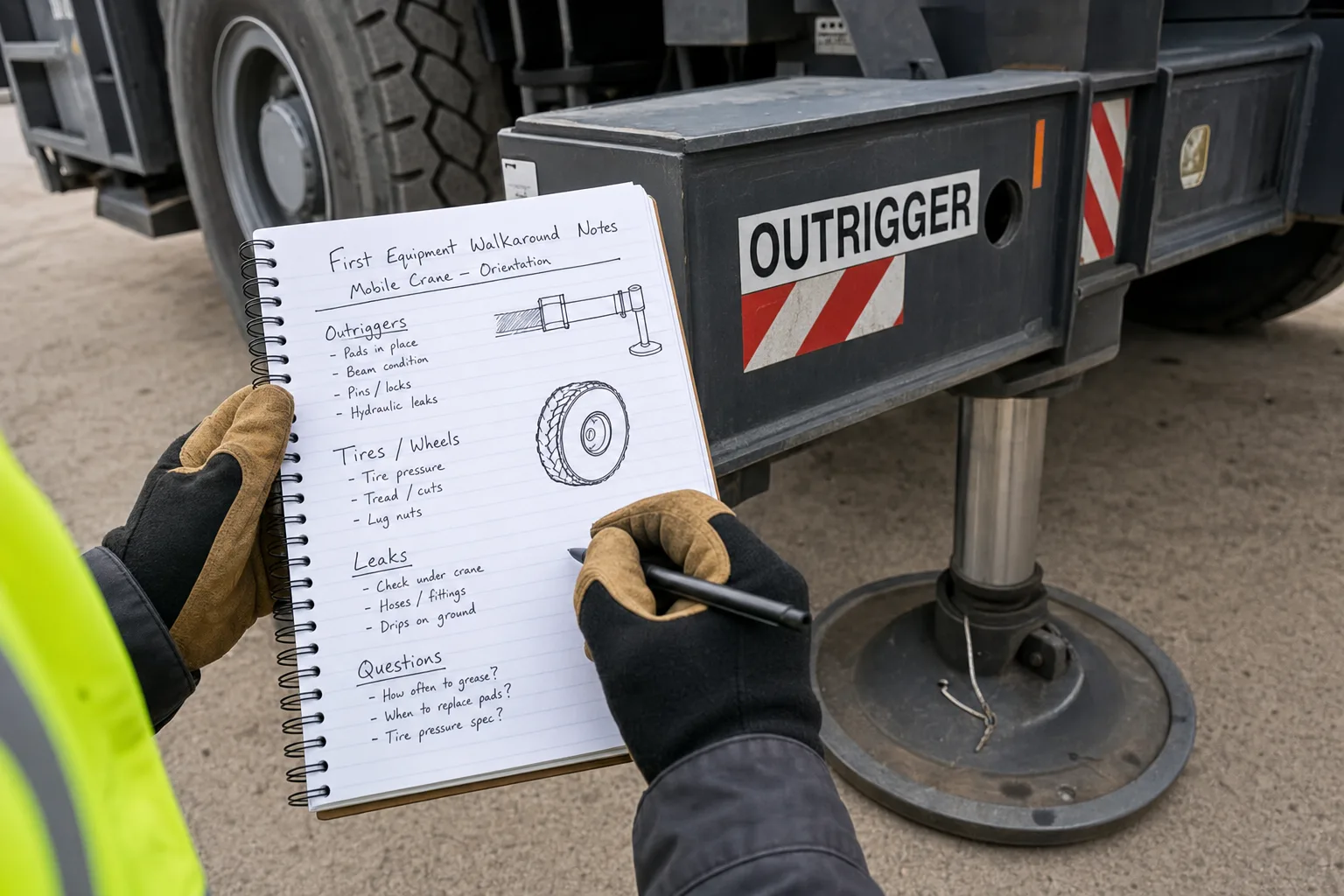
That is why writing “outriggers,” “boom,” or “hook block” by itself is usually not enough. Better notes connect a component to its purpose and to the instructor’s safety explanation. For example, instead of only writing “tires,” a student might write:
- Tires/wheels: instructor identified visible-condition checks and explained that site conditions and the crane’s setup matter before operation.
- Outriggers: note the terms used during the demonstration, where the instructor pointed out components, and the importance of following the applicable setup procedures for that crane.
- Load chart: record where the chart or relevant information is located and why capacity depends on configuration, radius, boom length, and other machine-specific factors.
These notes do not make a student qualified to inspect or operate a crane. They help the student listen carefully and retain the information provided during supervised training. Crane configurations, controls, operating procedures, and inspection requirements vary by machine, so your instructor and the manufacturer information for the crane being used remain the source for equipment-specific direction.
For Indianapolis workers moving from construction, manufacturing, rigging, or signal person duties toward an operator role, this approach can make unfamiliar terminology less overwhelming. You do not need to arrive knowing every component. You do need to arrive ready to observe, write down what is demonstrated, and follow the provider’s safety procedures during the walkaround.
If you are still comparing course formats, review the available mobile crane operator training options and consider which path fits the type of equipment and work responsibilities you are pursuing.
What to Bring and How to Set Up a Simple Walkaround Note Page
You do not need a complicated system. A durable notebook and pen are often more useful than trying to type notes while walking near equipment. Ask the training provider about any site rules regarding personal items, phones, required protective equipment, and where students may stand during the equipment introduction.
Before the walkaround begins, divide one notebook page into four simple categories:
- Controls and locations
- Terminology
- Inspection sequence and safety observations
- Instructor questions
This layout prevents a common first-day problem: writing scattered words with no context. You may hear a term before you fully understand it. Put it in the terminology section, add a short description of where it was pointed out, and leave space to clarify it later during classroom review.
A practical note-page example
Your page might look like this:

- Controls and locations: “Instructor pointed out the operator area and discussed machine-specific controls. Review terminology before practical session.”
- Terminology: “Carrier, superstructure, boom sections, outrigger beam, hook block, load chart, anti-two-block device.”
- Inspection sequence: “Observed instructor’s walkaround flow; record the order used in this course rather than guessing a universal sequence.”
- Questions: “Which items are explained in class versus observed during supervised equipment practice?”
This is a learning aid, not a crane pre-operational inspection form. A formal inspection record is completed according to employer procedures, applicable requirements, equipment documentation, and the responsible person’s process. Your personal training notes should never be presented as a completed inspection record or used in place of one.
It can also help to mark notes with simple symbols:
- Star: a point the instructor said is especially important.
- Question mark: a term or process to clarify later.
- Arrow: a connection between two systems or between a classroom concept and the equipment in front of you.
- “Review”: material you want to revisit before written exam preparation or practical instruction.
Bring a water-resistant notepad if conditions require it, but avoid becoming so focused on writing that you stop paying attention to boundaries, instructor directions, and moving equipment. Safe positioning and attention come first.
What to Record During the Equipment Introduction
During a first mobile crane walkaround, write down the instructor’s explanations in broad, usable categories. The exact components and terminology depend on the crane model and configuration, so treat the following as a note-taking framework rather than a machine-specific checklist.
1. The names used for major areas of the crane
Record the terms your instructor uses for the major parts of the equipment. Depending on the machine, the discussion may include the carrier, cab, superstructure, boom, hoist line, hook block, outriggers, tires, counterweight, and operator controls.
The useful part of your note is not just the name. Add a location cue. For example: “Counterweight—rear of rotating upper structure; instructor explained its relationship to crane configuration and operating limits.” This gives you a mental map when the term appears later in a classroom discussion.
2. The instructor’s walkaround flow
Pay attention to how your instructor moves around the crane and how they explain each area. You may hear why orderly observation matters, what items are reviewed before use, and where equipment documentation or machine information is accessed.
Do not assume that the exact sequence demonstrated on one crane automatically applies to every crane or every employer procedure. Instead, note the sequence taught in your course and the reason your instructor gives for it. The lesson is often about disciplined observation and using the correct procedure for the particular equipment.
3. Conditions and changes the instructor calls out
When an instructor points out a condition, write what you observed and what question it raised. Avoid trying to diagnose the equipment yourself. Appropriate notes sound like:
- “Instructor explained why visible leakage, damage, loose material, or unusual condition should be addressed through the proper process.”
- “Asked how documentation and reporting are handled during training versus on an employer jobsite.”
- “Need to review who has authority to decide whether equipment is taken out of service.”
That wording supports learning without making unsupported judgments about equipment condition. It also reinforces an important safety habit: an operator or trainee should not ignore an unusual condition simply because the day’s schedule is busy.
4. Setup and work-area observations
Mobile crane training involves more than the machine. The work area, ground conditions, swing area, access routes, communication plan, and nearby hazards all matter. During an equipment introduction, note how the instructor discusses the work zone and student boundaries.
For example, you might write: “Before practical exercise, instructor reviews where trainees stand, how to approach the equipment, and when to wait for direction.” That note is immediately useful because it prepares you to participate safely in later hands-on sessions.
5. The separation between orientation and operation
New students sometimes feel pressure to understand every control immediately. A first walkaround is generally the time to observe terms, locations, and safety concepts—not to improvise operating procedures. Make a note of what will be covered later under direct supervision, such as control familiarization, setup concepts, signaling, or practical evaluation preparation.
This distinction also helps students pursuing NCCCO certification preparation. Equipment orientation and supervised practical training can support readiness, but certification examination requirements and eligibility should be reviewed through the applicable candidate resources and with the training provider. No one should assume that a walkaround alone equals exam readiness or operator qualification.
How to Organize Notes Around Safety, Setup, and Operating Limits
Once the walkaround is complete, take five to ten minutes to reorganize your notes while the details are fresh. This step turns a page of terms into a study tool for practical training and written review.
Safety notes
Place instructor explanations about access, boundaries, communication, personal protective equipment, housekeeping, visible equipment conditions, and reporting procedures in a safety section. Write what the instructor said to do, who gives direction, and when to stop and ask for clarification.
A strong safety note is action-oriented but not a substitute for training. For example: “If unsure where to stand during a demonstration, stop and ask instructor before moving closer.” This supports the safe behavior you can use immediately.
Setup notes
Use a setup section for terms related to crane configuration, outrigger discussion, site preparation, machine positioning, and the work area. Keep these notes at a high level unless your instructor is teaching a specific, supervised exercise. Never convert general notes into self-directed setup instructions for a crane you are not assigned and authorized to operate.
For first-time students, it is especially useful to write down what changes from one configuration or work situation to another. That is a reminder that a crane is not operated from one memorized rule. Configuration, load information, conditions, manufacturer instructions, and the planned lift all affect decisions.
Operating-limit notes
Record the concepts your instructor connects to operating limits: load charts, rated capacity, boom length, operating radius, configuration, ground conditions, and communication. The point is to understand that capacity is conditional, not a single number to memorize.
Write notes such as, “Capacity information must be read for the actual crane configuration and operating situation,” rather than copying a number heard in class. A number without the related configuration can be misleading and unsafe.
Students who want a deeper look at school selection can read what to ask about practical crane training time. Practical time can be valuable, but it should be supervised, relevant to the course, and explained clearly before you reserve a seat.
Questions to Ask Your Instructor Without Slowing Down the Walkaround
Questions are a sign that you are engaged, but the equipment walkaround is not always the right setting for a long discussion. Use your question section to capture thoughts, then ask at a safe pause, during classroom review, or at the time your instructor designates.
Good first-time questions are specific and connected to what you observed:

- “What is the preferred term for this component in our course materials?”
- “Will we return to this system during supervised practical training?”
- “What should I review before the next equipment session?”
- “Which parts of this discussion are general crane concepts, and which are specific to this machine?”
- “How does the training course distinguish equipment orientation from a formal daily inspection process?”
- “What practical skills are included in this course, and what should students expect to practice under supervision?”
For employers preparing a crew member, these questions can also clarify course fit. A signal person or rigger may benefit from learning crane terminology and work-zone awareness, but their training objectives may differ from an aspiring operator’s objectives. Be direct about the employee’s role, current experience, and credential goals when speaking with a provider.
Train For The Crane provides crane training in Indianapolis for students who need straightforward guidance on mobile crane training and certification preparation. Ask what is included for your target role rather than assuming every course covers the same equipment, practice, or exam-prep scope.
Common First-Time Note-Taking Mistakes to Avoid
Good notes are brief, organized, and tied to the instruction you actually received. Avoid these common mistakes:
- Trying to write every word. You may miss the demonstration, instructor directions, or a critical safety point. Capture the key idea, then ask for clarification later.
- Copying terms without context. Add where the part is located, what the instructor said it relates to, or why it was mentioned.
- Treating notes as an inspection record. Training notes are not a completed crane pre-operational inspection and do not replace the proper inspection process.
- Assuming one crane represents every crane. Controls, configurations, terminology, and procedures can vary by machine. Learn the principles, then follow the documentation and instruction for the equipment in use.
- Writing down capacity numbers without conditions. Capacity is dependent on machine-specific information and the actual configuration. Do not treat an isolated number as an operating rule.
- Using notes to work independently. Notes should support supervised practice and review, not self-directed operation, setup, or troubleshooting.
- Waiting until after enrollment to ask about access. Before committing, ask how much equipment walkaround time and supervised practical time are included, and what certification preparation is covered.
Course price is another area where students should seek details rather than assumptions. A quoted tuition figure may not answer every planning question. Review the mobile crane operator training cost and planning guide for practical questions about comparing course costs, possible exam-related considerations, and what to confirm before making a decision.
FAQ: Preparing for a Mobile Crane Training Walkaround
What should I write down during my first crane equipment walkaround?
Write down the terminology used by your instructor, the major areas of the crane that are identified, the instructor’s safety and work-zone directions, the general walkaround sequence demonstrated, and questions you want to ask later. Organize notes under controls, terminology, inspection sequence, safety observations, and instructor questions. Include the purpose of a component or concept when it is explained, not just its name.
Do I need to know crane parts before starting a crane operator training program?
No. A first-time student does not need to arrive with complete knowledge of crane components. Arrive ready to learn, listen, follow site safety rules, and take organized notes. If you have construction, manufacturing, rigging, or signaling experience, that experience may help you connect concepts, but it does not eliminate the need for structured instruction.
How is a training walkaround different from a daily pre-operational inspection?
A training walkaround is an educational activity. It helps students become familiar with equipment areas, terminology, safety concepts, and the instructor’s explanation of proper procedures. A daily pre-operational inspection is a formal work-related process performed and documented according to the applicable equipment, employer, and regulatory requirements. Your class notes are for learning and review; they are not a substitute for a formal inspection record or authorized inspection process.
Will mobile crane operator training include practical equipment time, or only classroom instruction?
That depends on the specific course and training provider. Do not assume that every crane operator training program provides the same level of walkaround access, supervised equipment time, practical preparation, or written exam review. Before reserving a seat, ask exactly what is included, what equipment students will be introduced to, how practical time is structured, and whether the course addresses your mobile crane certification-preparation goal.
What should I confirm before reserving a crane training seat in Indianapolis?
Confirm the course’s intended student level, the equipment orientation and supervised practical opportunities included, the scope of certification preparation, any rigger or signal person options relevant to your job, total course costs, and current seat availability. Also ask what you should bring, what safety procedures apply on site, and whether the course is appropriate for your existing experience and career goal.
Use Your First Walkaround to Make a Better Training Decision
The best first-day notes are not a technical manual and are not proof that you can operate a crane. They are a record of the questions, safety concepts, terminology, and equipment observations that make the next phase of supervised instruction more productive.
If you are comparing a crane operator training program in Indianapolis or elsewhere in Indiana, ask Train For The Crane for a direct explanation of the equipment walkaround time, hands-on practice, certification preparation, course costs, and seat availability that apply to your specific goal. Call (317) 385-7190 to get a practical next-step answer before you enroll.