

NCCCO Written Exam Preparation: Studying Personnel Hoisting and Power-Line Questions Without Guessing
Personnel hoisting and overhead power lines are two of the most safety-critical subjects in crane work. They can also be difficult written-exam subjects because a single scenario may contain facts about both hazards. Candidates often miss these questions not because they have never heard the rules, but because they blend two separate analyses together, rely on a remembered number without its conditions, or overlook terminology that changes the question.
For aspiring and current crane operators in Indianapolis and across Indiana, effective NCCCO certification guidance and exam preparation begins with a disciplined reading process. This article explains how to separate personnel-hoisting concepts from power-line planning, identify what each scenario fact is testing, use current source materials, and build a study plan that supports both written preparation and practical training.
Important: This is exam-study guidance, not a substitute for a jobsite-specific lift plan. Actual crane operations must be planned using current OSHA requirements, employer procedures, manufacturer instructions, site conditions, utility coordination where applicable, and the direction of qualified personnel. A practice question can help you recognize hazards; it cannot replace planning a real lift.
Why Personnel Hoisting Near Power Lines Is a High-Stakes Exam Topic
A crane lifting material near an energized line presents one category of hazards. A crane lifting people in a personnel platform presents another. When both conditions exist in the same scenario, the operation requires closer attention to planning, movement control, communication, equipment condition, work-area control, and changing conditions.
That is why questions involving a crane exam power lines personnel hoisting scenario deserve more than quick memorization. A written exam may test whether you can identify the governing issue, recognize which facts matter, and understand that one safety measure does not replace another.
For example, a scenario might mention a suspended personnel platform, overhead conductors, a designated landing area, a signal person, utility coordination, a changed crane position, or an altered travel path. None of those details should be treated as filler. The question writer may be testing whether you notice that:
- The crane could be operating near an electrical hazard, even if its starting location appears clear.
- Workers are being raised or lowered, which can trigger personnel-hoisting analysis rather than ordinary material-handling logic.
- A change in boom angle, platform path, crane position, load path, or site condition can change the planning picture.
- Communication duties and movement controls matter differently depending on what the scenario asks.
- Power-line precautions and personnel-platform requirements may both need attention at the same time.
On a real jobsite, poor assumptions can expose workers to electrical contact, falls, dropped objects, equipment instability, unintended movement, and communication failures. On a crane operator certification written test, the risk is different but the discipline should be the same: read carefully, identify the facts, and avoid filling gaps with assumptions.
Before considering possible answers, ask these questions:
- Is the issue power-line planning, personnel hoisting, or both?
- Does the scenario say people are being hoisted, or is the load material only?
- What movement could bring the crane, boom, load, rigging, platform, or tag line toward the line?
- What stage of the operation is being tested: planning, setup, inspection, communication, movement, or a decision to proceed?
- Which facts would need verification through current OSHA requirements, certification-body materials, and a site-specific lift plan?
That approach is useful for Indianapolis crane training students, experienced operators refreshing for an exam, riggers and signal persons expanding their knowledge, and employers who need to identify workforce training gaps before sending employees to a course.
Start by Separating the Two Rule Sets in the Scenario
The most dependable way to approach a combined scenario is to split it into two categories: power-line safety and personnel hoisting. They may overlap operationally, but they are not the same topic and should not be studied as though they are.
Power-line concepts focus on electrical exposure and movement control
Power-line questions commonly focus on whether lines are energized, whether voltage information is known, what areas the equipment and load can enter, how the work zone is identified, and what planning or controls are required before work proceeds. The question may involve line status, utility coordination, work-zone planning, equipment movement, communication, or restrictions around the lift.
Do not narrow the issue to the crane’s boom tip or to a single remembered clearance figure. A real power-line analysis can involve the boom, load line, hook block, rigging, load, personnel platform, tag line, and movement of the machine itself. It can also involve load drift, boom deflection, swing, changing wind, limited visibility, travel paths, and repositioning.
For exam preparation, focus on the facts that drive the analysis. If a practice question states that voltage is unknown, that detail matters. If it describes a utility owner, de-energizing, grounding, work-zone controls, or a designated observer, read exactly what the scenario says. Do not assume that another precaution occurred simply because it would be good practice in a different fact pattern.
Personnel-hoisting concepts focus on protecting platform occupants
Personnel-hoisting questions concern operations where a crane is used to raise, lower, or position workers in a personnel platform or similar arrangement. These questions may address planning, platform and rigging condition, inspections, trial lifts, proof testing where applicable, communication, fall protection, occupancy, controlled movement, and changing conditions.
The applicable OSHA construction requirements are found within 29 CFR 1926 Subpart CC. Candidates should verify current language in the official standard rather than relying solely on old classroom notes, screenshots, flashcards, or social-media summaries. Industry standards such as ASME B30.23 can provide useful context on personnel lifting systems, but consensus standards do not replace OSHA regulatory requirements or employer procedures.
Terms that often signal a personnel-hoisting issue include:
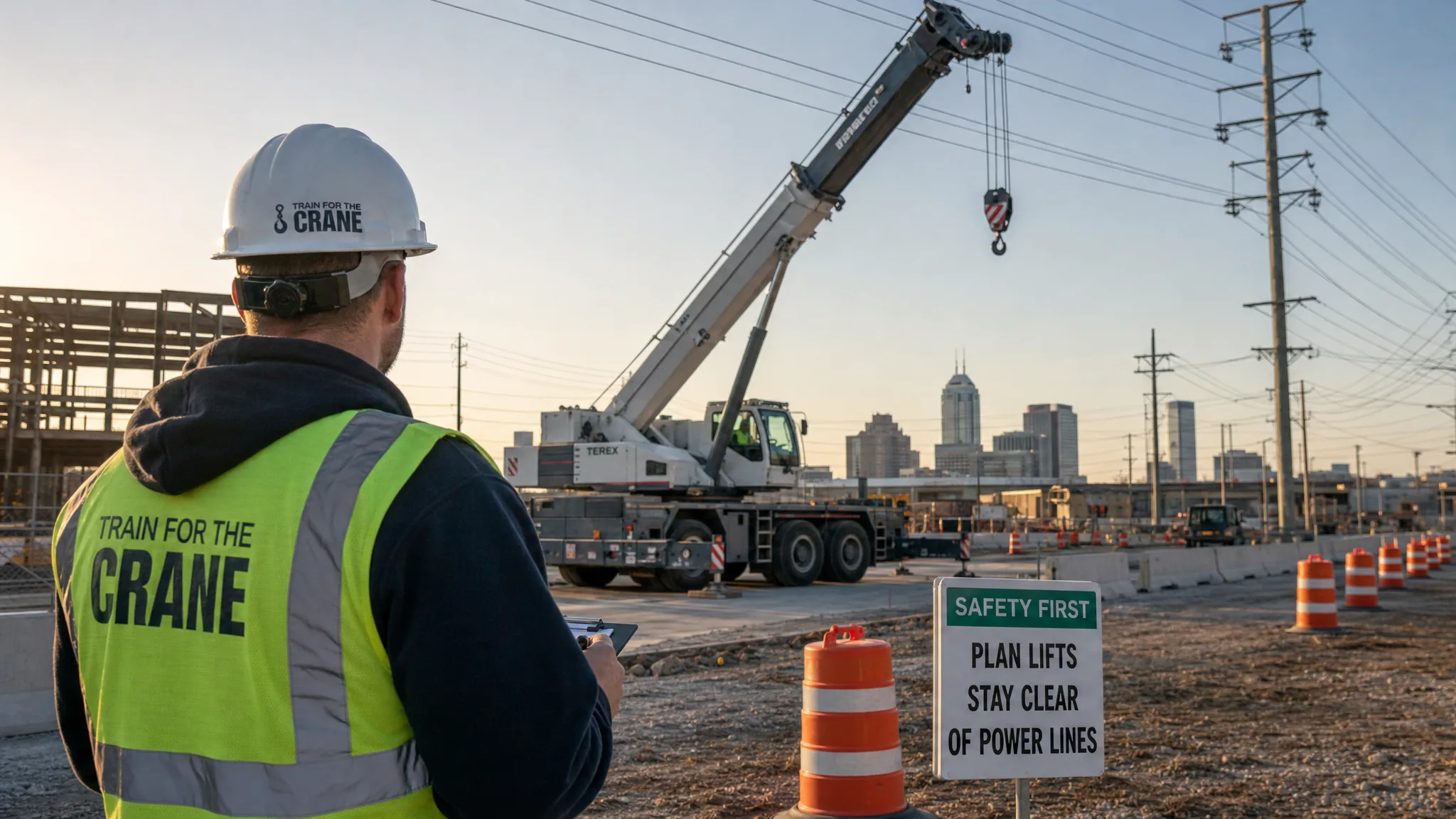
- Personnel platform, personnel basket, or suspended work platform
- Workers being raised, lowered, or positioned by a crane
- Platform occupants or a worker transferring to a structure
- Trial lift, proof test, pre-lift meeting, or platform inspection
- Platform capacity, fall protection, platform rigging, or securement
- A controlled route for a platform carrying people
If people are being lifted, do not analyze the question as an ordinary material pick. The question may be testing that distinction even when the scenario also contains a power-line hazard.
Combined scenarios require two lines of thinking
Suppose a question describes workers in a personnel platform near overhead conductors. Addressing the electrical hazard does not make the personnel-lift requirements disappear. Likewise, addressing one platform-related procedure does not remove the need to plan for power-line exposure.
A practical study habit is to picture two separate checklists. One checklist addresses electrical exposure and the crane’s potential movement envelope. The second addresses the personnel-lifting operation and protection of occupants. The exam may ask about only one issue, but the presence of facts from the other category is a reason to slow down and confirm what is actually being asked.
How to Read a Power-Line Question Before Choosing an Answer
A useful crane power line clearance study guide teaches a process, not a disconnected answer. When working through NCCCO written exam power line questions in a practice session, use the same sequence every time.
1. Identify what is known, unknown, energized, or assumed
Look for words that describe overhead lines, voltage information, transmission or distribution systems, utility coordination, de-energizing, grounding, line ownership, or the line’s status. If the scenario says that information is unknown, do not replace that missing information with a number or assumption from memory.
Many candidates lose points because they answer the situation they imagine rather than the one presented. The written test is asking whether you can make a decision from the stated facts. Read carefully enough to distinguish between “the line is known to be de-energized,” “the utility has been contacted,” and “the line’s status has not been confirmed.” Those are not interchangeable facts.
2. Map the movement zone, not just the crane setup point
A crane may be set up in a location that appears clear while its boom, load, platform, rigging, or intended movement path could still approach an overhead line. Pay attention to details involving:
- Boom angle and possible boom movement
- Swing path and machine position
- Load path, landing area, and potential load rotation
- Platform travel when personnel are being hoisted
- Possible load drift, wind effects, or side movement
- Travel, repositioning, or a changed setup location
- Obstructions that could alter the intended path
- Communication methods and who is directing movement
This is why universal clearance-distance memorization is a weak approach. Applicable requirements depend on the scenario and the current regulatory framework. Study the OSHA structure and learn which facts determine the required planning method. Avoid treating an old chart or a remembered figure as a universal answer for every power-line question.
3. Determine what the question is asking you to decide
Wrong answers often sound broadly safety-conscious but answer the wrong question. Read for the action word. Is the question asking you to identify a hazard, establish a work zone, verify a condition, inspect equipment, determine whether work may proceed, communicate a signal, or respond to a changed condition?
It can help to write a short label on scratch paper during practice: planning, inspection, communication, movement control, or proceed/stop decision. Then compare each possible answer to that specific task. An answer that describes a later step may not answer a question about the first planning step.
4. Use current primary materials to verify the concept
Study from current, dependable sources. For construction-crane requirements, review the official text of OSHA 29 CFR 1926 Subpart CC. For your certification path, review the current candidate handbook and official examination materials issued by the applicable certification body.
Candidate handbooks, exam outlines, eligibility details, referenced materials, and administrative processes can change. Instructor explanations and practice questions are valuable, but they should point you back to the governing concept rather than become a substitute for current source material.
What Personnel-Hoisting Questions Commonly Test
Personnel hoisting crane exam prep should cover the reasoning behind the rules. The written exam may not ask you to recite an entire procedure word for word. More often, it tests whether you recognize when personnel-hoisting requirements apply and why a particular operational fact matters.
Recognition of a personnel-lift operation
The first question is straightforward but important: are people being hoisted by a crane? Be exact. A worker standing near a material load is not the same as a worker occupying a platform that is being raised or lowered. The wording of the scenario tells you which issue is in play.
Look for direct evidence of occupants, a personnel platform, positioning workers at elevation, moving workers to a structure, or preparing the platform for use. If those facts are present, do not use ordinary material-handling assumptions as your only framework.
Planning, roles, and communication
Personnel lifts depend on disciplined coordination. Practice questions may test whether responsibilities are clear among the operator, lift director, rigger, signal person, platform occupants, and other involved personnel. They may also test whether communication is reliable, whether the work area is controlled, or whether a changed condition requires reassessment.
For workers with field experience, communication concepts may feel familiar. The exam challenge is to avoid shortcuts. If a scenario says communication was interrupted, a signal person lost sight of the path, the crane was moved, or the platform route changed, that fact may be central to the tested issue.
Equipment, rigging, and platform condition
Questions may mention platform design, rigging, hooks, safety devices, capacity, inspections, securement, or controls intended to keep the platform stable and managed. During written preparation, separate equipment-condition facts from operational-decision facts.
For instance, if the question asks about an inspection requirement, an answer discussing general load-chart capacity may be incomplete. Capacity is always important in crane work, but it may not be the exact concept the question is asking you to identify. The best answer is the one that responds to the stated issue and fits the facts provided.
Trial lifts and changed conditions
A trial lift should not be memorized as a vocabulary word with no purpose behind it. It reflects the need to evaluate the anticipated travel path, clearances, stability, interference, communication, and controls before occupants are exposed to the lift. When a question introduces a new landing point, obstruction, crane position, boom angle, platform route, or site condition, it may be testing whether prior assumptions remain valid.
This matters even more when power lines are part of the scenario. A route that appears manageable during one stage of work may not remain acceptable after the crane is repositioned or the platform path is altered.
A Step-by-Step Method for Working Through Combined Scenarios
Use this process while completing practice questions. It is designed to slow down guessing and reveal exactly where your understanding needs improvement.
- Read the final question first. Know what decision you are being asked to make before getting lost in the narrative.
- Read the scenario once without selecting an answer. Identify the crane activity, the load or platform, the people involved, and the nearby hazards.
- Mark personnel-lift facts. Note occupants, platform references, platform travel, transfer, trial lifts, inspections, or fall-protection facts.
- Mark power-line facts. Note line location, line status, voltage information, utility involvement, work-zone details, equipment movement, and possible encroachment.
- Sort the facts into two columns. Keep personnel-hoisting facts separate from power-line facts. Some details may affect both, but sorting keeps one topic from hiding the other.
- Name the decision category. Decide whether the question concerns planning, inspection, communication, movement control, equipment condition, or whether an operation may proceed.
- Eliminate answers that ignore a central fact. In a combined scenario, be cautious of an answer that addresses one obvious hazard while disregarding another clearly stated condition.
- Record why you were uncertain. Identify whether the gap involved terminology, line-status assumptions, planning sequence, personnel-platform procedures, or reading comprehension.
That final step is especially useful. “I need to study power lines” is too broad to guide improvement. “I confuse work-zone planning with platform pre-lift requirements” is a precise issue that an instructor can help diagnose. A focused error log turns missed practice questions into a practical study plan.
Common Study Mistakes That Lead to Wrong Answers
Memorizing a clearance concept without the conditions around it
Clearance-related questions depend on the facts supplied. Candidates need to understand how line status, available voltage information, work-zone conditions, equipment movement, and applicable OSHA provisions affect the analysis. Avoid trying to use one universal distance as the answer to every situation.
For real crane work, confirm current requirements and follow the site-specific plan. For exam preparation, learn how to identify the facts that tell you which provision or planning method must be considered.
Treating every suspended load as personnel hoisting
A material load and a personnel platform are not interchangeable. Read for occupants, platform terminology, and the stated purpose of the lift. When personnel-hoisting requirements apply, the scenario may test a distinct set of controls, responsibilities, and planning concerns.
Ignoring terminology that changes the issue
Terms such as qualified person, signal person, utility owner, trial lift, work zone, platform occupant, and dedicated spotter should not be dismissed as background language. Build a study list that defines each term from dependable source material and explains why it matters in a scenario.
Studying only written material
Written preparation and practical crane-operation training address different needs. Written preparation helps candidates interpret terminology, safety principles, inspections, load-chart concepts, and scenario facts. Practical training helps candidates understand supervised equipment operation, communication, movement control, and how equipment behavior can affect planning.
Neither should be casually assumed to cover the other. Before enrolling, review what to ask a crane operator school about practical time and exam preparation. Ask specifically what classroom review, practical operating time, equipment access, written exam preparation, and credential planning are included.
Trying to settle uncertainty by repeated guessing
If a practice question feels unclear, do not simply take it again until the correct choice becomes familiar. Keep an uncertainty log. Record the topic, the source used, the answer selected, the explanation, and the exact phrase or fact that caused confusion.
Bring recurring issues to an instructor for review. A candidate who repeatedly misses questions because of line-status assumptions needs a different review than a candidate who understands power-line planning but misreads personnel-platform terminology. Diagnostic study is more efficient than rereading an entire book without a specific goal.
Build a Focused Written-Exam Study Plan in Indianapolis
Indiana candidates comparing crane training options should begin by identifying their intended role and credential plan. A mobile crane operator may need a different preparation path than a rigger, signal person, tower crane operator, or worker who needs practical-prep support in addition to written study.
If you are still deciding which path fits your work goals, use this guide to choose between operator, rigger, signal person, and practical-prep courses. Starting with the right role can prevent paying for a course that does not address the knowledge or practical component you actually need.
A focused plan for personnel hoisting and power-line study can include the following steps:
- Collect current source materials. Begin with current certification-body candidate materials and applicable OSHA construction-crane requirements. Confirm that older notes still match the current source before relying on them.
- Create separate topic sections. Keep power-line safety notes separate from personnel-hoisting notes, then add a third section for combined scenarios.
- Learn terminology before drilling questions. Define important terms and connect each one to a responsibility, decision point, or hazard.
- Practice in short, reviewable sets. Work a manageable number of scenario questions, then review why every relevant fact mattered. Avoid rushing through large sets without analysis.
- Use an error log. Categorize missed questions by knowledge gap: terminology, sequence, equipment issue, power-line planning, personnel platform, or question interpretation.
- Schedule targeted instructor review. Bring recurring weak areas to class or a consultation. Do not rely on memory alone to resolve unclear safety requirements.
- Connect written study to practical preparation. Ask whether the course provides practical training, what equipment access is available, and whether the course aligns with your intended credential plan.
Cost and course structure should be part of your decision, but price alone does not show whether a course covers the written and practical preparation you need. Review the mobile crane operator training cost and course planning in Indianapolis guide to compare training, exam, and credential considerations more thoroughly.
Employers arranging workforce training can use the same approach. Determine which employees need operator-level written preparation, who needs rigger or signal person instruction, whether practical operating exposure is needed, and how individual gaps will be identified. A group course can be useful, but workers may still have different responsibilities and different preparation needs.
Frequently Asked Questions
Are personnel-hoisting and power-line questions likely to appear on the NCCCO written exam?
Power-line safety and personnel-hoisting knowledge are important crane safety subjects, but candidates should not rely on predictions about exact live-test questions, topic counts, or answer patterns. Review the current candidate handbook and official examination materials for the credential path you are pursuing. Prepare the applicable subject areas thoroughly rather than trying to anticipate a particular question.
How should I study clearance-distance questions without memorizing rules out of context?
Study the decision process rather than an isolated number. Identify line status, available voltage information, work-zone and movement facts, applicable OSHA provisions, and the controls described in the scenario. Use current official material to verify requirements. One remembered distance should not be treated as a universal answer because the conditions in the question and on a real jobsite matter.
What information in a crane exam scenario tells me that personnel-hoisting requirements apply?
Look for direct references to workers being lifted, a personnel platform or basket, occupants, platform travel, transferring workers to a work location, trial lifts, platform inspection, or fall-protection-related facts. These details distinguish a personnel-lift scenario from an ordinary material-handling lift.
Do I need practical crane training as well as written exam preparation?
Written exam preparation and practical training address different parts of crane competency and credential planning. Written study helps you understand rules, terminology, calculations, inspections, and scenario analysis. Practical training focuses on supervised equipment operation and controlled application of skills. Confirm the requirements for your intended path and ask the training provider exactly what the course includes.
How can Indianapolis students compare crane courses for exam prep, equipment access, and credential planning?
Ask whether the course covers the written topics you need, how scenario review is handled, what practical training is available, what equipment access is included, how exam arrangements are addressed, and whether the provider can help you map operator, rigger, signal person, tower crane, and practical-prep goals. The Train For The Crane resource hub for mobile crane training and certification prep can help you organize those questions before comparing options.
Turn Missed Questions Into a Clearer Credential Plan
Personnel hoisting near power lines is not a subject to study by guessing at a number or memorizing disconnected phrases. Read the scenario for what it is telling you. Separate power-line controls from personnel-hoisting requirements. Notice the terminology that triggers a different analysis. Then verify the rule or concept through current OSHA and certification-body materials.
If you are preparing for a crane operator certification written test in Indianapolis or elsewhere in Indiana and keep missing the same scenarios, speak with Train For The Crane about the areas causing trouble most often. Ask whether the course you are considering covers written exam preparation, practical crane-operation training, equipment access, and the credential path you want to pursue.
Call (317) 385-7190 to discuss the topics you are missing, confirm what preparation is included, and reserve a seat that fits your operator, rigger, signal person, tower crane, or practical-training plan. That conversation can help you identify the gap before uncertainty follows you into the exam room or onto the jobsite.