

Do You Need Advanced Math Before Crane Certification Training?
Many Indianapolis workers considering crane certification training have the same concern: “Do I need to be good at advanced math before I can start?” For most candidates, the answer is no. College-level algebra, calculus, and trigonometry are not usually the starting barrier to crane operator, rigger, or signal person preparation.
What does matter is practical math and careful information reading. Candidates should be prepared to work with whole numbers, fractions, decimals, measurements, basic conversions, percentages, charts, tables, and written instructions. These are not abstract classroom exercises. They are tools for understanding equipment information, communicating clearly, checking planning details, and making safer decisions around lifting work.
Exact eligibility, examination, employer, and worksite requirements can vary by credential and job role. Before choosing a path, review current official NCCCO candidate and examination information and applicable OSHA crane requirements for construction work. Training can help you prepare, but it does not replace official requirements, employer policies, equipment-specific instructions, or sound safety judgment.
Do You Need Advanced Math Before Crane Certification Training?
Advanced math is usually not the entry requirement people imagine when they first consider crane certification preparation. A candidate does not generally need to solve complex equations simply to begin learning about mobile crane operation, rigging, signaling, or load-chart interpretation.
Instead, crane training commonly calls on basic, job-connected skills:
- Adding, subtracting, multiplying, and dividing carefully.
- Reading common fractions such as 1/2, 1/4, 3/4, and 1/8.
- Understanding decimals and place values.
- Reading a tape measure and written dimensions.
- Keeping feet, inches, and other units straight.
- Making simple unit conversions when the source information uses different units.
- Finding the correct information in a chart, table, manual, drawing, or lift-related document.
- Reading notes, restrictions, headings, and warnings instead of relying on one number alone.
This distinction matters for workers in Indianapolis and throughout Indiana who have been out of school for years. Feeling rusty on fractions is not the same as being unable to pursue crane certification training. It may simply mean that a focused review should happen before or alongside preparation.
At the same time, basic math ability alone does not make someone ready to perform safety-sensitive crane work. A candidate must also learn role-specific responsibilities, safe operating practices, hazard recognition, communication procedures, equipment limitations, and the importance of stopping when critical information is missing or unclear.
The Practical Math Skills Crane Candidates Use Most
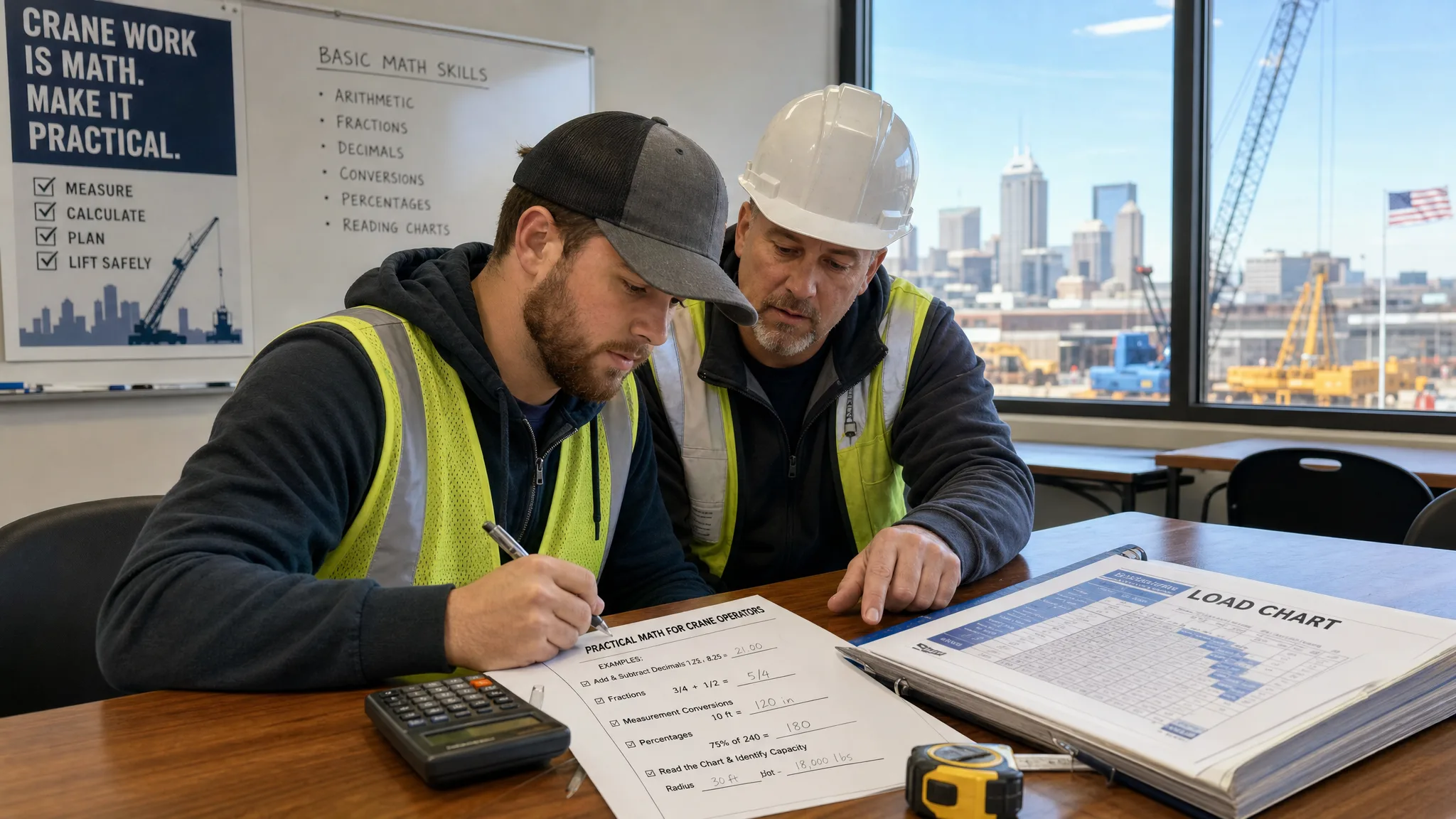
Basic math for crane operators is practical because it supports accurate reading, checking, and decision-making. It is often less about completing a complicated formula and more about using the right information in the right way.
Fractions and decimals
Fractions and decimals appear in measurements, dimensions, drawings, equipment information, and training exercises. A student may need to recognize that 1/2 inch and 0.5 inch describe the same length, or compare dimensions that are written in different formats.
The important habit is accuracy. If a measurement is given in feet and inches, the candidate should not casually treat it as a decimal number without confirming the conversion. If a drawing or document uses decimals, the candidate should be able to read each digit correctly and avoid unnecessary rounding.
In crane-related work, “close enough” is not a safe planning method. When a measurement affects equipment setup, clearance, capacity information, rigging selection, or a planned lift, workers need to use the stated information and follow the applicable procedures.
Measurement reading
Reading a tape measure is a useful skill for workers entering crane operator training, rigger training, or material-handling work. Candidates may encounter dimensions in feet and inches, fractional inch measurements, marked distances, component sizes, and basic jobsite drawings.
For example, a candidate should be able to identify whether a listed distance is 14 feet 6 inches, 14.6 feet, or 14 inches 6/10 of an inch. Those are not interchangeable descriptions. Learning to slow down and verify the unit is part of safe information handling.
Unit conversions
Conversions may include moving between inches and feet, comparing values written in feet-and-inches format with decimal feet, or confirming that the units used in a training problem match the units used in a reference chart.
A useful basic example is remembering that 12 inches equals 1 foot. A dimension of 30 inches can be expressed as 2 feet 6 inches. The goal is not to memorize every possible conversion. It is to recognize when units differ, use an accurate method to convert them, and verify the result before acting on it.
Percentages and proportional thinking
Some preparation materials and job-related discussions may include percentages or comparisons. Candidates should be comfortable understanding what a percentage represents and recognizing that numbers must be read in context.
For instance, a percentage is not automatically a capacity decision, a rigging decision, or permission to proceed. Safe crane work requires workers to use the correct manufacturer information, work procedures, lift planning information, and direction for the actual task.
Chart and table reading
Chart reading is one of the most important practical skills in crane certification preparation. A candidate may know how to multiply and divide but still make a serious error by selecting the wrong row, overlooking a footnote, using the wrong configuration, or missing an equipment limitation.
That is why crane load chart calculations should be viewed as an information-reading exercise as much as a math exercise. The process requires candidates to identify the equipment and configuration described, locate the relevant information, check notes and restrictions, and avoid assumptions.
Where Math Appears in Operator, Rigger, and Signal Person Preparation
The math and information-reading demands are not identical for every credential path. Candidates should choose training based on the role they want to perform rather than assuming that the same preparation fits every job.
Mobile crane operator preparation
Mobile crane operator preparation commonly includes crane load chart interpretation, equipment terminology, configuration details, operating radius, boom or jib information, and capacity-related concepts. The candidate may need to identify the correct chart for a stated crane setup and read the chart under the conditions presented in the training exercise.
A load chart is not a general estimate and should never be treated as a generic reference for every crane. The chart must match the actual equipment and configuration, and the operator must follow applicable notes, manufacturer instructions, employer procedures, and jobsite requirements.
In a controlled training example, a student might be asked to find a chart value based on a stated boom length and radius. The practical process includes locating the proper table, matching the stated conditions, confirming units, reading notes, and recognizing what the listed figure does and does not mean. The lesson is disciplined reasoning, not simply finding a number quickly.
Tower crane preparation
Workers considering tower crane training should expect equipment-specific terminology, operating practices, and preparation needs. Although practical math and careful reading remain important, the details of the equipment, work environment, and intended credential path may differ from mobile crane preparation.
Before enrolling, ask which course and credential path aligns with the equipment you expect to operate. Current official candidate materials and employer requirements should guide that conversation.
Rigger training
Rigger training can involve practical math and information-reading related to load weight, dimensions, center-of-gravity concepts, sling angles, hitches, rigging hardware, and capacity information. The work requires workers to understand that a number taken from a chart, tag, or reference material only applies under the conditions described.
For example, a rigger should not make a gear-selection decision based on a rough estimate, an incomplete load description, or a remembered capacity value. Proper rigging decisions require complete information, appropriate reference materials, and training that fits the assigned scope of work.
Workers comparing different rigging paths can review rigger training in Indiana for a clearer look at how basic and more advanced material-handling responsibilities may differ.
Signal person preparation
Signal person training focuses heavily on standardized communication, signal recognition, clear coordination, hazard awareness, and the responsibility to communicate effectively during lifting operations. It may not involve the same depth of load-chart work as an operator-focused path, but it still requires careful attention to the lift environment.
A signal person should understand that unclear conditions, unexpected hazards, incomplete instructions, or a loss of communication require action. Knowing when to stop a lift or seek clarification is a safety skill. It is not replaced by confidence, speed, or the ability to do math in your head.

If you are comparing job roles, review these crane courses for operator, rigger, and signal person goals before assuming that one credential is automatically the right fit.
Math Skills That Matter for Load Charts, Measurements, and Safe Decisions
Crane load chart calculations are often misunderstood as a long series of formulas. In many cases, the more important challenge is selecting and interpreting the correct information.
During crane certification training, a load-chart exercise may require a candidate to:
- Confirm the crane model or chart family used in the exercise.
- Identify the stated configuration, such as boom length, attachment, outrigger position, counterweight, or other listed factors.
- Read the operating radius in the correct unit.
- Locate the applicable row and column on the chart.
- Read all related chart notes, warnings, and restrictions.
- Distinguish between the question being asked and information that is not applicable.
- Check the answer instead of relying on a quick guess.
A candidate can make an error even with perfect arithmetic if the wrong chart is used or a restriction is overlooked. Likewise, a candidate who needs to refresh fractions or conversions can often improve with focused practice. The safer mindset is to treat each number as part of a larger set of conditions, not as a stand-alone answer.
Use approved information, not memory
On an actual job, workers should use the applicable equipment documentation, lift planning information, workplace procedures, and direction required for the task. A training problem is not permission to use a remembered chart value or a generic rule on a live lift.
This point is especially important in Indianapolis construction, industrial, manufacturing, logistics, and material-handling environments, where jobsite conditions can change. Pressure to move faster is never a reason to proceed with incomplete lift information, mismatched units, uncertain rigging details, or unclear communication.
How to Prepare if You Are Rusty on Fractions or Conversions
Being rusty is common. The better question is not whether you were naturally strong in school math. It is whether you can identify the practical skills you need to review and practice them carefully.
Start with a practical self-check
Before reserving a crane certification training seat, try these basic tasks:
- Read common fractional marks on a tape measure.
- Add and subtract whole numbers and decimals.
- Recognize common fractions such as 1/2, 1/4, 3/4, and 1/8.
- Convert a stated number of inches into feet and inches.
- Compare two measurements expressed in different formats.
- Find information in a table by matching the correct row and column.
- Explain why a chart number only applies when the stated conditions match.
If one of these tasks feels difficult, write down exactly where the problem occurred. Was the issue arithmetic, fractions, unit conversion, reading directions, or keeping track of several conditions at once? That detail helps you focus your review instead of treating “math” as one large, vague obstacle.
Build review habits that support safe work
Use a written process when practicing. Rather than doing every step mentally, write down the original measurement, the units, the conversion method, and the result. Then check it.
Develop these habits early:
- Confirm the unit attached to every measurement.
- Do not round or estimate when exact information is needed.
- Read chart headings before selecting a value.
- Read notes and footnotes before relying on a chart entry.
- Check that the chart or table matches the stated equipment conditions.
- Stop and ask for clarification when the information is incomplete.
For first-time students, a useful school conversation should explain how practical math review, classroom study, written exam preparation, and hands-on learning fit together. See crane certification classes for first-time students for questions that can help you evaluate the process before enrolling.
Questions to ask about study resources
When comparing crane operator training in Indianapolis, ask directly about preparation support. There is no benefit to hiding concerns about fractions, chart reading, or conversions until the course begins.
- Which practical math and measurement topics should I review before class?
- Are study materials or recommended review topics available before the course?
- How does the course approach crane load chart interpretation?
- Which current official NCCCO candidate materials should I read for my intended path?
- How are classroom instruction, exam preparation, and practical training connected?
- What role is the course designed for: operator, rigger, signal person, or another credential path?
- What equipment exposure or practical training opportunities should I expect to discuss?
It is also reasonable to ask how much practical learning is part of the overall preparation. Written knowledge matters, but it should be connected to equipment awareness, role responsibilities, and safe decision-making. This guide to choosing a crane operator school with practical training time offers useful questions about equipment access, hands-on learning, and exam preparation.
What Math Ability Does Not Replace: Training, Practice, and Safety Judgment
Strong math skills do not make someone a qualified crane operator, rigger, or signal person by themselves. A worker also needs appropriate role-specific training, familiarity with responsibilities, awareness of hazards, communication skills, and direction that matches the equipment and work being performed.

Certification preparation should not be treated as a shortcut around experience, employer requirements, equipment-specific familiarization, or workplace procedures. Passing an examination is important, but it is not the only part of readiness for a safety-sensitive role.
Safe crane work depends on a worker’s ability to recognize what is known, identify what is missing, use the correct reference materials, communicate clearly, and stop when conditions do not support a safe lift. Math supports those decisions; it does not replace them.
For current requirements and authoritative guidance, consult official NCCCO examination materials and OSHA resources, including OSHA’s crane, derrick, and hoist safety resources. Employers may also have job-specific expectations that go beyond a course outline or general certification preparation discussion.
How Indianapolis Candidates Can Choose the Right Preparation Path
Indianapolis-area candidates should start by defining the role they want to pursue. Are you interested in mobile crane operator work? Are you already around lifting operations and considering rigger or signal person responsibilities? Are you an employer arranging preparation for workers with different duties?
Your answer changes what you should review. An operator candidate may need more preparation around equipment information and crane load charts. A rigger candidate may need to focus on dimensions, weights, rigging concepts, and capacity information. A signal person candidate may need to prioritize communication, standardized signals, and site awareness while still understanding their place in the lift process.
Employers should avoid assuming every worker needs the same credential or the same depth of preparation. Match the training conversation to actual assigned duties, work environment, equipment exposure, and employer expectations. A worker who connects loads may need a different path from a worker assigned signal person duties, and both may differ from someone pursuing crane operator responsibilities.
Before choosing a course, review the current official requirements, identify any math or information-reading areas that need attention, and ask how the training path relates to your intended role. That approach is more useful than choosing the most advanced-sounding course title without considering the work you expect to perform.
Frequently Asked Questions About Crane Certification Math Requirements
Do I need algebra or advanced math to begin crane certification training?
Advanced math is not usually the main starting requirement for crane certification training. Candidates should expect practical arithmetic, fractions, decimals, measurements, conversions, and chart or table reading. Exact requirements can vary by credential, examination, employer, and work setting, so review current official NCCCO information for your intended path.
What kinds of math are used on crane operator certification exams and in training?
Crane certification preparation may involve arithmetic, common fractions, decimals, measurement conversions, percentages, chart reading, and table interpretation. Operator-focused preparation often includes load-chart interpretation. The purpose is to use job-related information accurately and make safer decisions, not to complete advanced academic math problems.
Can I take crane training if I struggle with fractions, decimals, or unit conversions?
Many candidates can strengthen these skills through focused review and practice. Be honest about where you need help, whether it is reading a tape measure, converting units, following chart notes, or keeping track of multiple conditions. Do not ignore the issue, because precision and careful reading matter in safety-sensitive work.
Is the math different for crane operator, rigger, and signal person credentials?
Yes, the emphasis can differ. Operators may work more directly with equipment capacity information and load charts. Riggers may encounter load weight, dimensions, sling-angle concepts, hitches, hardware, and capacity-related information. Signal persons focus heavily on communication and signaling responsibilities, although they must still understand the importance of changing conditions and coordinated lift activity.
What should I review before enrolling in crane certification preparation in Indianapolis?
Review basic arithmetic, common fractions, decimals, tape-measure reading, simple unit conversions, and chart or table reading. Review current official candidate information for your intended credential, then prepare questions about course content, study resources, practical training, and the job role you want to pursue.
Ask About Your Readiness Before Reserving a Course Seat
Math should not become a vague barrier that keeps a capable worker from exploring crane certification training. The practical question is whether you can read measurements, work carefully with numbers, follow charts and instructions, and commit to reviewing the areas where you need more confidence.
If you are unsure whether your current math skills fit your intended operator, rigger, or signal person path, call Train For The Crane at (317) 385-7190. Ask what practical skills to review before reserving a course seat and which preparation path fits the work you want to do in Indianapolis or elsewhere in Indiana.