

Why Knowing the Different Types of Fall Arrest Systems Could Save Your Life
The different types of fall arrest systems fall into two main categories:
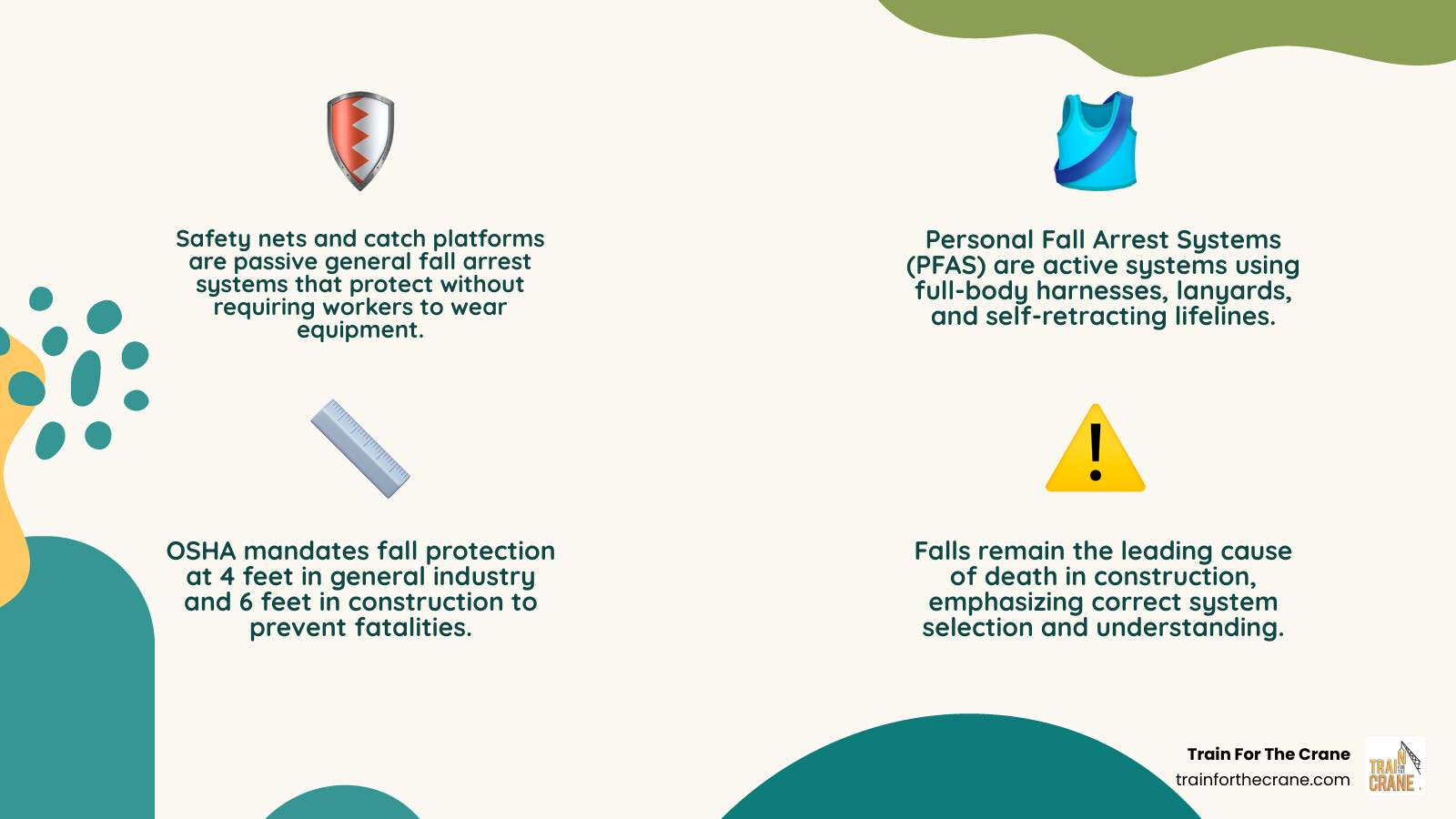
- General (Passive) Fall Arrest Systems – Safety nets and catch platforms that protect workers without requiring them to wear or attach anything
- Personal (Active) Fall Arrest Systems (PFAS) – Body-worn systems including full-body harnesses, lanyards, self-retracting lifelines, and anchorage connectors that stop a fall after it begins
Falls are the leading cause of death in construction. Yet many workers — even experienced ones — aren’t clear on which type of fall protection system they’re actually using, or why it matters.
There’s a big difference between a system that prevents a fall and one that stops you mid-fall. Mixing those up isn’t just a compliance problem. It’s a life-safety issue.
OSHA requires fall protection starting at just 4 feet in general industry and 6 feet in construction. Once you’re working at those heights, the type of system you choose — and how well you understand it — determines what happens if something goes wrong.
This guide breaks down every major fall arrest system type, how each one works, what the regulations require, and how to inspect and use them correctly.
Related content about different types of fall arrest systems:
Understanding the Hierarchy of Fall Protection
When we talk about working at heights, we always look at the “Hierarchy of Fall Protection.” This is a tiered approach to safety that prioritizes the most effective methods first. Think of it like a ladder: you want to stay as close to the top as possible.

- Hazard Elimination: The gold standard. If you can do the work on the ground, do it there.
- Fall Prevention (Passive): Using physical barriers like guardrails or covers.
- Travel Restraint (Active): Using a tether to prevent you from reaching the edge.
- Work Positioning: Holding you in place while you work (like on a rebar wall).
- Fall Arrest: The “last resort” that stops you after you’ve already slipped.
Fall Prevention vs. Fall Arrest
It is a common mistake to use these terms interchangeably, but they are very different animals. Fall prevention systems are typically passive. They don’t require the worker to do anything special once they are installed. A guardrail doesn’t care if you’re wearing a harness; it simply blocks you from the edge.
Fall arrest, on the other hand, is an active system. It involves a “Personal Fall Arrest System” (PFAS) where the worker must actively put on equipment and “tie off.” While prevention stops the fall from happening, arrest is designed to safely stop a person who is already in mid-air.
| Feature | Fall Prevention | Travel Restraint | Fall Arrest |
|---|---|---|---|
| System Type | Passive (usually) | Active | Active |
| Worker Action | None required | Must clip in | Must clip in |
| Fall Distance | 0 feet | 0 feet | Up to 6 feet |
| Risk Level | Lowest | Low | High |
The Role of Travel Restraint Systems
A travel restraint system is often the “sweet spot” of safety. It uses a harness and a fixed-length lanyard attached to an anchor. The key here is the length: the lanyard is short enough that you physically cannot reach the “unprotected side or edge.”
Under OSHA 1910 Subpart D, travel restraint is categorized as a system that prevents the user from falling any distance. Because there is no “drop,” the equipment doesn’t need to be as beefy as fall arrest gear. For instance, a travel restraint lanyard only needs to withstand 800 lbs of force, whereas a fall arrest lanyard must withstand a 5,000 lb dead weight.
The ABCDEs of a Personal Fall Arrest System
If you find yourself in a situation where you must use a PFAS, you need to remember your ABCDEs. If any one of these components is missing or fails, the whole system is compromised.
- A – Anchorage: The secure point of attachment (the “tie-off” point).
- B – Body Wear: The full-body harness worn by the worker.
- C – Connectors: The devices that link the harness to the anchor (lanyards, snap-hooks).
- D – Deceleration: The shock absorber that slows you down and reduces the force on your body.
- E – Emergency Plan: A written plan for how to get you down if you fall.
Determining the right setup often requires a fall protection qualified person to design the system, especially when dealing with complex horizontal lifelines.
Essential Components of Different Types of Fall Arrest Systems
When we look at different types of fall arrest systems, the hardware changes based on the job.
- Full-Body Harness: This is the only acceptable body wear for fall arrest. It must have a dorsal D-ring (between the shoulder blades).
- Shock-Absorbing Lanyards: These feature an internal “rip-stitch” that expands during a fall to keep the arresting forces below 1,800 lbs.
- Self-Retracting Lifelines (SRL): These work like a car seatbelt. They allow for movement but lock instantly if a fall occurs, significantly shortening the fall distance.
- Anchorage Strength: OSHA is very strict here. An anchor must be capable of supporting 5,000 lbs per employee attached, or be designed by a qualified person as part of a complete system with a safety factor of two.
Why Full-Body Harnesses Replace Body Belts
In the old days, workers used body belts. We don’t do that anymore for fall arrest. Why? Because if you fall while wearing a belt, the force is concentrated entirely on your midsection. This can cause internal organ damage or even snap your spine.
A full-body harness (Type I) is designed to distribute those massive forces across your shoulders, chest, pelvis, and thighs. It keeps you upright after a fall, which is critical for preventing suspension trauma. Body belts are now relegated to “Type II” status—meaning they are only for positioning or restraint, never for stopping a fall.
Exploring Different Types of Fall Arrest Systems
Safety isn’t one-size-fits-all. Depending on the site—whether it’s a warehouse in Danville or a construction site in Indianapolis—we use various different types of fall arrest systems.
Passive General Fall Arrest Systems
Passive systems protect everyone in the area without them needing to “hook up.” The most common example is the safety net. These are often used in bridge construction or high-rise steel erection where it’s impractical for every worker to be tied off.
To ensure they actually work, safety nets must pass a “drop test.” We drop a 400-pound bag of sand into the net to ensure it can catch a 75kg person without breaking or hitting the ground below.
Active Personal Fall Arrest Systems
These are the systems we most commonly train operators and riggers to use.
- Vertical Lifelines: A rope or cable that hangs down, allowing a worker to move up and down (like on a ladder) using a “rope grab” device that locks during a fall.
- Horizontal Lifelines (HLL): These consist of a cable strung between two anchors. They allow workers to move across a large area while remaining tied off. These are complex because a fall in the middle of the cable creates massive “leverage” forces on the end anchors.
- Specialized Harnesses: Not all harnesses are nylon. If you are welding, you need a heat-resistant Kevlar harness. If you’re an electrical utility worker, you need an arc-flash rated harness that won’t melt or conduct electricity.
OSHA Requirements and Fall Clearance Calculations
OSHA doesn’t just suggest fall protection; they mandate it based on your industry. In Indiana, we follow federal OSHA standards:
- General Industry: 4 feet
- Shipyards: 5 feet
- Construction: 6 feet
- Longshoring: 8 feet
However, if you’re working over dangerous machinery or open vats of chemicals, you need protection regardless of the height.
Calculating Clearance for Different Types of Fall Arrest Systems
This is where most people “trip up.” You can’t just clip a 6-foot lanyard to your feet and assume you’re safe. You have to calculate the Fall Clearance.
If you use a 6-foot lanyard, you have to account for:
- Lanyard Length: 6 feet.
- Deceleration Distance: Up to 3.5 feet (the shock absorber stretching).
- Worker Height: Usually 6 feet.
- Harness Stretch: About 1 foot (the D-ring moving up).
- Safety Factor: 2 feet of “buffer” so you don’t kiss the concrete.
Total? About 18.5 to 20 feet. If you are only 12 feet off the ground, a standard 6-foot lanyard will not stop you before you hit the floor. In those cases, you must use an SRL.
Anchorage Point Specifications and Strength
Your anchor is your lifeline—literally. It must have a minimum strength of 12kN (about 2,700 lbs) if certified by a professional, or 5,000 lbs if it’s a “non-certified” anchor (like a structural steel beam).
We often use mobile anchors like beam clamps or anchor slings for temporary setups. Just remember: a “qualified person” must oversee the design of these systems to ensure the structure can actually handle the load of a falling worker.
Inspection, Maintenance, and Emergency Rescue
Your gear is exposed to sun, rain, and dirt. It won’t last forever. You must perform a pre-use inspection every single time you put the harness on. Look for frayed webbing, burnt fibers, or “pulled” stitch patterns that indicate the harness has already been in a fall.
A competent person must perform a more thorough, documented inspection at least every six months. If a piece of equipment has been involved in a fall, it must be removed from service immediately and destroyed (cut it up so no one else tries to use it).
Training Requirements and the Competent Person
You can’t just hand a guy a harness and say, “Good luck.” OSHA requires fall-protection-training for anyone working at heights. This training covers hazard recognition and the proper use of equipment.
A “Competent Person” is someone who can identify hazards and has the authority to stop work to fix them. After completing the right course, you can earn a fall-arrest-training-certificate to prove you know your stuff.
Rescue Planning and Suspension Trauma
What happens after the fall? If you are hanging in a harness, you are in danger of suspension trauma. This happens when the leg loops cut off blood flow from your legs back to your heart. It can be fatal in as little as 15 to 30 minutes.
Every site needs a comprehensive fall rescue training plan. This might include:
- Self-Rescue: Using “relief straps” (little stirrups you deploy to stand up in your harness).
- Mechanical Retrieval: Using a winch or a crane-suspended personnel platform to get you down.
- Assisted Rescue: Using a ladder or lift to reach the fallen worker.
Frequently Asked Questions about Fall Protection
What is the difference between a competent person and a qualified person?
A Competent Person is trained to recognize existing hazards and has the authority to correct them. A Qualified Person usually has a degree or professional standing (like an engineer) and is capable of designing the systems, such as calculating the loads on a horizontal lifeline.
When must a fall arrest system be removed from service?
Immediately if it has been subjected to a fall, or if an inspection reveals damage like cuts, tears, heavy abrasion, chemical burns, or distorted D-rings. There is no universal “expiration date,” but most manufacturers suggest a 5-year limit for heavy use.
Can I use a body belt for fall arrest?
Absolutely not. Body belts are strictly for positioning (keeping you in place while you work) or travel restraint. Using one for fall arrest can lead to severe internal injuries or death during the “arrest” phase of a fall.
Conclusion
At Train For The Crane, we’ve seen how the right knowledge prevents tragedies. Whether you’re a rigger in a manufacturing plant or a crane operator on a busy construction site, understanding the different types of fall arrest systems is part of being a professional.
Our experienced instructors bring over 30 years of combined experience to our on-site NCCCO training. We don’t just help you pass the exam; we make sure you and your crew go home safe every night. From identifying the right anchor point to calculating complex fall clearances, we provide the proven methods that lead to high pass rates and safer job sites.
Ready to take your safety and career to the next level? Elevate your career with professional crane and rigging training