

Why Rock Drill Operator Training Is Your Gateway to a High-Demand Career
Rock drill operator training teaches you to safely set up, inspect, and operate heavy-duty drilling equipment used in construction, mining, foundation work, and pipeline projects.
Here’s what you need to know at a glance:
- Who it’s for: New and experienced operators in construction, mining, quarrying, and pipeline industries
- What you’ll learn: Equipment types, safety protocols, pre-operation inspections, drilling techniques, and emergency procedures
- Key certifications: NCCCO Foundation Drill Rig (FDR) and NCCCO Anchor/Micropile (AMP)
- Certification validity: NCCCO certifications are valid for 5 years; some regional licenses require renewal every 2 years
- Core exam format: Written Core exam (90 questions) + Specialty exam (45 questions) + Practical exam
- Career paths: Foundation drilling, surface mining, geotechnical drilling, pipeline, and commercial construction
Rock drills are powerful tools. They use a combination of percussive force and rotary action to break through rock and hard ground. That power creates real risks — silica dust, noise-induced hearing loss, flying debris, and high-pressure hydraulic lines are all part of the job.
That’s exactly why formal training matters.
Regulatory bodies and employers have identified a clear need for standardized operator training. Without it, operators face preventable injuries — and employers face serious liability. With it, you become a safer, more hireable, and more confident professional.
Whether you’re entering the field for the first time or looking to get certified after years of hands-on experience, this guide walks you through everything: equipment types, safety requirements, certification programs, and how to build a long-term career in drilling.
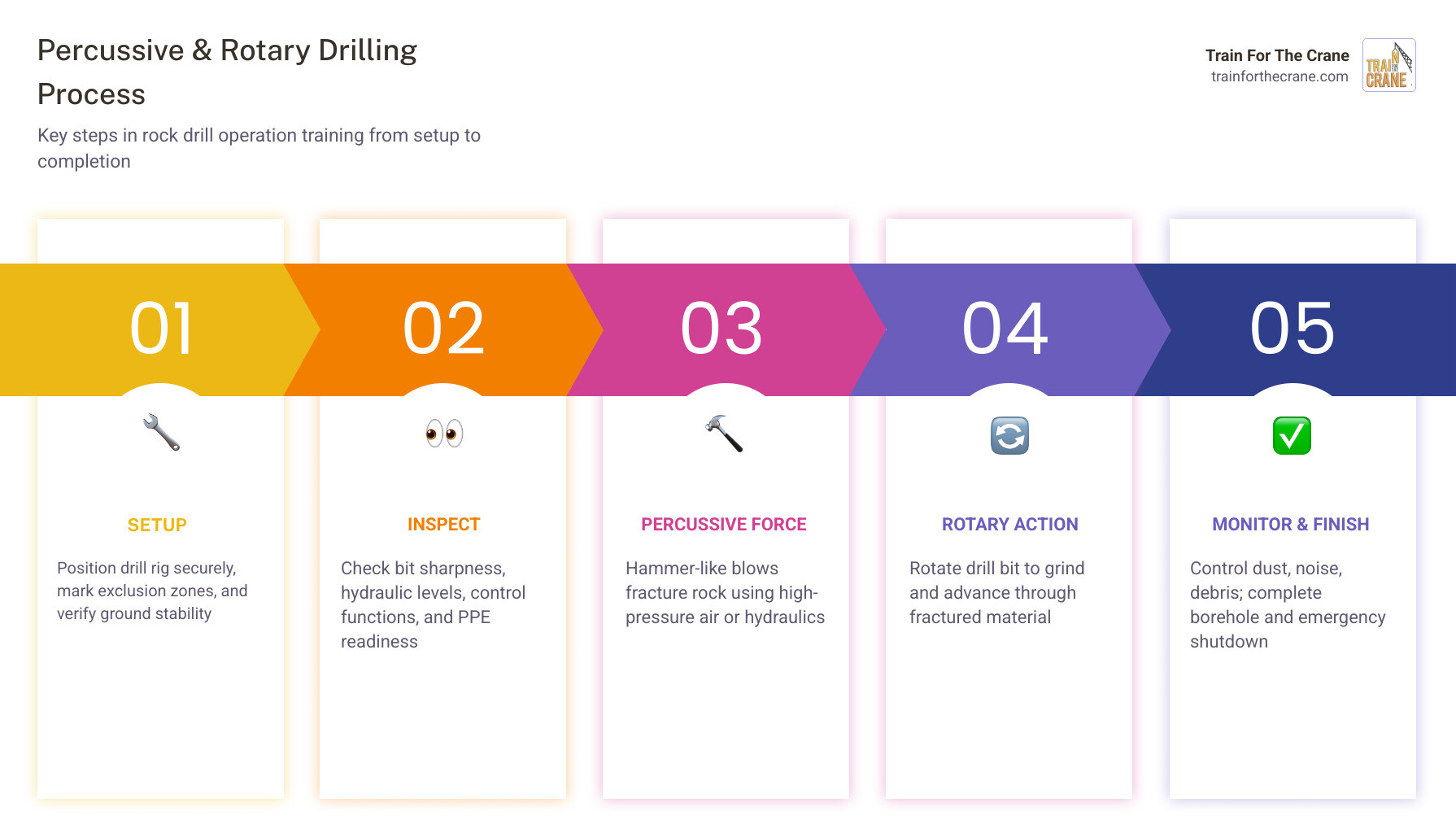
Rock drill operator training terms made easy:
Understanding Equipment Types and Rock Drill Operator Training
To become a master of the job site, we first need to understand the beast we’re operating. A rock drill isn’t just a giant jackhammer; it is a sophisticated piece of engineering designed to penetrate the toughest geological formations on earth. Most modern drill-rig setups utilize a combination of rotary action (turning the bit) and percussive force (hammering the bit) to pulverize rock into manageable cuttings.
When you undergo drill-rig-training, you will encounter three primary power sources for these machines:
- Pneumatic Drills: These are powered by compressed air. You’ll often see these in quarrying or surface mining. They are rugged and reliable, though they require massive compressors to keep them running.
- Hydraulic Systems: These use pressurized fluid to provide a high power-to-weight ratio. They are generally more efficient and quieter than pneumatic drills, making them a favorite for foundation work in urban areas.
- Electric Rock Drills: While less common on surface construction sites, these are vital in underground mining where air quality is a major concern and exhaust from diesel or gas engines isn’t an option.
Understanding these power sources is the first step in rock drill operator training. Each system has its own maintenance needs and safety quirks—for instance, a pinhole leak in a hydraulic line can be far more dangerous than a leak in an air hose due to high-pressure injection risks.
Primary Drill Mechanisms
The industry categorizes drills based on how they move and what they are designed to build. In our experience, knowing the right tool for the job is half the battle.
- Air-Track Drills: These are crawler-mounted units that generally drill 4 to 4.5-inch holes. They are incredibly mobile on rough terrain.
- Rotary Drills: These can be mounted on trucks, trailers, or crawlers. They use massive bits (up to 26 inches in diameter!) and are the workhorses of large-scale surface mining and deep foundation projects.
- Hand-Held Units: Used for smaller tasks or in tight spaces where a rig can’t reach. Don’t let the size fool you—they still pack enough punch to cause serious vibration-related injuries if not handled correctly.
- Foundation Drilling Rigs: These are specialized for creating the deep “legs” that hold up skyscrapers and bridges. If you want to go from zero to hero, mastering these rigs is a fantastic career move.
Essential Safety Protocols and Hazard Mitigation
Safety isn’t just a chapter in a manual; it’s the most important skill we teach. Rock drilling is inherently violent—you are literally exploding or crushing rock inches away from where you stand.
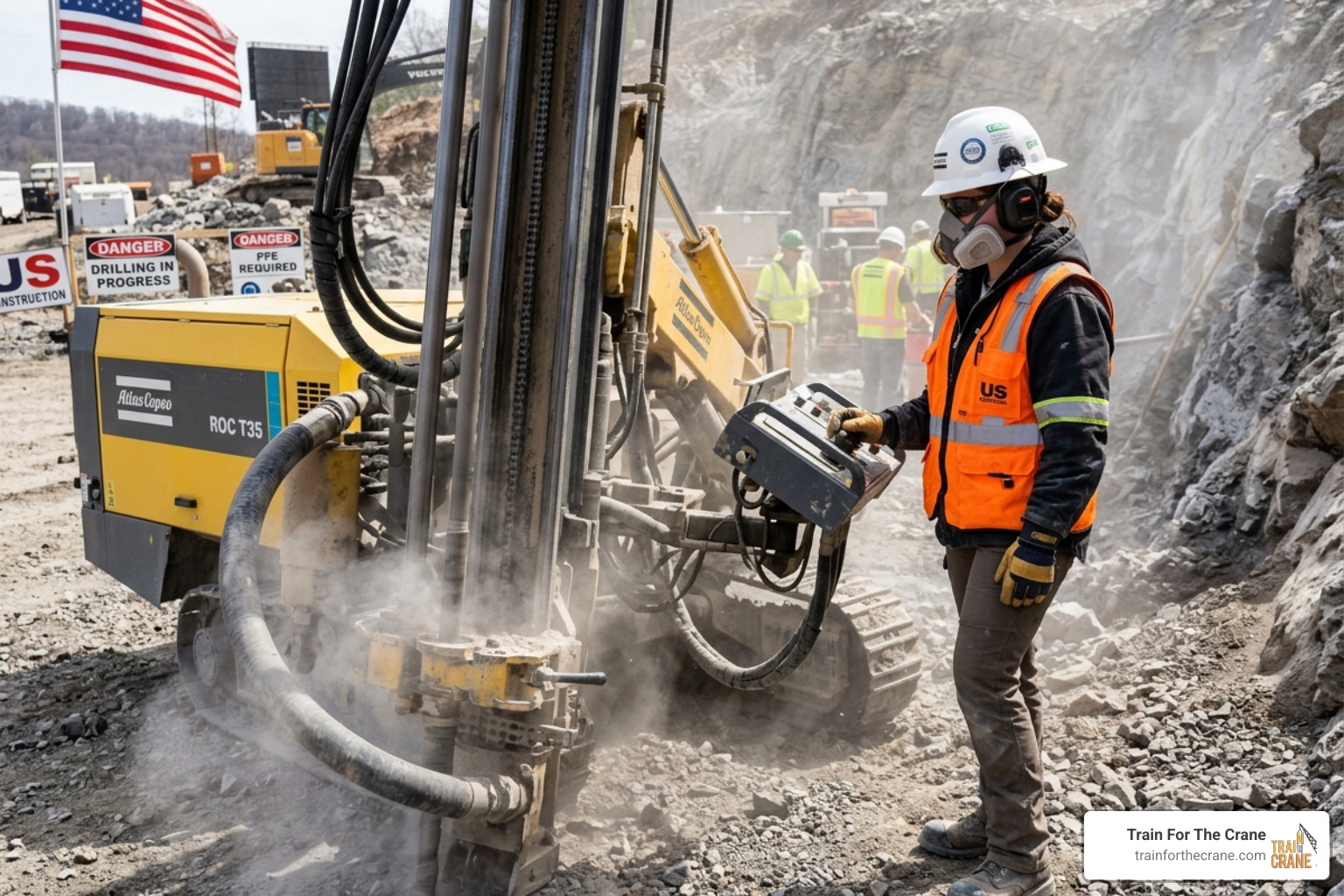
The hazards are real, but they are manageable. Here are the “Big Four” we focus on during rock drill operator training:
- Silica Dust: Drilling into rock produces fine dust containing crystalline silica. If you breathe this in, it stays in your lungs forever. We mitigate this using water suppression systems or specialized dust collectors.
- Noise-Induced Hearing Loss: Rock drills are loud—period. Constant exposure without protection will lead to permanent hearing damage.
- Flying Debris: Shrapnel from the rock face or a failing drill bit can travel at high speeds.
- High-Pressure Lines: Hydraulic and air lines can whip or spray if they fail.
Hazard Comparison and Mitigation Table
| Hazard Type | Primary Risk | Mitigation Step |
|---|---|---|
| Respirable Dust | Silicosis / Lung Disease | Water sprays or dust extraction systems |
| Excessive Noise | Permanent Hearing Loss | Dual hearing protection (plugs + muffs) |
| Moving Parts | Being caught in/struck by | Guarding and strict exclusion zones |
| High-Pressure Lines | Injection injuries / whipping | Regular hose inspections and whip checks |
Personal Protective Equipment for Rock Drill Operator Training
You wouldn’t go into a storm without a coat, and you shouldn’t step onto a drill site without your “armor.” For a dedicated pile driver or rock drill operator, PPE is non-negotiable.
- Respirators: Specifically N95 or higher rated for silica dust.
- Hearing Protection: High-NRR rated muffs or earplugs.
- Steel-Toed Boots: Must be slip-resistant and provide ankle support.
- Heavy-Duty Gloves: To protect against sharp rock fragments and pinch points.
- Hard Hats: To protect against falling objects from the mast or highwalls.
Emergency Procedures and Site Safety
If things go wrong, you don’t have time to look up the manual. We train operators to react instinctively. This includes knowing the location of the emergency shutdown switch (the quickest way to kill the machine) and understanding lightning protocols. If you see lightning, you stop drilling and move away from the mast—it’s a giant lightning rod, after all!
One of the most critical safety rules involves power lines. According to OSHA standards, you must maintain a minimum distance (usually 20 feet for lines up to 350kV) to prevent electrocution. If your rig does contact a line, the rule is simple: Stay on the rig. If you must jump, jump clear so you never touch the machine and the ground at the same time. This is a core part of pile-driver-training and drill rig safety.
Pre-Operation Inspections and Site Preparation
A professional operator starts their day with a walk-around. We don’t just kick the tires; we look for the small defects that turn into big accidents.
Your daily checklist should include:
- Hydraulic Fluid Levels: Checking for leaks or contamination.
- Bit Sharpness: A dull bit doesn’t just drill slower; it puts unnecessary stress on the entire rig.
- Control Checks: Ensuring every lever and button does exactly what it’s supposed to do.
- Ground Stability: Ensuring the rig is on a level, compacted surface so it doesn’t tip during operation.
- Utility Marking: Calling “811” or the local utility locator 2-3 days before you break ground.
Before the first hole is drilled, we also conduct a Job Safety Analysis (JSA). This is where the crew sits down to discuss the specific risks of this site on this day.
Technical Skills in Rock Drill Operator Training
Once the safety checks are done, the real work begins. Modern rock drill operator training covers technical maneuvers that require precision and a bit of “feel” for the machine.
- Slurry Drilling: Using mineral or polymer fluids to keep a hole open in unstable soil. You’ll learn to test viscosity, pH, and sand content.
- Cased Holes: Installing steel casing to prevent the hole from collapsing while you drill deeper.
- Rigging Fundamentals: Safely hoisting and moving heavy drill steels and tools.
- Bore-hole Alignment: Using levels and sensors to ensure the hole is perfectly vertical (or angled, depending on the specs).
If you’re looking for drilling rig training schools, ensure they offer hands-on time with these specific techniques. Theory is great, but you need to feel the rig react when it hits a hard shelf of limestone.
Certification Pathways and Career Opportunities
In today’s industry, being “good with a rig” isn’t enough. You need the credentials to prove it. The most recognized certifications in the United States come from the National Commission for the Certification of Crane Operators (NCCCO). They offer two specific designations:
- Foundation Drill Rig (FDR)
- Anchor/Micropile Drill Rig (AMP)
To get certified, you’ll need to pass a written Core exam, a Specialty written exam, and a Practical exam. The practical exam is a timed test where you demonstrate skills like tool positioning, drilling passes, and safe shutdown.
Professional training programs are often developed in partnership with industry leaders to ensure the curriculum matches what’s actually happening on job sites. These programs focus on the technical and safety standards required to pass national exams and operate safely in the field.
Maintaining Compliance and Recertification
Once you have your CCO certification, it is valid for five years. To keep it, you’ll need to recertify. The good news? If you can document at least 500 hours of operating experience during those five years, you might be able to waive the practical exam and only take the written refresher.
However, don’t let your certification lapse! If it expires, there is no grace period. You’ll have to start the whole process over as a new candidate. Staying compliant with OSHA and MSHA (for mining) standards is what keeps our industry professional and safe.
Frequently Asked Questions about Rock Drilling
How much does rock drill operator training cost?
The cost varies depending on the depth of the program. For example, specialized intensive training programs can vary in price based on the length of the course and whether materials are included. Many employers will sponsor this training for their workers because the return on investment—fewer accidents and better productivity—is so high.
How often do drilling certifications need to be renewed?
As mentioned, NCCCO certifications follow a 5-year cycle. However, some specific sectors or regional jurisdictions require a license renewal every 2 years. Always check with your local regulatory body. If you haven’t operated a rig in over two years, we highly recommend a refresher course to get your “seat feel” back before jumping onto a major project.
What are the physical requirements for drill rig operators?
This is a physically demanding job. You don’t need to be an Olympic athlete, but you do need:
- Manual Dexterity: To handle controls and perform maintenance.
- Vision Standards: To see signals and monitor gauges.
- Lifting Ability: You should be able to lift at least 25kg (about 55 lbs) regularly.
- Coordination: To manage multiple controls while watching the mast.
- DOT Medical Card: Many employers require this to ensure you are fit for duty.
Conclusion
Operating a heavy-duty rock drill is a career of precision, power, and responsibility. It’s a job where you can see the literal foundations of our world being built because of your skill. But as we always say at Train For The Crane, the most important part of any machine is the operator.
By investing in professional rock drill operator training, you aren’t just learning to move levers; you are committing to a standard of safety excellence. Our experienced instructors have seen it all, and we use that 30+ years of combined knowledge to help our students achieve high pass rates on certification exams.
Ready to take the next step? Whether you’re aiming for your NCCCO FDR or AMP certification, we’re here to help you master the equipment and stay safe on the job. Start your drill rig operator career today and join the ranks of the most skilled professionals in the construction industry.