

Why Arizona Is One of the Best Places to Start Your Crane Operating Career
How to become a crane operator in Arizona is a straightforward process when you know the right steps — and the good news is that Arizona has no extra state-specific licensing requirements on top of national standards. At Train For The Crane, we specialize in bringing professional, on-site NCCCO training directly to your location in Arizona, ensuring your team meets national standards without the need for travel.
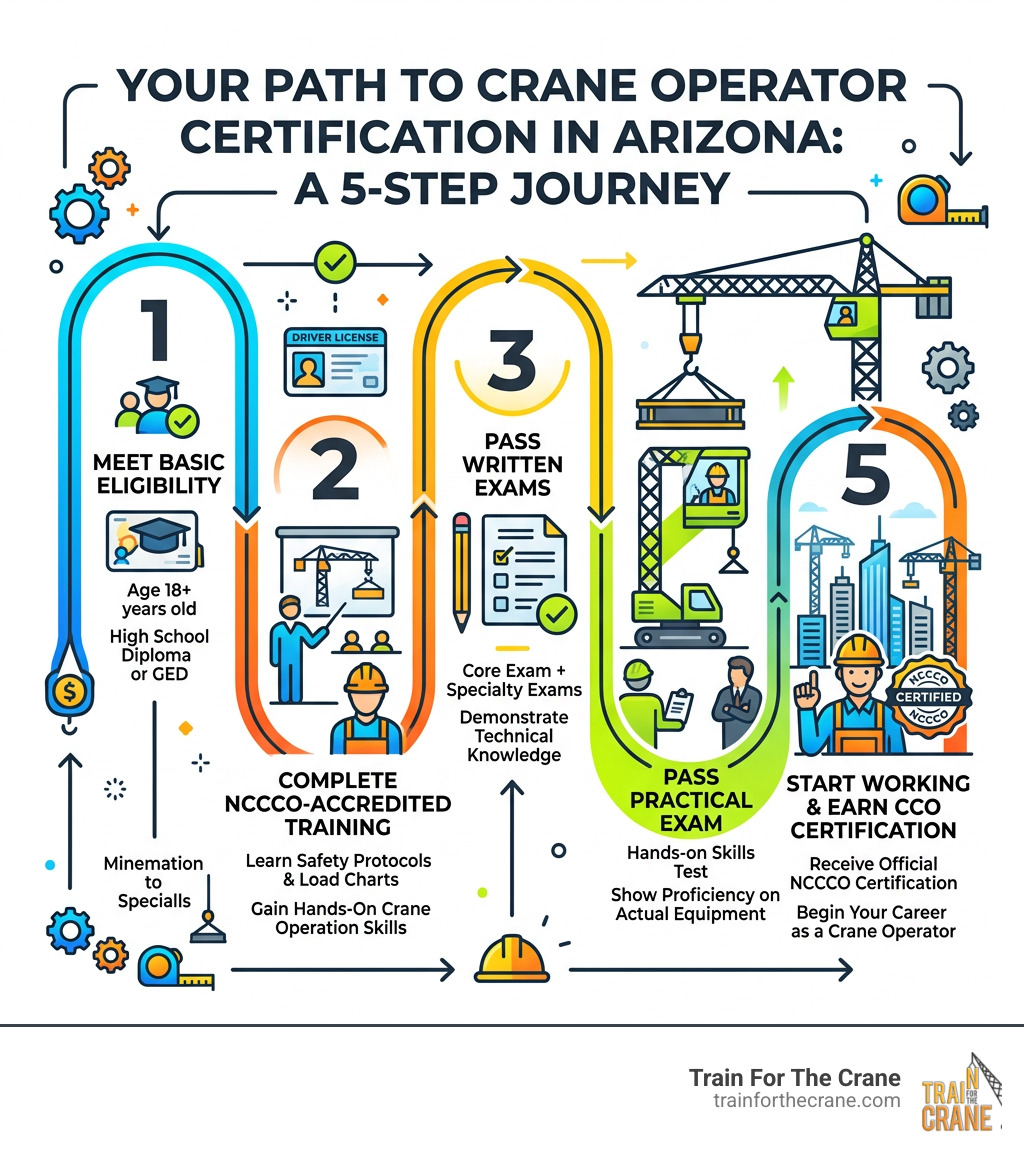
Here is a quick overview of the path:
- Meet basic eligibility — be at least 18 years old and have a high school diploma or GED
- Complete an NCCCO-accredited training program — covering safety, load charts, and hands-on crane operation
- Pass the NCCCO written exams — a core exam plus one or more specialty exams based on your crane type
- Pass the NCCCO practical exam — a hands-on skills test on actual equipment
- Start working — your NCCCO certification is valid for 5 years, then you recertify
That’s it. No state license. No extra Arizona-specific hoops to jump through.
Phoenix is booming. Tucson is growing. And across the state, large-scale infrastructure projects, industrial facilities, and high-rise developments are creating serious demand for skilled crane operators.
The average wage for crane and tower operators in Arizona sits around $26.87 per hour, with annual earnings ranging from $48,000 to $72,000 depending on experience and crane type. For a career you can enter in a matter of weeks — not years — those are strong numbers.
Whether you’re brand new to construction or already working in the trades and looking to level up, this guide walks you through everything you need to know.
How to become a crane operator in arizona vocab to learn:
- crane operator safety training
- how do you become a certified crane operator
- how long does it take to become a crane operator
Basic Requirements for How to Become a Crane Operator in Arizona
Before you jump into the cab of a multi-million dollar piece of machinery, you need to make sure you check the foundational boxes. The industry doesn’t just look for someone who can pull levers; they look for professionals who meet specific crane operator job requirements.
In Arizona, the baseline starts with age and education. You must be at least 18 years old. While you don’t need a college degree, a high school diploma or GED is typically required by both training providers and employers. Think of it as your “ticket to entry.”
Physical Fitness and Medical Standards
Operating a crane is mentally taxing and requires a high degree of physical coordination. Arizona follows the ASME B30.5 standards for physical qualifications. This means you’ll need to pass a medical exam, often resulting in a DOT medical card.
The requirements for crane operator safety include:
- Vision: At least 20/30 in one eye and 20/50 in the other (with or without glasses). You also need good depth perception and the ability to distinguish colors (those signal flags and lights matter!).
- Hearing: You must be able to hear adequate warning signals, even in a noisy construction environment.
- Coordination: Sharp hand-eye coordination and manual dexterity are non-negotiable.
- Substance Abuse Policy: The NCCCO has a strict substance abuse policy. Safety is the priority, so staying clean is a requirement of the job.
Lastly, you’ll need English proficiency. Since communication with riggers and signalpersons is vital for preventing accidents, you must be able to read, write, and speak English well enough to handle technical manuals and radio instructions.
The Step-by-Step Path to NCCCO Certification
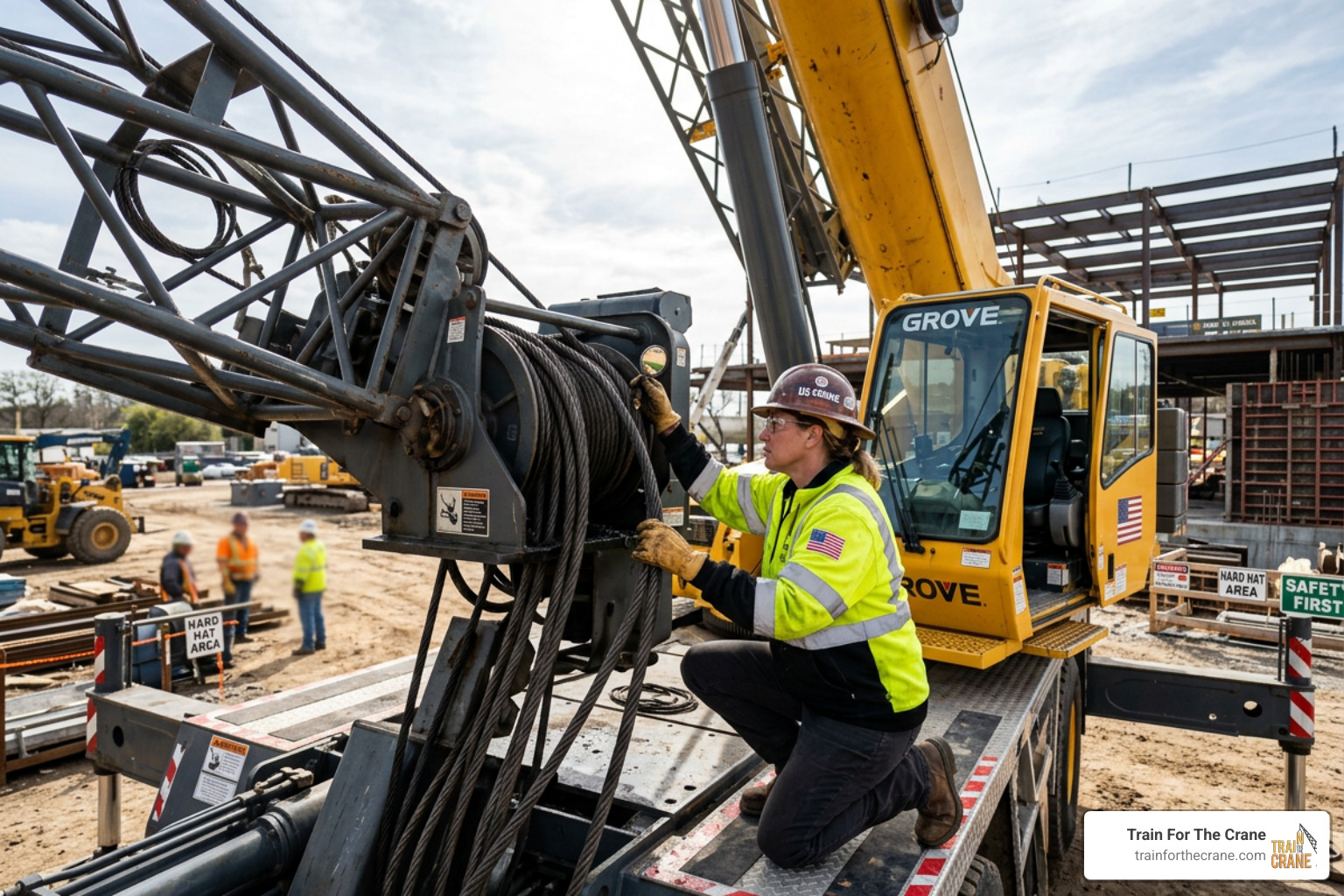
If you’re researching how to become a crane operator in Arizona, you’ll quickly find that the National Commission for the Certification of Crane Operators (NCCCO) is the gold standard. While some states have their own licensing boards, Arizona relies on this nationally accredited certification to satisfy OSHA requirements. Our on-site training model means we bring the expertise to you, whether you’re operating in the heart of Phoenix or the outskirts of Tucson.
The journey of how to become a crane operator usually follows a specific sequence of testing.
The Written Exams
You can’t just wing these. The written portion consists of a Core Exam and at least one Specialty Exam. Our nccco crane operator training complete guide details how the Core Exam tests your general knowledge of crane safety, site conditions, and basic operations. The specialty exams focus on the specific type of crane you intend to operate, such as telescopic booms or lattice booms.
The Practical Test
Once you’ve tackled the books, it’s time for the “sticks.” The practical exam is a hands-on test where an examiner watches you navigate a timed course. You’ll demonstrate your ability to control a load, catch a swing, and place a headache ball in a target area. It’s a test of precision and nerves.
Additional Qualifications: Rigger and Signalperson
In today’s market, being “just” an operator isn’t always enough. Many Arizona employers prefer (or require) that you also hold Rigger Level I or II and Signalperson certifications. Knowing how to get crane certification often involves bundling these skills together to make yourself more employable.
Your certification is valid for five years. To keep your seat in the cab, you’ll need to undergo recertification, which typically involves a written specialty exam and documenting at least 1,000 hours of crane-related experience during those five years.
How to Become a Crane Operator in Arizona: Choosing Your Specialization
Arizona’s landscape offers a variety of work, and different projects require different “iron.”
- Mobile Cranes: These are the workhorses of the desert. From rough terrain cranes in the mines to all-terrain cranes on Phoenix highway projects, mobile crane operators are always in demand.
- Tower Cranes: Look at the skyline of downtown Phoenix or the University of Arizona in Tucson, and you’ll see tower cranes. These require specialized training for high-rise construction.
- Overhead and Articulating Booms: Common in manufacturing and delivery services, these cranes often require separate certifications but offer steady, localized work.
- Service Truck Cranes: If you’re interested in utilities or telecommunications, becoming certified on service truck cranes is a great niche.
How to Become a Crane Operator in Arizona: Passing the Exams
Preparation is the difference between a passing grade and a retake. We focus heavily on load charts, which are the “math” of crane operation. You must be able to calculate exactly how much weight a crane can lift at a specific radius and boom angle.
Our nccco crane certification complete guide emphasizes that you must also master OSHA standards and ASME rules. You’ll learn about site evaluation—checking the ground for stability and looking out for those dangerous power lines. Technical knowledge isn’t just about the machine; it’s about the environment around it.
Arizona Regulations, CDL Needs, and Safety Standards
In the Grand Canyon State, safety is governed by federal OSHA 1926.1427 standards, which are enforced locally by ADOSH (Arizona Division of Occupational Safety and Health).
One of the most common questions we get regarding how to become a crane operator in Arizona is: “Do I need a CDL?”
The answer is: It depends. If you are operating a mobile crane that travels on public roads, you will almost certainly need a Class A or Class B Commercial Driver’s License (CDL). However, if you are operating a stationary tower crane or an overhead crane inside a factory, a CDL is generally not required. We always recommend getting your CDL anyway—it makes you infinitely more valuable to an employer who needs to move equipment from Mesa to Flagstaff.
Our crane operator training requirements guide 2026 highlights that even after you get your NCCCO card, your employer still has a duty to evaluate you. OSHA requires employers to perform a “qualification” check to ensure you can operate the specific make and model of crane on their job site.
Salary Expectations and Job Outlook in the Grand Canyon State
Arizona is currently a hotspot for construction. With the massive semiconductor plants being built in the Phoenix area and infrastructure upgrades across the state, the job outlook is incredibly positive.
| Location | Entry-Level Salary (Est.) | Experienced Salary (Est.) |
|---|---|---|
| Phoenix | $52,000 | $78,000+ |
| Tucson | $48,000 | $72,000+ |
| Flagstaff | $46,000 | $68,000 |
On average, operators in Arizona earn about $26.87 per hour. If you specialize in tower cranes or large lattice boom cranes, those numbers can climb significantly. Beyond the base salary, many operators enjoy benefits like overtime, per diem for travel, and robust union or company retirement plans.
Frequently Asked Questions
How long does it take to become a certified crane operator?
If you attend a dedicated training program, the classroom and hands-on portion usually takes about 3 weeks. After that, you’ll schedule your NCCCO exams. Most people can go from “never touched a crane” to “certified and working” in about one to three months, depending on exam availability. It’s one of the fastest paths to a middle-class income in the skilled trades.
Do I need a CDL to operate a crane in Arizona?
As mentioned, if the crane is mounted on a truck chassis and you plan to drive it on Arizona highways, you’ll need a CDL. For tower cranes or cranes that stay on a single site (crawler cranes), it isn’t legally required for operation, but it’s a huge plus for your resume.
How much does crane operator training cost in Arizona?
Costs can vary widely. A basic prep course might cost around $1,500, while a comprehensive, multi-week program that includes tower crane, rigger, and signalperson training can reach $10,200. This usually covers tuition, books, and those all-important exam fees. Many students find funding through WIOA (Workforce Innovation and Opportunity Act) or third-party financing.
Conclusion
Becoming a crane operator in Arizona is a journey that requires dedication, a commitment to safety, and the right training. At Train For The Crane, we pride ourselves on our experienced instructors who bring over 30 years of combined field experience to every class. Although we are headquartered in Danville, Indiana, we provide comprehensive on-site training throughout the United States, bringing our expertise directly to your job site in the Grand Canyon State.
We don’t just teach you how to pass a test; we teach you how to be a professional who gets home safe every night. Our on-site training methods are proven, leading to high pass rates for the NCCCO exams. We understand the Arizona market and what local employers are looking for.
Are you ready to stop looking up at the cranes and start sitting in the seat? Start your journey with professional crane operator training today and lift your future to new heights!