
What It Really Takes to Become a Crane Operator

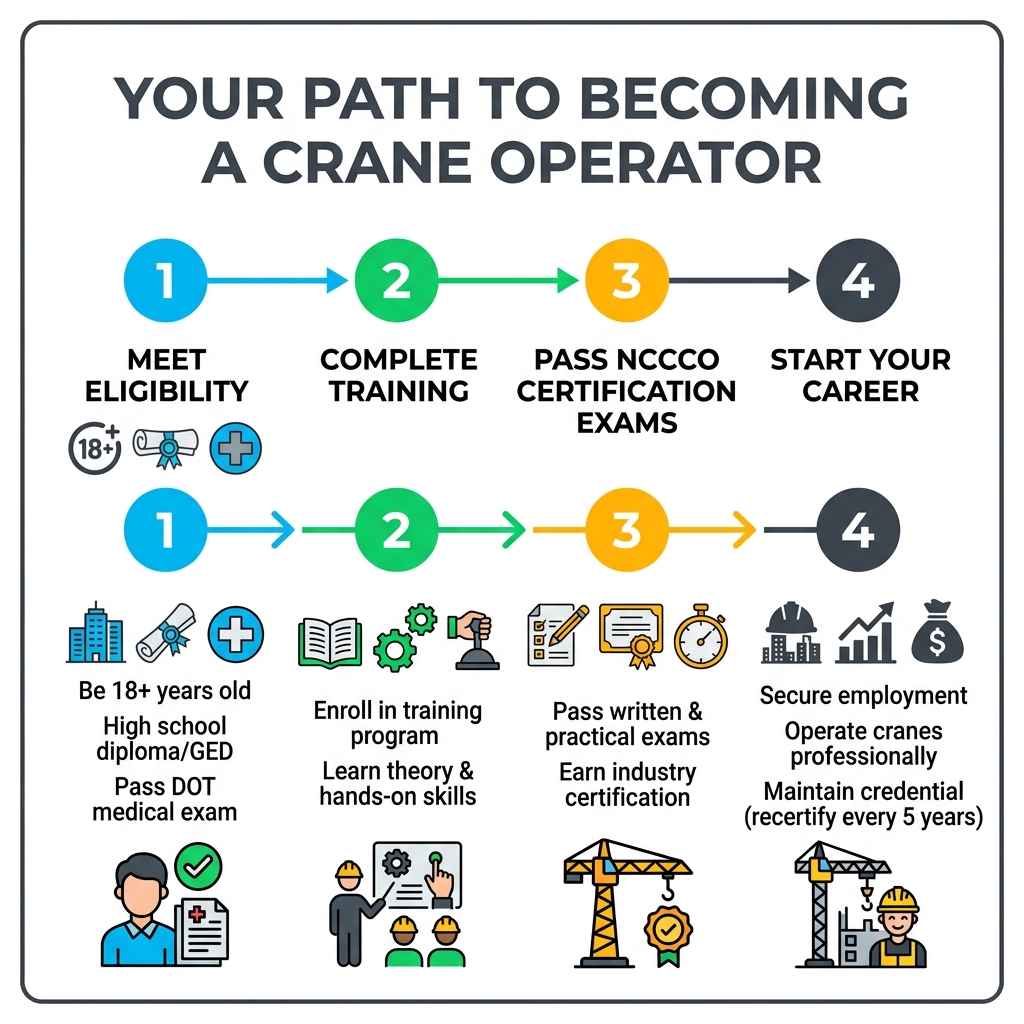
Want to become a crane operator? Here is the short version:
- Meet basic eligibility – Be at least 18 years old, hold a high school diploma or GED, and pass a DOT medical exam
- Complete crane operator training – Enroll in an NCCCO-accredited program (formal programs run 4-8 weeks; apprenticeships run 3-4 years)
- Pass NCCCO certification exams – A written Core exam, at least one Specialty exam, and a practical exam (all within a 12-month window)
- Start working and maintain your certification – Your NCCCO credential is valid for 5 years, then recertification is required
Crane operators are in high demand. The Bureau of Labor Statistics reports a median salary of $68,040 per year for crane and tower operators, with over 42,000 people working in the field and steady job growth projected through 2032.
It is also one of the faster skilled trades to enter. With the right training program, motivated candidates can go from zero experience to certified in just a few months.
But the path does involve real commitment. You need to meet physical standards, pass challenging written and practical exams, and understand how to operate heavy machinery safely. Crane accidents cause an average of 42 deaths per year in the U.S. — so this is a career where preparation genuinely matters.
Whether you are brand new to construction or already working in the trades and looking to level up, this guide walks you through every step of the process clearly and honestly.
The Role and Responsibilities of a Crane Operator
When you decide to become a crane operator, you aren’t just learning to pull levers; you are becoming the “air traffic control” of the construction site. A crane operator’s day begins long before the first load is lifted. It starts with a rigorous inspection of the machinery to ensure every cable, bolt, and hydraulic line is in perfect working order.
Safety is the absolute priority. Operators must be experts at reading load charts—complex tables that tell you exactly how much weight a crane can safely lift at various angles and distances. Miscalculating a load by even a few hundred pounds can lead to a catastrophic tip-over. This is why we emphasize that a Crane Operator Complete Guide always starts with the fundamentals of physics and mechanical limits.
Beyond the machine, you are a communicator. You will work closely with riggers, who secure the loads, and signalpersons, who guide your movements when you can’t see the destination. Whether using hand signals or radio communication, the coordination must be seamless. For a deeper look at what the daily grind looks like, check out our Crane Operator Careers Guide.
Types of Cranes You Will Operate
Not all cranes are created equal. Depending on the industry—whether it’s high-rise construction in a city or a manufacturing plant in Indiana—you will encounter different mechanical beasts.
- Mobile Cranes: These are the most versatile. They can be driven to a job site, set up quickly on outriggers, and moved as the project progresses. They include rough-terrain cranes, crawler cranes (which move on tracks), and truck-mounted “boom trucks.”
- Tower Cranes: These are the giants of the skyline. They are fixed to the ground (or the building itself) and offer incredible height and lifting capacity. They are assembled on-site and stay there until the job is done.
- Lattice Boom vs. Telescopic Boom: Lattice booms use a lightweight, crisscrossed steel structure to lift massive loads, while telescopic booms use hydraulic cylinders to extend and retract like a giant telescope.
| Feature | Mobile Cranes | Tower Cranes |
|---|---|---|
| Mobility | High; can drive on roads or tracks | Low; fixed to a foundation |
| Setup Time | Quick (minutes to hours) | Long (days to weeks) |
| Max Height | Limited by boom length | Extremely high (skyscrapers) |
| Typical Use | Varied construction, ports | High-rise building construction |
Essential Requirements to Become a Crane Operator
Before you ever step into a cab, you have to clear some hurdles. To become a crane operator, you must meet the standards set by OSHA and the American Society of Mechanical Engineers (ASME B30.5). These aren’t just suggestions; they are legal requirements designed to keep everyone on the job site alive.
First, the basics: You must be at least 18 years old and possess a high school diploma or GED. You also need to pass a Department of Transportation (DOT) medical exam. This physical ensures you have the stamina and health to handle the demands of the job. You can find a full list of these prerequisites in our Crane Operator Job Requirements post.
Physical and Mental Skills
Operating a crane is as much a mental game as it is a physical one. If you want to know How to Be a Crane Operator, you need to evaluate yourself against these five key traits:
- Depth Perception and Vision: You must have at least 20/30 vision in one eye and 20/50 in the other (with or without glasses). You also need to be able to distinguish colors—red and green lights/flags are kind of a big deal in this business.
- Spatial Awareness: You need to be able to visualize how a 10-ton load will move through 3D space, accounting for wind, swing, and obstacles you might not see directly.
- Mathematical Aptitude: You don’t need to be a calculus professor, but you must be comfortable with basic arithmetic (addition, subtraction, and multiplication up to the nines) to calculate load weights and interpret charts.
- Hand-Eye Coordination: Think of it like a very high-stakes video game. You’ll be using both hands and sometimes your feet to control multiple movements simultaneously.
- Calm Under Pressure: When a load starts to swing or the wind picks up, you cannot panic. A steady hand is the difference between a successful lift and a headline in the local news.
The Step-by-Step Path to NCCCO Certification
The National Commission for the Certification of Crane Operators (NCCCO) is the gold standard. In the United States, and specifically for those looking to work in Indiana, having this certification is often the only way to get hired. The process is rigorous, and for good reason.
You generally have a 12-month window to complete all parts of the certification. If you pass your written test in January, you have until the following January to pass your practical. If you miss that window, you’re back to square one. This is why we recommend a How to Get a Crane Operator License strategy that tackles both components in a structured timeframe.
The exams consist of:
- The Core Written Exam: 90 questions covering general knowledge, safety, and regulations. You have 90 minutes to finish.
- Specialty Written Exams: These focus on specific crane types (like Telescopic Swing Cab or Lattice Boom). These are shorter (26 questions) but more technical.
- The Practical Exam: This is where you prove you can actually drive. You’ll navigate a course, move loads through obstacles, and demonstrate total control of the machine.
Training Pathways and Options
How you choose to learn will define how quickly you enter the workforce. There are two primary routes:
1. Formal Training Programs: These are intensive, structured courses that can get you ready for the exams in as little as 4 to 8 weeks. At Train For The Crane, we focus on this accelerated path. Our instructors bring over 30 years of combined experience to the table, ensuring you aren’t just memorizing answers but actually understanding the machine. This is often the Best Crane Operator Training Schools choice for those who want to start earning a paycheck sooner rather than later.
2. Apprenticeships: This is the “long game.” Apprenticeships usually last 3 to 4 years and involve on-the-job training under a master operator, often through a union. You earn while you learn, but it takes much longer to become fully certified.
Regardless of the path, you should look for programs that offer plenty of “seat time.” You can read more about evaluating these options in our guide on Mastering the Heights: The Best Crane Operation Training Programs Revealed. For a deep dive into the specifics of the CCO process, see our NCCCO Certification Training Ultimate Guide.
Salary, Job Outlook, and Career Advancement
Is it worth it to become a crane operator? The numbers say yes. According to the BLS (May 2023), the median annual salary for crane and tower operators is $68,040, which breaks down to about $32.71 per hour. However, that is just the middle of the road.
If you specialize in high-demand industries like aerospace manufacturing or electric power generation, salaries can climb toward the $90,000 to $100,000 range. Top-tier operators in major metropolitan areas or specialized sectors like offshore drilling are among the highest earners in the construction world. You can see a more detailed breakdown in our article How Much Do Crane Operators Make.
The job outlook is equally sunny. With a projected 3% growth rate and over 42,000 job openings expected annually due to retirements and infrastructure growth, your skills will be in demand for decades.
Recertification and Moving Up
Your CCO card isn’t a “one and done” deal. It is valid for five years. To keep it, you must recertify. The good news? If you can prove you have logged at least 1,000 hours of crane-related experience during those five years, you can often skip the practical exam and only retake the written portions.
As you gain experience, you don’t have to stay in the cab forever. Many operators move into roles like:
- Lift Director: The person in charge of planning and overseeing complex lifts.
- Crane Inspector: Ensuring machines meet safety standards.
- Foreman or Site Supervisor: Managing entire crews and projects.
Staying ahead of the curve is vital. As technology changes, so do the rules. Check out the Crane Operator Training Requirements Guide 2026 to see what’s coming next for the industry.
Frequently Asked Questions about Becoming a Crane Operator
How long does it take to become a crane operator?
If you choose a formal, accelerated training program, you can be ready for your certification exams in 4 to 8 weeks. Most students can go from zero experience to a certified operator in 3 to 4 months once you factor in testing windows and license processing. Apprenticeships, by contrast, take 3 to 4 years. For a more detailed timeline, read How Long Does It Take to Become a Crane Operator.
Is a Commercial Driver’s License (CDL) required to become a crane operator?
It depends on the crane. If you are operating a stationary tower crane, you don’t need a CDL. However, if you want to become a crane operator for mobile cranes that drive on public roads, a CDL is almost always required by state law and DOT regulations. Even if it isn’t strictly required for a specific job, having a CDL makes you much more employable.
How much does crane operator school cost?
Costs vary significantly based on the depth of the program. A basic 3-day or 5-day certification prep course might cost a few thousand dollars, while a comprehensive “zero-to-hero” program that includes rigging, signaling, and weeks of hands-on seat time can exceed $10,000. It’s an investment in a career that pays for itself quickly. You can find more details on budgeting in our guide: How Much Is Crane Operator School?.
Conclusion
Deciding to become a crane operator is a choice to enter a respected, high-paying, and vital profession. It isn’t for everyone—it requires discipline, a head for numbers, and an unwavering commitment to safety. But for those who enjoy seeing the results of their work rise into the sky every day, there is no better seat in the house.
At Train For The Crane, we are dedicated to helping you reach those heights. Based in Danville, Indiana, we provide on-site NCCCO training for construction and manufacturing teams across the region. Our instructors don’t just teach the test; they share the wisdom of decades in the field to ensure our students have some of the highest pass rates in the industry.
If you’re ready to stop watching the skyline and start building it, we are here to help. Reach out to us to learn How Do You Become a Certified Crane Operator and take the first step toward your new career today.