

The Foundation of Safety: Construction Rigging Training
Construction rigging training teaches you how to lift and move heavy objects safely on a job site. This is critical for preventing accidents, injuries, and even deaths. Without proper training, lifting operations can quickly turn dangerous.
Here’s why construction rigging training is so important for safety:
- Preventing Accidents: Hoisting and rigging accidents are far too common, often causing extensive property damage, serious injuries, or even fatalities. From 2003 to 2018, there were 143 industry fatalities.
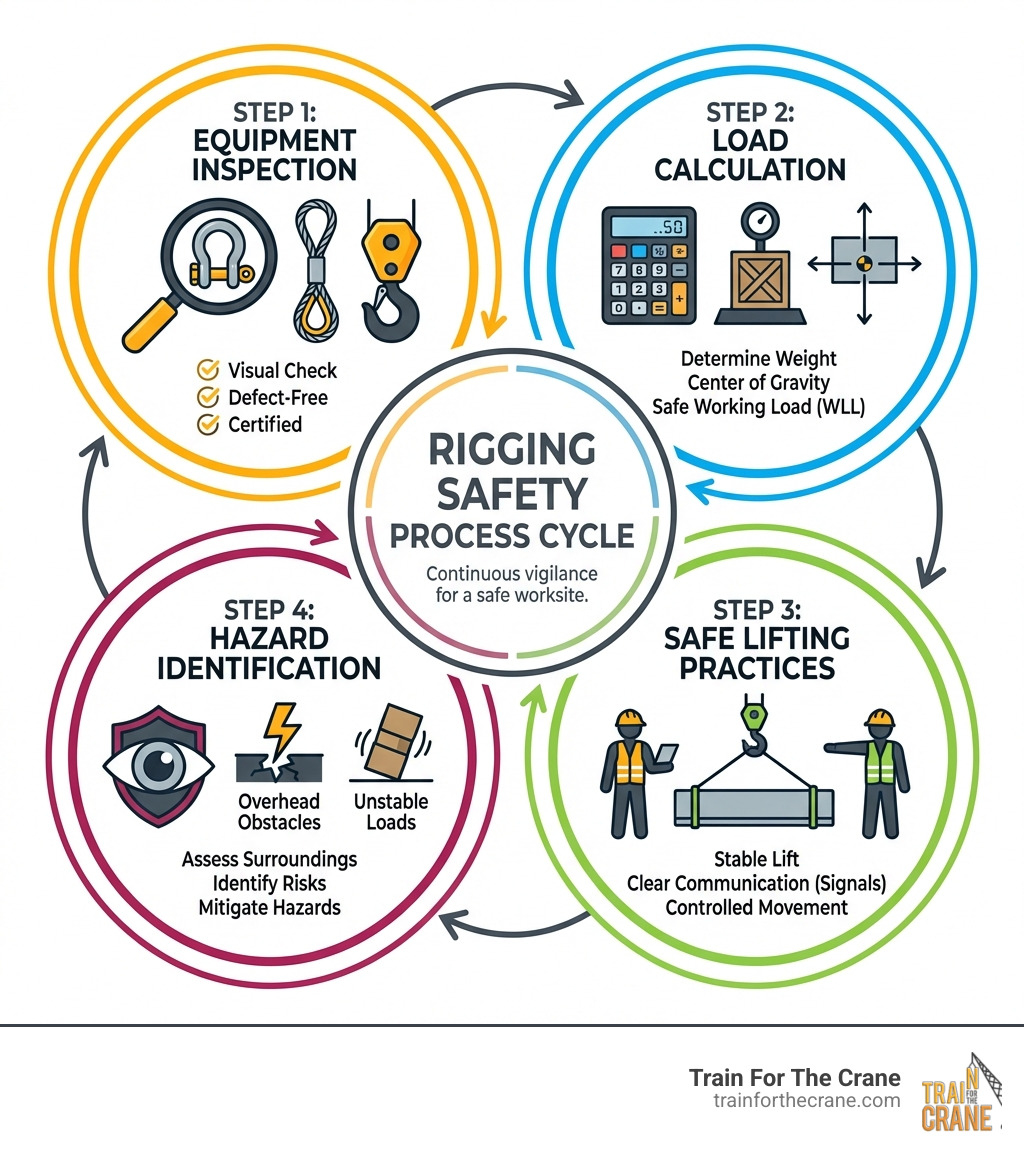
- Hazard Awareness: Training helps workers identify common hazards related to lifting, such as improper load balancing or faulty equipment.
- Equipment Knowledge: You’ll learn to select, inspect, and use various rigging equipment and hardware correctly. This includes understanding safe working loads (WLL) and safety factors (e.g., 10:1 for ropes, 4:1 for blocks, 5:1 for shackles).
- Compliance: Courses adhere to strict industry standards and regulations, like OSHA and ASME, ensuring legal and safe operations.
- Skill Development: Trainees gain essential skills in load calculation, sling angles, and proper communication, which are vital for a smooth and safe lift.
This training is not just a good idea; it’s a lifeline for everyone on a construction site. It helps individuals, whether new or experienced, gain the certified knowledge needed to perform tasks safely and advance their careers.
Construction rigging training terms you need:
Core Components of Construction Rigging Training
When we dive into Construction rigging training, we aren’t just talking about tying a few knots and hoping for the best. It is a highly technical field that blends physics, geometry, and mechanical intuition. At its heart, rigging is about controlling the movement of mass through space. If you don’t respect the math, the gravity will certainly make you respect it later—and usually in a very expensive or dangerous way.
One of the first things we cover in a comprehensive program is load dynamics. A load doesn’t just sit there; it reacts to wind, movement, and the way it is attached to the crane. Understanding the center of gravity (CG) is non-negotiable. If the pick point isn’t above the CG, the load will shift or tilt the moment it leaves the ground. We teach our students how to find that “sweet spot” even on non-symmetric loads like engines or complex steel assemblies.
Sling angles are another major pillar. Many people don’t realize that as the angle between the horizontal and the sling decreases, the tension on that sling increases exponentially. We use Basic Rigging Training to hammer home the importance of the “Sling Angle Factor.” For example, at a 30-degree angle, the tension on the sling is double what it would be if the load were hanging straight down.
Essential Skills for Rigging Professionals
Beyond the math, a rigger needs a specific set of manual and communication skills. You might be the best mathematician in Indiana, but if you can’t tie a proper bowline or a clove hitch under pressure, you’re in trouble. Our Rigger Level I & II Training focuses heavily on these “hands-on” essentials.
Communication is the “glue” that keeps a lift together. We teach standardized voice signals and hand signals that follow ASME B30 standards. In a noisy construction environment, there is no room for “I think he meant ‘up’.” It has to be clear, concise, and immediate. We also cover advanced maneuvers like load drifting—moving a load horizontally while it’s suspended—and lateral load movement, which requires a deep understanding of hoist line installation and the forces at play.
To keep things safe, we follow strict safety factors for all hardware. Here is a quick reference table we use to ensure everyone knows the limits of their gear:
| Equipment Type | Typical Safety Factor | Notes |
|---|---|---|
| Synthetic Ropes | 10:1 | 10% of Minimum Breaking Strength (MBS) |
| Rigging Blocks | 4:1 | Per ASME B30.26 standards |
| Shackles | 5:1 | Per ASME B30.26 standards |
| Wire Rope Slings | 5:1 | Standard for most general lifting |
Practical Assessment and Hands-on Experience
You can watch videos all day, but you haven’t truly learned rigging until you’ve felt the tension in a sling. That’s why our Certified Rigger Course prioritizes practical assessment. We put our trainees through real-world scenarios, including field verification of load weights and proof loading hoist anchorages.
During these sessions, we focus on:
- Equipment Inspection: Every shift starts with a visual check. If a sling has a tear or a shackle is deformed, it’s out. No exceptions.
- Signal Person Duties: Acting as the “eyes” for the crane operator.
- Rigging Plan Execution: Following a written plan to ensure the lift goes exactly as engineered.
Industry Standards and Safety Regulations
In the United States, and specifically here in Danville, IN, we live and breathe by OSHA 29 CFR 1926. This is the “law of the land” for construction. However, OSHA often points to ASME (American Society of Mechanical Engineers) B30 standards for the “how-to” details of rigging hardware.
When you pursue Crane Rigger Certification, you are learning to navigate these regulations. For instance, ANSI A10.48 is the go-to standard for communication structures (like cell towers), while others might reference CSA Z150-98 for specific slinging practices.
One of the most important concepts we teach is the relationship between Minimum Breaking Strength (MBS) and Working Load Limit (WLL). If a rope has an MBS of 11,000 lbs, its WLL is only 1,100 lbs because of that 10:1 safety factor. We also teach the “10/70 Rule” for specialized lifts: if your load angle exceeds 10 degrees or your tag angle exceeds 70 degrees, you’ve entered “special lift” territory that might require a qualified engineer.
Compliance and Documentation Requirements
Safety isn’t just about the lift; it’s about the paperwork that proves the lift was safe. Riggers are responsible for maintaining rope inspection logs and ensuring all equipment meets manufacturer specifications.
Our training on NCCCO Rigger Certification Cost often includes discussions on the administrative side of the job. This includes:
- Periodic Inspections: At least once a year, a qualified person must do a deep-dive inspection of all blocks and shackles.
- Equipment Retirement: Knowing exactly when a double-braid rope sheath has 50% wear and must be cut up and thrown away.
- Job Hazard Analysis (JHA): Walking the site to identify power lines, soft ground, or public access issues before the crane even arrives.
Levels of Construction Rigging Training and Certification
Not all riggers are created equal. The industry follows a tiered system, often based on the NCCER curriculum, which allows workers to progress as they gain experience and hours.
- Basic Rigger (Level 1): This usually requires about 140 hours of recommended study. It covers the fundamentals: hitches, basic hardware, and communication.
- Intermediate Rigger (Level 2): Approximately 105 hours. Here, we get into the “heavy lifting” of the mind—load dynamics, multi-part lines, and telescopic boom assembly.
- Advanced Rigger (Level 3): About 95 hours of specialized study. This level is for the pros who handle multi-crane lifts, use equalizer beams, and create complex lift plans for hoisting personnel.
When considering the Rigger Certification Cost, it’s important to view it as an investment in technical competence. Most certifications, like those from the ECITB or NCCCO, require renewal every three to five years to ensure your skills haven’t gone “rusty.”
Basic, Intermediate, and Advanced Construction Rigging Training
As you move up the ladder, the complexity of the math increases. In basic training, you learn what a sling is. In Crane Rigging Certification at the intermediate level, you learn about D/d ratios—the relationship between the diameter of the object you’re wrapping around (D) and the diameter of the rope (d). If that ratio is too small, you permanently damage the rope.
Advanced training moves into specialized material handling. This includes:
- Multi-Crane Lifts: Where two or more cranes share the weight of a single, massive load.
- Equalizer Beams: Used to ensure that even if the cranes move slightly out of sync, the load remains level.
- Hoisting Personnel: The most high-stakes rigging there is, requiring specialized platforms and 10:1 safety factors for every component.
Safe Use of Hardware in Construction Rigging Training
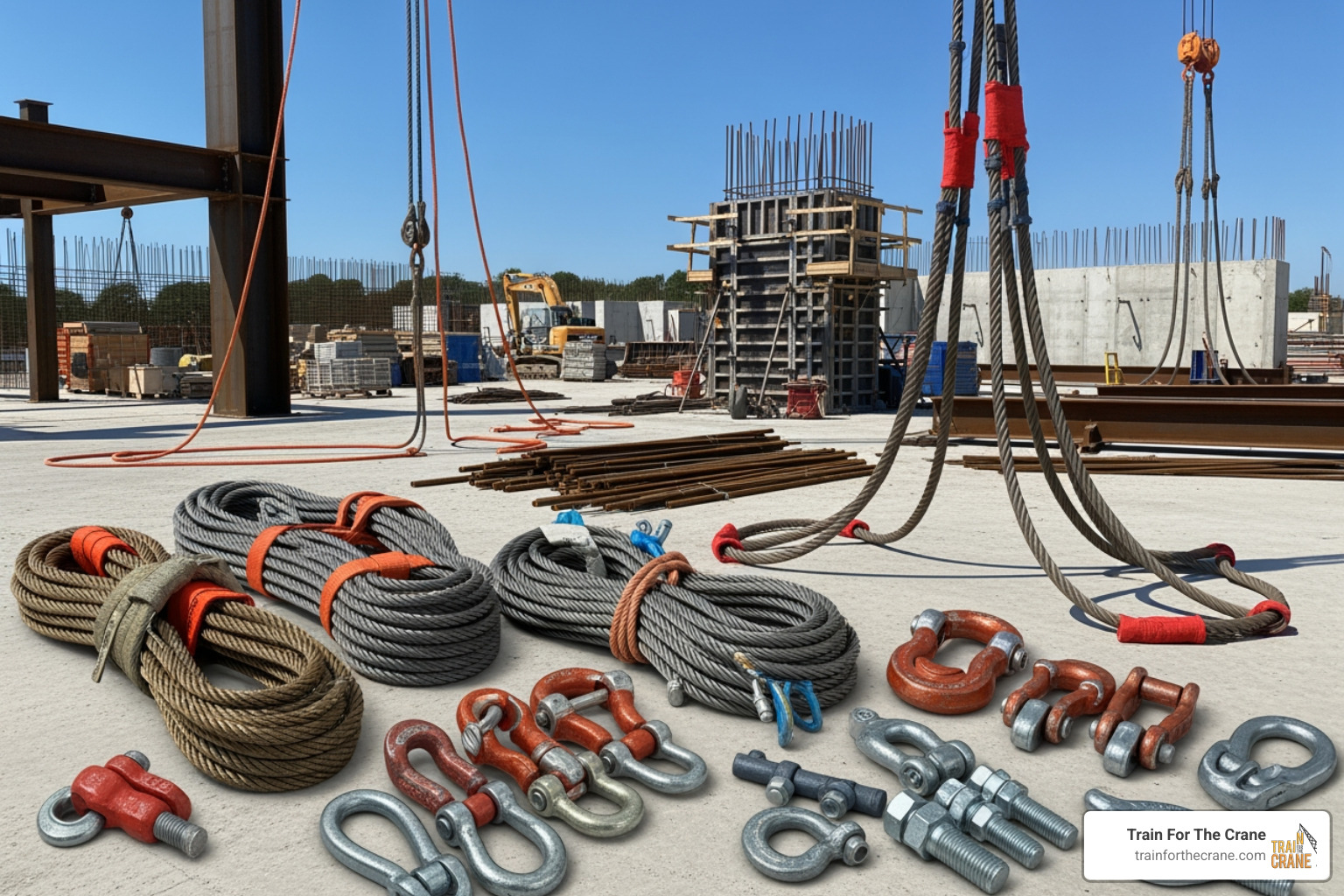
A rigger is only as good as their tools. We spend a significant amount of time discussing the pros and cons of synthetic rope versus wire rope. Synthetic rope is light and easy on the hands, but it’s susceptible to UV damage and heat. Wire rope is a beast for durability but can develop “bird-caging” or broken wires that make it dangerous to handle.
Understanding the Rigging Certification Cost also means understanding the cost of not maintaining your gear. We teach students how to perform:
- Hook Inspections: Checking for throat opening increases or twists.
- Shackle Care: Ensuring the pin is always fully seated and never replaced with a hardware-store bolt.
- Below-the-Hook Devices: Inspecting spreader bars and custom lifting jigs for weld cracks.
Proper storage is the final step. Rope should be stored in a cool, dry, dark place. Dirt is the enemy of rope—it gets inside the fibers and acts like tiny saws, cutting the rope from the inside out. We teach our students to wash their ropes with non-detergent soap and dry them away from direct sunlight.
Frequently Asked Questions about Rigging Training
What are the prerequisites for rigger training?
For most basic courses, there are no strict prerequisites other than being at least 18 years old and having a basic grasp of math. However, for Rigger Level II or III, you typically need to show proof of Level I completion or significant on-the-job experience.
How long does a rigging certification remain valid?
Most industry-standard certifications, such as those through NCCCO, are valid for five years. Some technical competence certifications, like the ECITB model, require renewal every three years. It is vital to check your specific card for the expiration date, as working with an expired “ticket” can lead to immediate dismissal from many job sites.
Can I complete rigging training through online modules?
Yes, many foundational principles can be learned online. Many “Basic Rigging” bundles take about 90 minutes to 3 hours to complete and provide a great introduction to the theory. However, for true certification, most employers and regulatory bodies require a practical, hands-on assessment. You can’t learn to feel the “swing” of a load through a computer screen!
Conclusion
Mastering the art of lifting is a journey that starts with the right foundation. At Train For The Crane, we believe that safety and efficiency go hand-in-hand. Our experienced instructors bring over 30 years of combined experience to the table, ensuring that our students don’t just pass a test—they become assets to their companies.
We specialize in on-site training solutions across Indiana, focusing on high pass rates and real-world skills. Whether you are looking for NCCCO preparation or specialized rigging workshops, we are here to help your team reach new heights.
Master your lifting skills with professional training and ensure that every pick on your site is a safe one. Contact us today at our Danville, IN location to schedule your next training session.