

What You Need to Know About Rigger Level 2 Certification (At a Glance)
Rigger Level 2 Certification is an advanced, nationally recognized credential issued by the NCCCO (National Commission for the Certification of Crane Operators) that qualifies you to perform complex rigging tasks without supervision — including selecting rigging components, estimating load weight, and determining a load’s center of gravity.
Here’s a quick summary of the key facts:
- Issued by: NCCCO (National Commission for the Certification of Crane Operators)
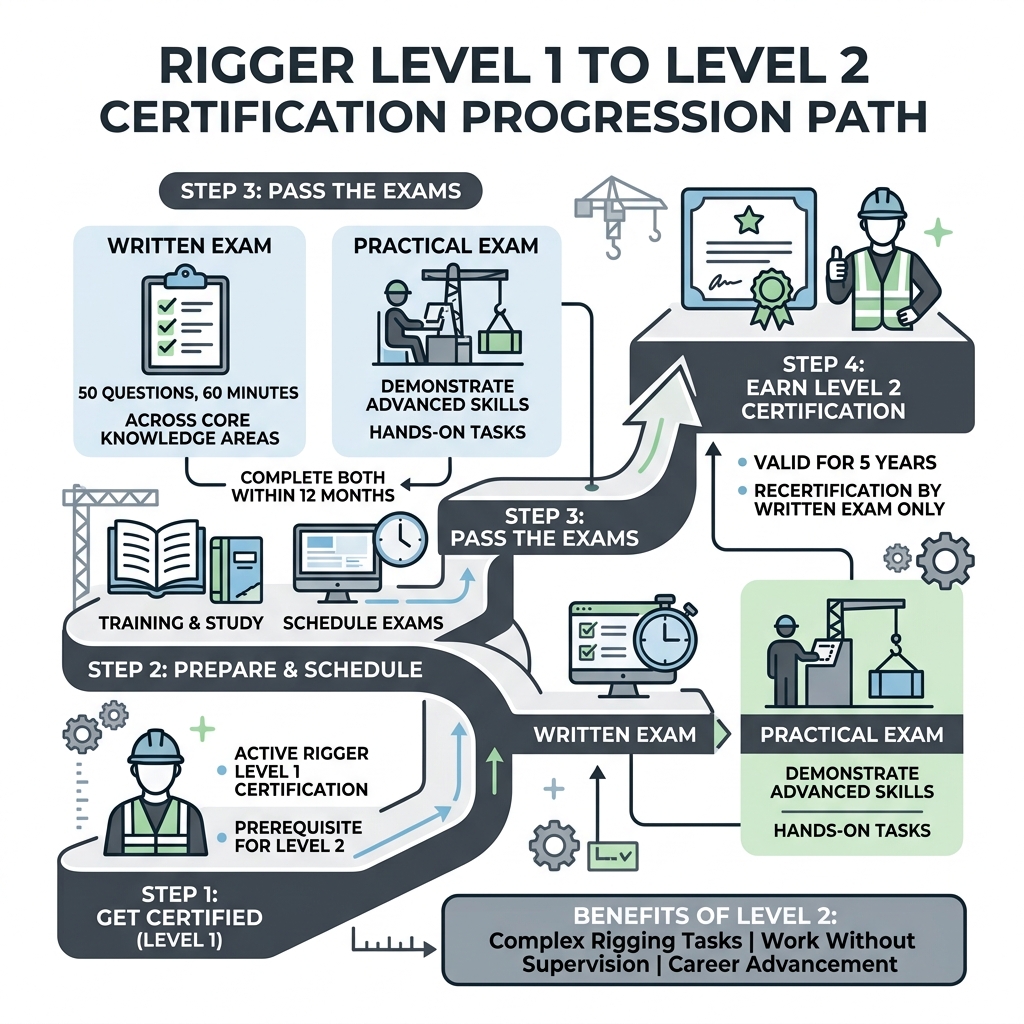
- Prerequisite: Active Rigger Level 1 certification
- Exams required: Written exam (90 questions, 90 minutes) + Practical exam
- Time to complete both exams: Within 12 months of passing the first
- Certification period: 5 years
- Recertification: Written exam only (no practical required)
- Regulatory compliance: Meets OSHA §1926, §1910, and ASME B30 standards
Whether you’re looking to move from entry-level rigging into supervisory or lift planning roles, or your employer needs you to meet OSHA compliance requirements, this certification is the recognized standard in the industry.
Since November 2010, OSHA has required all riggers working under Subpart CC to be qualified. Rigger Level 2 is how you prove — on paper and in practice — that you have the skills to handle that responsibility.
This guide walks you through everything: what the certification covers, how the exams work, how to prepare, and how to maintain your credential once you’ve earned it.
Learn more about Rigger Level 2 Certification:
What is Rigger Level 2 Certification?
When we talk about Rigger Level 2 Certification, we are talking about moving from a “helper” or “apprentice” mindset into the role of a journeyman. While a Level 1 rigger is fantastic at handling repetitive tasks where the load weight and center of gravity are already known, a Level 2 rigger is the person who makes the big decisions.
A Certified Rigger Level II is someone who can walk onto a job site, look at a complex, irregular load, and figure out exactly how to move it safely without a supervisor holding their hand. This certification validates that you have the advanced technical knowledge to select the right gear and procedures based on the rigging capacity and the specific environment.
To get a better idea of how these roles stack up, check out this comparison:
| Feature | Rigger Level 1 | Rigger Level 2 |
|---|---|---|
| Supervision | Often requires oversight for complex lifts | Can work unsupervised |
| Load Parameters | Works with known weights & COG | Estimates weight & finds COG |
| Rigging Selection | Uses pre-determined gear | Selects gear based on load dynamics |
| Complexity | Simple, repetitive tasks | Complex, irregular, or tandem lifts |
| Prerequisites | None | Must hold Level 1 or take combined |
Earning this credential means you’ve mastered Certified Excellence: Earning Your NCCCO Rigger Credential. It’s not just about knowing how to tie a knot; it’s about understanding the physics behind the pull. For a deeper dive into what 2025 holds for the industry, take a look at our Certified Rigger Guide 2025.
Key Differences from Level 1
The jump from Level 1 to Level 2 is all about responsibility. In Level 1, you are typically told what to do. You might be attaching slings to a load where the manufacturer has already marked the lift points and told you the weight. You are focused on Get Hooked: Everything You Need to Know About Rigger Level 1 Training, which covers the basic hitches and safety protocols.
In Level 2, the training shifts. We expect you to perform weight estimations. You’ll need to identify lift points that aren’t obvious and account for load dynamics—like how a load might shift or swing during travel. You aren’t just a “hook-and-go” operator anymore; you are a planner.
Alignment with OSHA and ASME Standards
We don’t just teach these skills because they’re “good to know.” We teach them because the law requires them. Rigger Level 2 Certification aligns perfectly with OSHA 1926.251 (rigging equipment for material handling) and OSHA 1910.184 (slings).
Furthermore, the certification follows the ASME B30 series—specifically B30.9 for slings and B30.26 for rigging hardware. These standards ensure that every shackle, hook, and wire rope you use is being applied within its legal and safe working limits. Staying compliant isn’t just about avoiding fines; it’s about making sure everyone goes home at the end of the day. You can find more details on these regulations in our guide to Crane Rigging Certification.
Core Skills and Responsibilities of a Level II Rigger
What does a typical day look like for a Level 2 rigger? It involves a lot of mental math and eagle-eyed inspections. You are responsible for the “Plan of Attack” for every lift.

Your core responsibilities include:
- Estimating Load Weight: Using volume, material density, and dimensions to figure out exactly how heavy that “mystery box” really is.
- Finding the Center of Gravity (COG): Ensuring the load stays level and doesn’t tip or slide once it leaves the ground.
- Selection of Rigging: Choosing between wire rope, chain, or synthetic slings based on the load’s surface and the environment.
- Identifying Lift Points: Determining where to attach the gear to maintain structural integrity.
- Communication Protocols: Coordinating with the crane operator and signalpersons using standardized hand or voice signals.
Our Certified Rigger Complete Guide provides an even more exhaustive list of these daily duties.
Advanced Technical Knowledge
This is where the “Level 2” part really kicks in. You’ll need to understand the D/d ratio—the relationship between the diameter of the object the sling is wrapped around (D) and the diameter of the sling itself (d). If that ratio is too small, you lose significant lifting capacity, and the sling could fail.
You also move beyond just cranes. A Level 2 rigger needs to know how to use:
- Industrial Rollers: For moving heavy machinery across a floor.
- Jacks and Winches: For horizontal movements or tight-space lifting.
- Below-the-Hook Devices: Like spreader bars or lifting beams.
Understanding these tools is vital, especially when you start looking into Mastering the Signals: Your Guide to Signalman Certification.
Inspection and Safety Execution
Safety is the heartbeat of rigging. A Level 2 rigger must perform a pre-use inspection on every piece of gear. If a sling has a tear, a hook is stretched, or a shackle is missing its pin, it’s your job to take it out of service immediately.
Hazard assessment is also key. You need to look for overhead power lines, ground stability, and wind conditions. And of course, you must always wear the proper PPE:
- OSHA-approved hard hat
- High-visibility safety vest
- Full-fingered work gloves
- Steel-toed, low-heeled work boots
- Eye protection
If you’re just starting out, you might want to brush up on the fundamentals with our Basic Rigging Training resources.
The Path to Rigger Level 2 Certification: Requirements and Exam Breakdown
Getting certified isn’t an overnight process, but it is a straightforward one if you have the right training. The NCCCO requires you to pass both a written and a practical exam.
The most important rule to remember is the 12-month window. Once you pass your first exam (either written or practical), you have exactly one year to pass the other. If you miss that window, you have to start over from scratch!
Eligibility for Rigger Level 2 Certification
Before you can sit for the Level 2 exams, you have to meet a few basic requirements:
- Prerequisite: You must have an active Rigger Level 1 certification. (Though some programs allow you to take combined training, you must pass the Level 1 requirements to earn the Level 2).
- Age: You must be at least 18 years old.
- Policies: You must comply with the NCCCO Substance Abuse Policy and Code of Ethics.
- Physical Requirements: You need to be physically able to perform the duties of a rigger.
You can learn more about the specific classroom requirements in our Certified Rigger Course.
Written Exam Domains and Scoring
The Rigger Level 2 Certification written exam consists of 50 multiple-choice questions, and you are given 60 minutes to complete it. It’s a test that covers six specific “domains.”
Here is how the exam is weighted:
- Selection of Rigging Components (34%): This is the biggest chunk. You’ll be tested on choosing the right slings, shackles, and hoists.
- Planning the Rigging Activity (15%): How do you set up the site? What’s the travel path?
- Scope of the Rigging Activity (15%): Identifying the load and environmental hazards.
- Technical Knowledge (13%): The “math” part—sling tension, angles, and load dynamics.
- Execution of Rigging Activity (13%): Directing the lift and using taglines.
- Inspection (10%): Knowing when gear is “dead” and needs to be tossed.
For more information on the logistical side of testing, check out the NCCCO Rigger Certification Complete Guide and our breakdown of the NCCCO Rigger Certification Cost.
Why Rigger Level 2 Certification Matters for Your Career
Why go through the trouble? Besides the fact that it makes you a much safer worker, it’s a massive boost to your resume. In the construction and manufacturing worlds, a Level 2 certification is often the “ticket” required for supervisory roles.
If you want to become a Lift Director, a Lift Planner, or a Safety Manager, you usually need this credential first. It shows employers that you have the professional recognition and the technical chops to manage high-stakes lifts.
Beyond the title, it’s about risk mitigation. Companies want riggers who can prevent accidents before they happen. By being certified, you are telling the world that you understand the stakes. As we say, Get Certified Get Ahead: Everything You Need to Know About Rigging Training.
Maintaining Your Rigger Level 2 Certification
Your certification is valid for five years. There is no grace period, so if your card expires on a Tuesday, you are no longer a certified rigger on Wednesday.
The good news? Recertification for Level 2 is simpler than the initial process. You only need to take and pass the Level 2 written exam during the 12 months before your expiration date. If you pass the Level 2 recertification exam, it automatically renews both your Level 1 and Level 2 credentials! You don’t even have to do the practical exam again, provided you meet the requirements.
Keep your info up to date in the myCCO portal, and if you ever lose your card, there’s usually a small fee for a replacement. For a full breakdown of the renewal steps, see our Rigger Certification Training Complete Guide.
Frequently Asked Questions about Rigger Certification
What are the costs associated with Rigger Level 2 training?
While we don’t list specific prices here (as they can change based on location and group size), you should budget for two main things: the training tuition and the NCCCO exam fees. Training usually includes several days of classroom prep and hands-on practice. Some providers offer “refresher” pricing for those who just need a quick tune-up. You can find more details on our Rigging Certification Cost page.
How long does the Rigger Level 2 certification last?
The certification lasts for five years. To stay certified, you must complete the recertification process before your current card expires. If you let it lapse, you may have to take both the written and practical exams all over again. Check out our Rigger Certification Cost article for more on the long-term value of this investment.
Can I take the Level 2 exam without being Level 1 certified?
Technically, Level 1 is a prerequisite. However, many candidates choose to take a “combined” course where they train for both levels at once. You will still have to pass the Level 1 exams to be granted the Level 2 credential. It’s a common path for experienced workers who have the skills but just need the paperwork to prove it. See our guide on Crane Rigger Certification for more on testing sequences.
Conclusion
Earning your Rigger Level 2 Certification is one of the smartest moves you can make in your heavy industry career. It moves you from the sidelines into a leadership position where you are responsible for the safety and success of complex lifting operations.
At Train For The Crane, we specialize in helping you cross that finish line. Based in Danville, Indiana, we provide on-site NCCCO training that comes to you. Our instructors have over 30 years of combined experience, and our proven methods lead to some of the highest pass rates in the industry. We don’t just want you to pass a test; we want you to be the best rigger on the job site.
Ready to take the next step? Check out our Training/Rigger Level I-II programs and let’s get to work!