

Why Crane Risk Management Can’t Be an Afterthought
Crane risk management is the system of practices, protocols, and training that keeps crane operations safe — and it covers everything from pre-lift planning and operator competency to weather monitoring and emergency response.
Here’s a quick overview of what effective crane risk management involves:
- Pre-lift planning — site assessment, load calculations, hazard identification
- Operator competency — certified, trained, and familiar with the specific equipment
- Ground conditions — stable, level, and capable of bearing the crane’s load
- Environmental monitoring — wind speed, temperature, visibility, lightning
- Communication protocols — designated signalers, radio checks, clear hand signals
- Load management — staying within rated capacity, proper rigging, verified center of gravity
- Power line safety — minimum clearance distances enforced before every lift
- Emergency response — exclusion zones, stop-work authority, contingency plans
Cranes are the backbone of large-scale construction. But they also carry serious risk.
Human error accounts for up to 90% of crane accidents — and that’s the most important number in this entire guide. Because it means the vast majority of crane incidents are preventable.
The financial reality is just as sobering. Crane lifting accidents cost US construction companies an average of $185,000 per incident. A fleet of just 10 cranes operating without systematic safety protocols can rack up nearly $485,000 in preventable costs every single year.
And yet, improper safety procedures are still responsible for 72% of preventable crane injuries and equipment damage across the industry.
Whether you’re new to the industry or a seasoned construction professional, understanding crane risk is the first step toward preventing it. This guide breaks down the causes, the protocols, the technology, and the training that make crane operations safer — and more profitable.
Key terms for Crane risk management:
Primary Causes of Accidents and the Human Factor
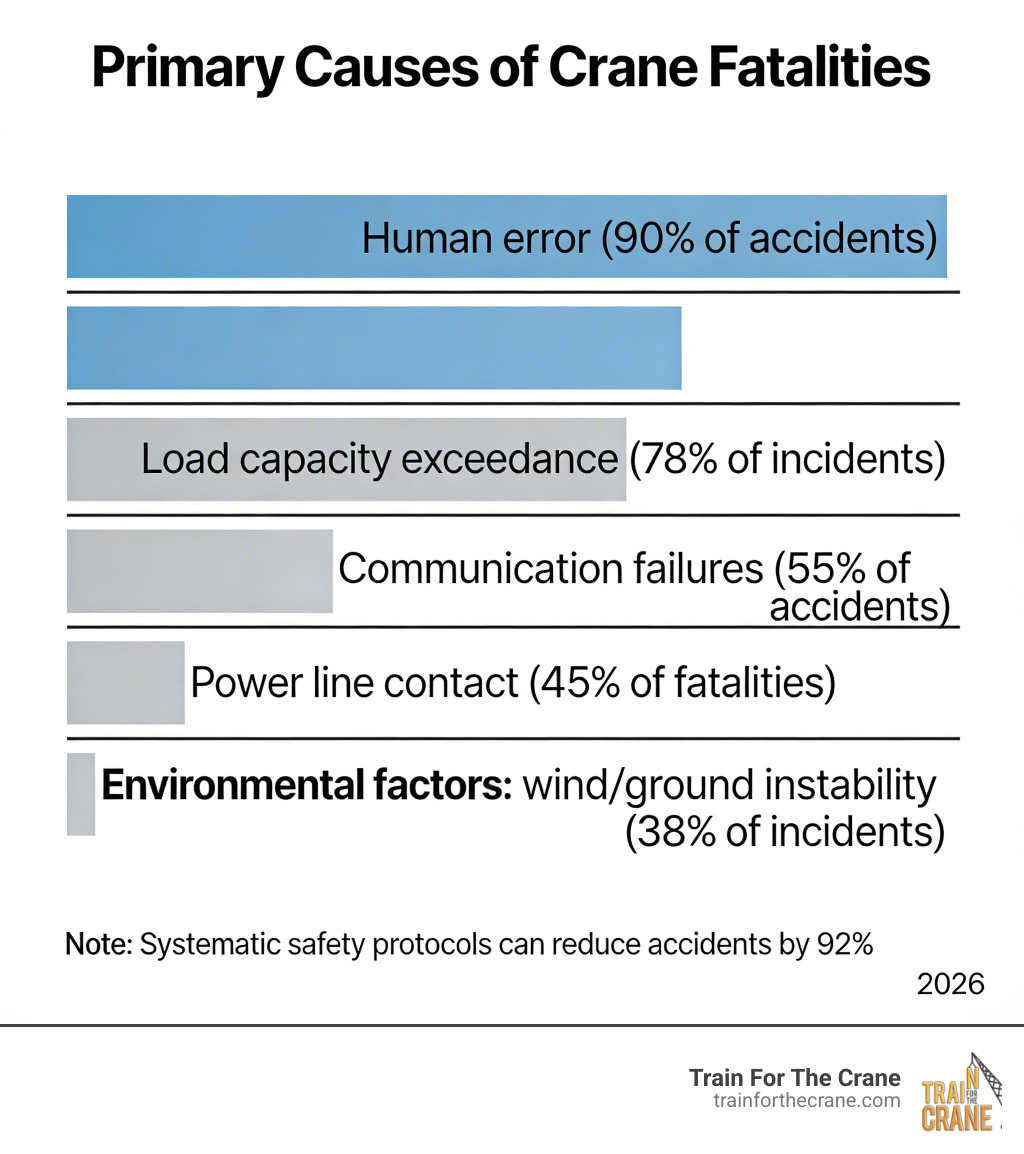
When we talk about Crane risk management, we have to start with the “why” behind the accidents. It’s easy to blame a mechanical failure or a “freak” gust of wind, but the data tells a different story. As we mentioned, human error is the culprit in 90% of cases. This isn’t just about an operator pulling the wrong lever; it encompasses poor planning, inadequate training, and lapses in judgment by the entire lifting team.
One of the most lethal hazards on any site is power line contact. In the mobile crane world, energized power lines cause nearly 45% of all crane-related fatalities. It’s a terrifying statistic because it’s almost always avoidable with proper site assessment and the use of dedicated spotters.
Another major red flag is load capacity exceedance. Roughly 78% of crane accidents involve a load that was simply too heavy for the crane’s current configuration. Whether it’s a miscalculation of the load weight or a failure to account for the boom angle, pushing the limits is a recipe for disaster. We’ve found that crane-lifting-safety protocols often break down because of simple communication failures—which account for 55% of accidents. If the rigger and the operator aren’t on the same page, the load is already in danger.

Addressing the Skills Mismatch in Crane Risk Management
The construction industry is currently facing a massive “skills mismatch.” With a high number of veteran operators retiring and a new generation entering the workforce, there is a significant gap in hands-on experience. This creates a hidden crisis in Crane risk management.
To combat this, we advocate for workforce qualification standards that go beyond just having a piece of paper. Companies need activity-driven tracking—meaning we don’t just check if someone was “trained” three years ago; we look at their actual performance and due diligence on the job today. Ensuring operator competency is a proactive solution. When we provide lifting-safety-training, we focus on making sure candidates have the specific skills needed for the unique dynamics of their job site, rather than just teaching them how to pass a test.
Communication Protocols for Lifting Teams
A crane doesn’t operate in a vacuum. It’s part of a team. To manage risk effectively, we must establish standardized communication protocols. This starts with designated qualified signalers. Whether using hand signals or hands-free radios, the signal person must be the operator’s “eyes” in areas where visibility is blocked.
We often recommend crane-safety-consulting to help firms develop a “Method Statement.” This document outlines exactly how the lift will proceed, who is responsible for what, and how the team will talk to each other. If the radio fails or a signal is misunderstood, the protocol should be simple: stop the lift immediately.
Core Components of a Comprehensive Crane Risk Management Plan
A solid Crane risk management plan is your roadmap to a zero-incident site. It’s not just a binder that sits on a shelf; it’s a living document that guides every move. We start with pre-lift planning for every lift, not just the big ones.
A comprehensive plan includes:
- Site Assessment: Checking for overhead obstructions, underground utilities, and public access.
- Hazard Identification: Pinpointing what could go wrong (e.g., “The ground is soft here” or “The wind is picking up”).
- Method Statements: A step-by-step guide on how the load will be moved from point A to point B.
Ground Conditions and Soil Stability
You can have the best crane in the world, but if the ground beneath it gives way, it’s going over. Ground instability and poor leveling are responsible for a huge chunk of mobile crane incidents.
Here is a technical truth that every supervisor needs to know: A crane that is just three degrees out of level can lose up to 50% of its rated capacity. That is a massive reduction for a seemingly small tilt. We must ensure the soil bearing capacity is tested and that outriggers are fully extended and supported by proper padding or cribbing. Our safe-work-practices emphasize that if the ground looks “mushy” or uncompacted, the lift doesn’t happen until it’s fixed.
Weather Monitoring and Environmental Factors
Weather is the ultimate wild card. For safe operations, we generally look for wind speeds to be less than 35-50 km/h (roughly 22-31 mph), though manufacturer specs always take precedence. Temperature also plays a role; in extreme cold (below -20°C or -4°F), the steel in the crane can become brittle, and hydraulic systems may struggle.
Visibility hazards like fog, heavy rain, or blowing snow can make it impossible for an operator to see the signal person or the load. Our crane-lifting-plans-complete-guide suggests a “weather watch” protocol where a designated person monitors local radar and wind gauges constantly during high-risk lifts.
Essential Safety Protocols for Mobile and Tower Cranes
While both types of cranes lift heavy things, their risks are different. Tower cranes are fixed and often operate in dense urban environments, requiring strict adherence to codes like OSHA 1926 Subpart CC or international standards like CSA Z248-17. They require zone-limiting devices to prevent the boom from swinging over energized power lines or neighboring buildings.
Mobile cranes, on the other hand, deal with the constant threat of “tipping” due to ground conditions or improper leveling. A mobile crane operator must be a master of the load chart, understanding how boom length and angle drastically change what the machine can handle. We always insist on a thorough crane-inspection before the crane is even unfolded.
| Feature | Mobile Crane Safety | Tower Crane Safety |
|---|---|---|
| Primary Risk | Ground stability & Power lines | Structural failure & Zoning |
| Leveling | Critical (3° rule) | Fixed foundation/Plumb |
| Visibility | Operator often sees load | Often “blind” lifts (requires radio) |
| Weather | High wind & Soft ground | High wind & Lightning |
| Setup | Outriggers/Stabilization | Professional Engineering (PE) review |
Managing Critical and Complex Lifts
When a lift involves a load that is over 75% of the crane’s rated capacity, we classify it as a “Critical Lift.” These require an extra level of Crane risk management. Other factors that make a lift critical include:
- Multi-crane lifts (tandem lifts)
- Lifting over live equipment or occupied buildings
- Lifts near high-voltage lines
- Lifts involving hazardous materials
For these, a formal how-to-create-critical-lift-plan is mandatory. This plan must be reviewed by a Lift Director or a professional engineer to ensure the math is right and the risks are mitigated.
Rigging Integrity and Load Management
The crane is only as good as the rigging holding the load. We must identify the load’s center of gravity (CoG) before it leaves the ground. If the CoG is off, the load will shift, potentially snapping a sling or causing a violent swing.
Tag lines are essential for controlling the load’s rotation, but they must be used correctly—never wrapped around a worker’s hand! We also perform a regular crane-boom-inspection to check for any structural weaknesses that could be exacerbated by a heavy, swinging load.
Leveraging Technology in Crane Risk Management
Modern technology is a game-changer for safety. The most critical tool in the cab today is the Load Moment Indicator (LMI). These systems provide real-time data on the load’s weight, the boom’s angle, and the crane’s capacity. LMIs are incredibly effective, preventing over 95% of overload incidents when used correctly.
We are also seeing the rise of IoT sensors and AI-driven monitoring. These systems can track environmental conditions, detect nearby obstructions, and even provide predictive analytics to warn us of a potential failure before it happens. Using a crane-inspection-checklist-ultimate-guide alongside digital documentation ensures that no maintenance task is missed.
Regulatory Compliance and Standards
In the United States, the gold standard is OSHA 29 CFR 1926 Subpart CC. This regulation covers everything from operator certification to the clearance distances required for power lines (for example, keeping a minimum of 10 feet away from lines up to 50kV).
Compliance isn’t just about avoiding fines; it’s about establishing a baseline for safety. This includes filing a “Notice of Project” (NOP) for complex setups and ensuring annual certifications are up to date. Our crane-safety-training-course is designed to meet and exceed these regulatory requirements, ensuring your team is not just compliant, but truly safe.
Training Excellence with Train For The Crane
At Train For The Crane, we believe that experience is the best teacher. Our instructors bring over 30 years of combined experience to the table. We provide on-site NCCCO crane operator training that focuses on the real-world challenges operators face in Indiana and beyond.
Our proven methods lead to exceptionally high pass rates for certification exams. But more importantly, we foster a “safety-first” culture. We teach every student about Stop-Work Authority—the right and responsibility of any team member to halt a lift if they see something unsafe. This cultural transformation is the “secret sauce” of effective Crane risk management.
Financial Impact and ROI of Systematic Safety
If the moral argument for safety doesn’t convince the bean counters, the financial one should. A single accident can cost $185,000 in direct costs, but the indirect costs—insurance premium hikes, project delays, and legal fees—can be much higher.
By implementing systematic safety protocols, companies can see:
- 92% reduction in accidents
- 48% extension in equipment lifespan (due to better maintenance and fewer “near-miss” stresses)
- 75% lower liability costs
For a 10-crane fleet, this translates to roughly $275,000 to $485,000 in annual savings. That is a 6-to-9x return on investment (ROI) within the first year of implementing a comprehensive safety program.
Cost-Saving Benefits of Crane Safety:
- Reduced insurance premiums
- Minimized equipment downtime
- Avoidance of OSHA fines and legal fees
- Enhanced company reputation (leading to more contract wins)
- Improved worker morale and retention
Frequently Asked Questions about Crane Risk Management
What defines a critical lift in crane operations?
A lift is generally considered “critical” if the load exceeds 75% of the crane’s rated capacity for that specific configuration. It also includes any lift involving two or more cranes, lifting over power lines, or moving high-value/hazardous loads.
How does being out of level affect a mobile crane’s capacity?
It affects it drastically. A crane that is just three degrees out of level can lose up to 50% of its lifting capacity. This is because the weight of the boom and the load shifts, creating side-loading forces the crane wasn’t designed to handle.
What are the minimum clearance distances for power lines?
According to OSHA Table A, the minimum clearance for energized lines up to 50kV is 10 feet. As the voltage increases, so does the distance (e.g., 20 feet for lines up to 350kV). Always assume lines are energized unless you have written confirmation from the utility company.
Conclusion
Crane risk management isn’t about paperwork; it’s about people. By combining rigorous pre-lift planning, advanced technology, and top-tier training, we can eliminate the “human error” that leads to 90% of accidents.
At Train For The Crane, we are dedicated to helping construction firms in Indiana and across the country achieve operational excellence. Whether you need to certify your operators or want to hire a professional lift director to oversee a complex project, we have the expertise to ensure every lift is a safe one. Let’s build a safety-first culture together—because at the end of the day, the most important thing we lift is our reputation for safety.