

Where to Find Crane Certification Near Me
If you’re looking for crane certification near me, here are the most reliable ways to find a qualified training program:
- Search national providers that offer on-site training at your location to ensure your team is trained on familiar equipment
- Check community colleges in your area — some offer structured NCCCO prep programs with hands-on seat time
- Contact NCCCO-affiliated schools directly via my.ccocert.org to find accredited exam sites near you
- Ask your employer — many companies bring certified trainers on-site for group certifications
- Look for mobile training providers that travel to your facility and use your own equipment
Finding the right crane training program is one of the most important career decisions you can make as an operator. Whether you’re just starting out or need to renew an existing credential, the school you choose directly affects your ability to pass nationally recognized exams — and land a well-paying job.
Crane operators earn a median annual wage of over $64,000, and that number climbs with experience and specialized certifications. But before you can get to work, you need to meet federal safety requirements and pass both written and practical exams — most commonly through the NCCCO (National Commission for the Certification of Crane Operators), the most widely recognized certification body in the U.S.
The challenge? Not all training programs are equal. Some offer real hands-on time on actual equipment. Others are mostly classroom-based. Some have pass guarantees. Others don’t track outcomes at all.
This guide breaks down the top-rated crane certification schools and programs — so you can find the right fit, whether you want local training or a nationwide provider that comes to you.
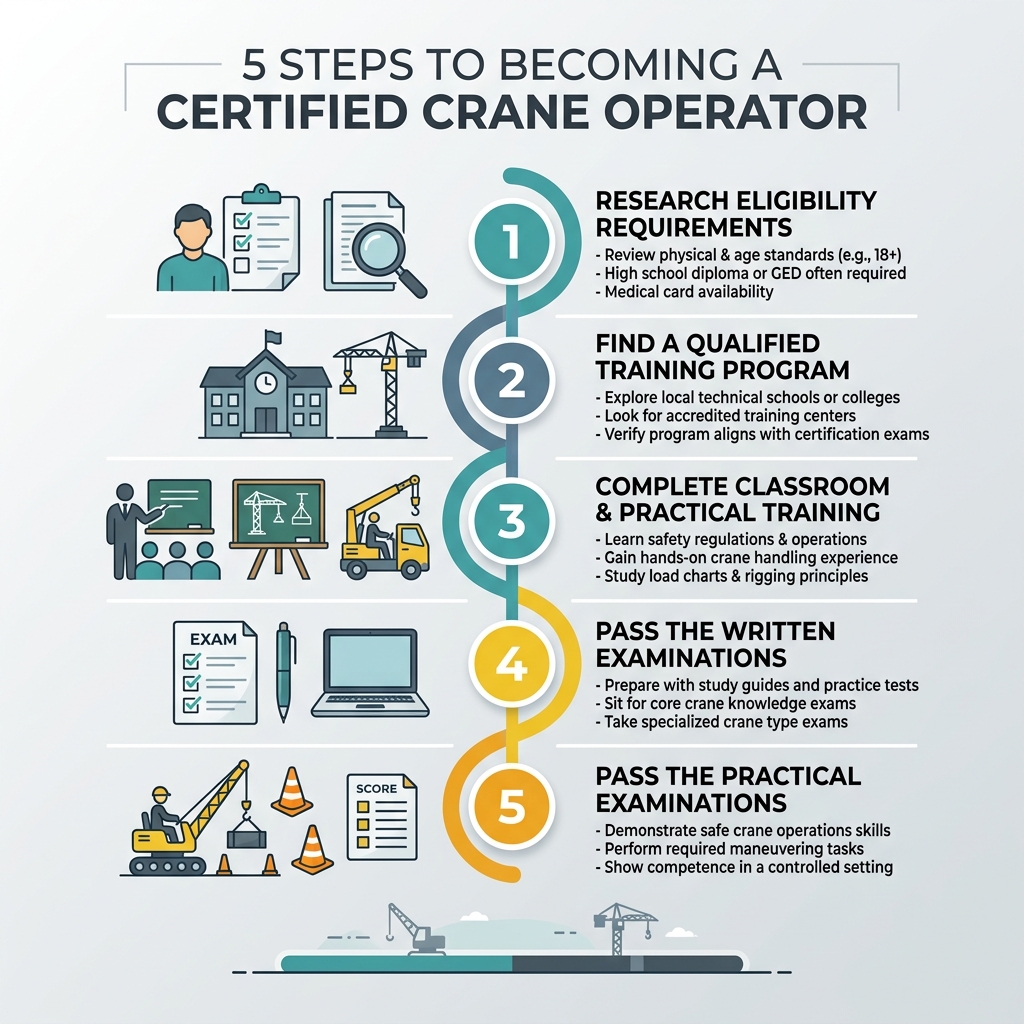
Terms related to crane certification near me:
Understanding Crane Certification and OSHA Requirements
When we talk about crane certification, we aren’t just talking about a piece of paper to hang on the wall. We are talking about a legal and safety mandate. Under OSHA 1926.1427, any operator engaged in construction-related crane activity must be “certified or qualified.” This standard ensures that every person behind the controls has the knowledge and skill to prevent catastrophic accidents.
The most widely recognized gold standard in the industry is the NCCCO (National Commission for the Certification of Crane Operators). While OSHA sets the law, organizations like the NCCCO provide the testing and credentials that prove you meet those laws. These certifications are also built around ANSI (American National Standards Institute) standards, ensuring that the training you receive is consistent across the country.
Being “nationally accredited” means your certification isn’t just valid in your home town; it’s recognized by employers from coast to coast. For a deeper dive into the specifics of these regulations, you can check out our crane operator certification complete guide or explore the nccco crane certification complete guide for a step-by-step breakdown of the testing process.
How to Find the Best Crane Certification Near Me
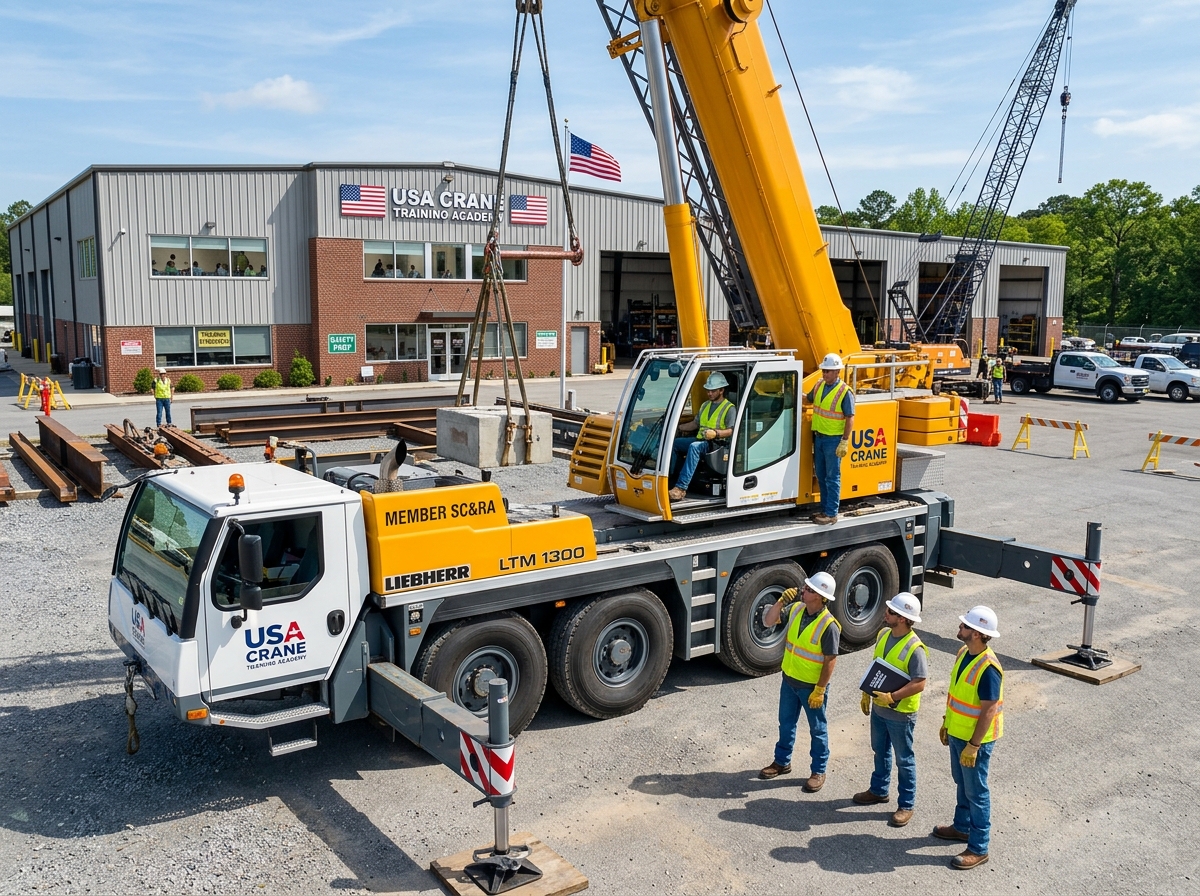
Searching for crane certification near me can sometimes feel like looking for a needle in a haystack, especially if you live in a specialized market like Indiana. However, the “best” school isn’t always the one with the shortest commute. A reputable school should offer a blend of classroom theory and, most importantly, hands-on practice.
When evaluating crane schools near me, look for providers that use real-world equipment. It is one thing to read about a load chart; it is another thing entirely to calculate a lift while sitting in a swing-cab telescopic crane. Reputable crane certification schools often provide assistance with the administrative side of things too—helping you navigate the myCCO portal and scheduling your practical exams.
If you are an employer, you might not even need a “school” in the traditional sense. Many top-tier providers offer on-site training, where instructors come to your facility in Danville or elsewhere in Indiana to train your team on the exact equipment they use every day. This is often the most efficient way to get a crew certified without the downtime of travel. You can find more about these options at our crane school information page.
Benefits of Local Crane Certification Near Me
Choosing a local provider or an on-site option offers several distinct advantages:
- Reduced Travel Costs: You save on hotels, airfare, and per diems for your staff.
- Local Networking: Training locally often connects you with regional employers and unions.
- State-Specific Licensing: While NCCCO is national, some states (like Minnesota or Maryland) have specific licensing hooks. Local trainers are usually experts in these nuances.
- Hands-on Familiarization: Training on the actual cranes you will be operating on the job site builds “muscle memory” that a generic simulator simply cannot match.
Training Programs, Costs, and Career Outlook
The path you take depends on the type of equipment you plan to operate. Certification isn’t a “one size fits all” deal. You might specialize in:
- Mobile Cranes: Including lattice boom, large telescopic (swing-cab), and small telescopic (fixed-cab).
- Tower Cranes: The giants of the skyline.
- Overhead Cranes: Common in manufacturing and warehousing.
- Articulating Cranes: Often referred to as “knuckle booms.”
For those already in the seat, recertification is a vital part of the career cycle. Every five years, you’ll need to prove you’ve kept your skills sharp.
The career outlook for certified operators is incredibly bright. With a median annual wage of over $64,000, crane operation is a high-demand trade that offers a path to the middle class without a four-year degree. The duration of training can vary—some “fast track” programs for experienced operators take only 3 days, while beginner programs might span several weeks to ensure enough “seat time.”
To understand how to start this journey, visit our guide on how to get crane certification. If you’re worried about the financial investment, we have a detailed breakdown of crane certification cost to help you plan.
What is the Average Cost of Crane Certification Near Me?
Pricing for crane certification near me depends heavily on your experience level and the number of certifications you are pursuing. Generally, a “Full Package” for a beginner—which includes classroom prep, rigging/signalperson training, and hands-on seat time—will be more of an investment than a simple recertification for a veteran operator.
Factors that affect pricing include:
- Exam Fees: These are paid to the certifying body (like NCCCO).
- Number of Crane Types: Adding a “specialty” (like moving from fixed-cab to swing-cab) adds cost.
- Location: On-site training often has a flat day rate plus travel, while open enrollment classes are priced per person.
For a specific look at the numbers, check out our resource on nccco certification cost.
Frequently Asked Questions about Crane Certification
How long does crane certification near me take?
We often get asked if you can become a crane operator in a weekend. The answer is: it depends. For experienced operators who just need to brush up on regulations and take the test, a 3-day prep course is standard. For those who have never touched a crane, we recommend a 5-day full package at minimum, though some community college programs can last 4 to 6 weeks to provide maximum seat time. You can find more details on timing at our crane training near me page.
What are the requirements for crane certification near me?
To get started with crane certification near me, you generally need to meet these baseline requirements:
- Age: You must be at least 18 years old.
- Medical: You must meet physical requirements (often requiring a DOT medical card or similar physical).
- Exams: You must pass a core written exam, specialty written exams, and a practical (driving) evaluation.
- Ethics: You must comply with the certifying body’s code of ethics.
Find a full list of prerequisites at our crane certification near me portal.
How often is recertification required?
NCCCO certifications operate on a five-year cycle. To recertify, you typically need to document at least 1,000 hours of crane-related experience during that period. If you meet the hour requirement, you only need to pass the recertification written exams. If you don’t have the hours, you may be required to retake the practical exam as well. Staying ahead of this deadline is crucial to avoid a gap in your ability to work. Learn more about the renewal process through our nccco schools resource.
Conclusion
At Train For The Crane, we understand that getting certified isn’t just about passing a test—it’s about coming home safe every night and building a career you can be proud of. Based in Danville, Indiana, we specialize in providing on-site NCCCO crane operator training that brings the school to you.
Our instructors bring over 30 years of combined experience to the table. We don’t just teach you how to pass the exam; we teach you how to be a professional operator. Our proven methods have led to exceptionally high pass rates, helping hundreds of operators in Indiana and beyond get their credentials and get to work.
Whether you are a company looking to certify your entire crew or an individual ready to take the next step in your career, we are here to help. Start your journey with professional crane training in Indiana today and see why so many operators trust us for their certification needs.