

What Is a Certified Operator Program (And Why It Matters)
A Certified Operator Program is a formal system that tests, verifies, and licenses the people responsible for running water and wastewater treatment facilities — ensuring they have the skills to protect public health and the environment.
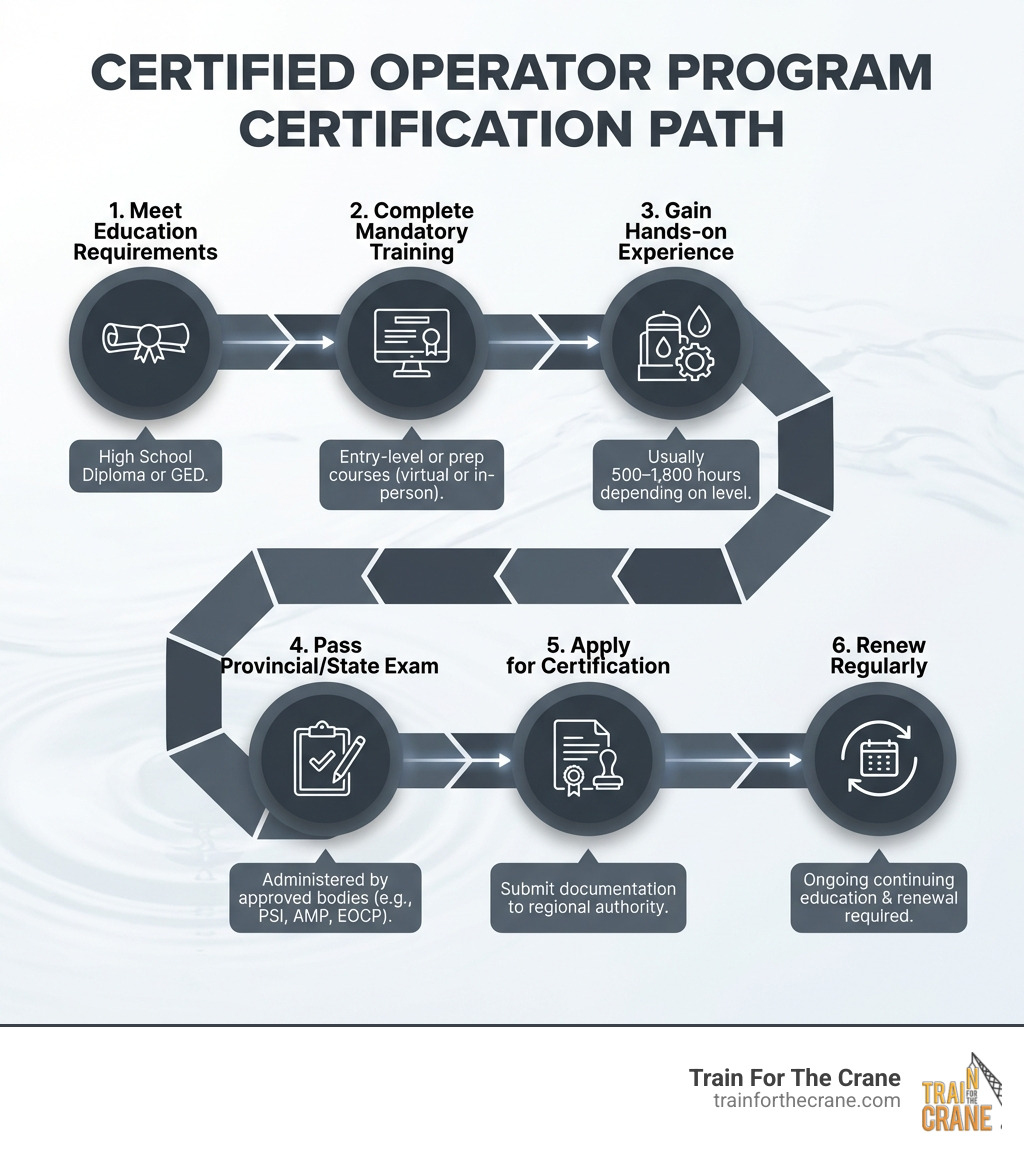
Here’s a quick overview of what’s typically involved:
| Step | What It Means |
|---|---|
| Meet education requirements | High School Diploma or GED |
| Complete mandatory training | Entry-level or prep courses (virtual or in-person) |
| Gain hands-on experience | Usually 500–1,800 hours depending on certification level |
| Pass a provincial or state exam | Administered through bodies like PSI, AMP, or EOCP |
| Apply for certification | Submit documentation through your regional authority |
| Renew regularly | Ongoing continuing education and renewal applications required |
Whether you’re in Alberta, Ontario, British Columbia, California, or New York, the core idea is the same: you need to prove you’re competent before you’re trusted to run systems that millions of people depend on daily.
The stakes are high. Drinking water systems, wastewater treatment plants, and distribution networks are complex. A mistake can mean contaminated water, environmental damage, or public health emergencies. That’s why governments across North America — backed by frameworks like the U.S. Safe Drinking Water Act (SDWA) — have made operator certification mandatory, not optional.
As one certification body puts it, a certified operator is the most valuable resource in a water and/or wastewater system — someone with the skills, knowledge, experience, and judgment to keep a facility running safely and efficiently.
This guide breaks down everything you need to know: requirements by region, training options, exam processes, renewal rules, and career paths.
Certified operator program terms to remember:
- Certified equipment operator
- boom truck certification requirements by state
- boom truck operator requirements
The Core Pillars of a Certified Operator Program
At its heart, a Certified operator program is designed to create a baseline of excellence. We often see similarities between water system operators and the heavy equipment world; just as a crane operator needs to understand load charts and physics, a water operator must master chemistry, microbiology, and complex hydraulic systems.

The program rests on several key pillars:
- Competency Standards: Ensuring every operator possesses the specific knowledge required for their class of facility.
- Risk Mitigation: Reducing the likelihood of system failures that could lead to waterborne illnesses or environmental catastrophes.
- Facility Performance: Maximizing the efficiency of expensive infrastructure, which in turn optimizes operational costs for the community.
- Standardized Evaluation: Providing a fair, consistent way to measure an individual’s “Direct Responsible Charge” (DRC) capability.
In many ways, this mirrors the rigorous standards found in NCCCO Certification, where safety and precision are the only acceptable outcomes.
Professional Recognition and Safety
Certification isn’t just about following rules; it’s about professional pride. When you earn your credentials, you aren’t just an “employee”—you are a recognized professional. In the water industry, this is often celebrated through “pinning ceremonies.” These events are frequently held in higher regard than high school or college graduations because they represent a commitment to safeguarding an entire community.
Furthermore, a Certified operator program drastically improves workplace safety. By ensuring every team member understands high-pressure systems and hazardous chemical handling, accident rates drop. This professionalization also aids in hiring and salary decisions, providing a clear ladder for career mobility. It is very similar to the clarity provided by knowing What is NCCCO Certification? when entering the construction trades.
Impact on Public Health
We cannot overstate the importance of the operator as a “guardian of public health.” Every time someone turns on a tap or flushes a toilet, they are relying on the expertise of a certified professional. By adhering to the Safe Drinking Water Act (SDWA) guidelines and maintaining strict pollution control, operators ensure that community wellbeing remains high. They are the invisible front line, preventing the spread of diseases and protecting local ecosystems from untreated waste.
Navigating Regional Requirements and Reciprocity
Because water and wastewater systems are managed at the state or provincial level, the requirements can shift depending on where you stand. However, most programs follow a similar tiered structure (Class I through IV).
Global Standards in a Certified Operator Program
In the United States, the Environmental Protection Agency (EPA) sets the baseline. If a state doesn’t maintain a compliant Certified operator program, the EPA can actually withhold 20% of that state’s Drinking Water State Revolving Fund (DWSRF) capitalization grant. This financial “stick” ensures that states like Indiana, New York, and California maintain high standards.
For instance, the California State Water Board oversees both drinking water and wastewater certification, requiring specific experience and education before an operator can even sit for an exam. Similarly, the New York Department of Health (DOH) manages a robust program to combat the current shortage of qualified professionals, offering career paths with significant flexibility and employer-supported training. Understanding these broad standards is as essential as consulting a National Crane Certification Complete Guide if you were switching to heavy equipment operation.
Transferring Credentials via Reciprocity
What happens if you move? Most Canadian provinces and U.S. states have reciprocity agreements. This means if you are certified in one region, you can often transfer those credentials to another without starting from scratch.
However, there are exceptions. Quebec, for example, operates its own distinct system where wastewater plants are categorized (A, B, or C) based on flow rate and technology complexity, and they don’t always follow the same reciprocity rules as the rest of Canada. In many regions, you can substitute up to 50% of your required experience with “allied trades” experience—such as plumbing or mechanical maintenance—which is a great way for veterans of other industries to transition. This is not unlike how a rigger might look at a Certified Rigger Guide 2025 to see how their skills translate across different job sites.
The Path to Certification: Education, Experience, and Exams
Getting started in a Certified operator program requires a mix of “book smarts” and “boots on the ground” experience.
- Education: At a minimum, you’ll need a High School Diploma or a GED.
- Operator in Training (OIT): This is the entry point. In many regions, you can become an OIT with just 90 hours (9.0 CEUs) of approved training or roughly three months (500 hours) of hands-on experience.
- Level I Certification: This typically requires 12 months (or 1,800 hours) of hands-on experience in a recognized facility.
This structured progression is very similar to the tiered learning found in a Certified Rigger Course, where you must master the basics before moving to complex lifts.
Mastering Exams within the Certified Operator Program
Once you meet the experience requirements, the exam is your final hurdle. Most states and provinces use standardized testing through providers like PSI or AMP.
- The Window: You usually have a 180-day eligibility period once your application is approved.
- The Retake: If you don’t pass on the first try, don’t panic. You can typically attempt the exam again every 30 days.
- Preparation: While some people “challenge” the exam based on experience alone, we highly recommend using study guides and prep courses. Just as a Certified Signal Person must know every hand signal by heart, you need to know your chemical dosage formulas and flow calculations.
Training Formats and Entry-Level Options
The modern Certified operator program is more flexible than ever. You can choose from:
- Virtual/Self-Paced Learning: Perfect for those already working a full-time job.
- Post-Secondary Programs: Many colleges offer dedicated water/wastewater diplomas that count toward your experience requirements.
- Intensive Prep Courses: Usually 3 to 4 days of focused study to get you ready for the Level I exam.
Whether you are looking for a Certified Rigger Complete Guide or a manual on wastewater microbes, the key is finding a format that matches your learning style.
Maintaining Excellence: Renewals and Career Advancement
Certification isn’t a “one and done” deal. To keep your license, you must be an active participant in your own professional development.
Application Processes and Fees
While we won’t get into specific dynamic pricing, it’s important to know that most programs involve an application fee (often around $145) and an exam administration fee (averaging $69 per attempt). Many jurisdictions are moving to digital portals, like the Water Wastewater Operator Certification System (WWOCS) in Ontario or the Certemy portal for Professional Operators (PO).
Pro-tip: Check your email! In Ontario, for example, effective June 16, 2025, all exam registration and results letters will be sent via email instead of traditional mail. Staying on top of these digital transitions is vital to avoid missing renewal deadlines. This focus on digital documentation is a trend we see across all industries, including the NCCCO Crane Operator Certification Complete Guide.
Career Paths in a Certified Operator Program
The sky is the limit once you’re in. You can move from a Level I Operator to a Level IV Chief Plant Operator, overseeing massive municipal systems. There are also specialized roles for contract operators—individuals or firms that manage private or smaller public plants on a contract basis.
With current workforce shortages, especially in states like New York, there has never been a better time to enter the field. The demand for multi-utility roles (people who can handle both water and wastewater) is particularly high. If you enjoy technical challenges and community service, this is a path that offers incredible job security. It’s a career journey very much like the one described in our Crane Operator Certification Complete Guide.
Frequently Asked Questions about Operator Certification
How do disruptions like postal strikes affect my certification?
In the event of postal disruptions, most certification offices switch entirely to email and online portals. For example, OWWCO has already signaled a shift to email for all official correspondence by mid-2025. Always ensure your email address is updated in your regional portal (like WWOCS or Certemy) and check your spam folder regularly. You can usually verify your current status through an online “Operator Listing Report” even if your physical certificate is delayed in the mail.
What are the experience requirements for Level I certification?
For most Level I certifications, you need 12 months of full-time, hands-on experience (roughly 1,800 hours). Some programs allow you to substitute up to 50% of this time with experience from related fields like maintenance, plumbing, or industrial mechanics. You will need a supervisor to verify these hours as part of your application.
Can newcomers use OIT certification for Express Entry?
It’s important to note that while an Operator-in-Training (OIT) certificate is a great career starter, it generally does not qualify for Express Entry points for permanent residency in Canada. If you are a newcomer, you should aim for the full Level I certification to maximize your immigration and career opportunities.
Conclusion
At Train For The Crane, we know what it takes to master a complex machine and a demanding certification process. Whether you are navigating a Certified operator program for water systems or looking to Start your journey with a Certified Mobile Crane Operator program, the principles of safety, dedication, and professional excellence remain the same.
The water industry is looking for the next generation of “water geeks”—people who care about their communities and aren’t afraid of a little technical heavy lifting. With the right training and a commitment to public safety, you can build a stable, rewarding career that truly makes a difference. So, water you waiting for? Get started on your certification today!