

Understanding Boom Truck Certification Across All 50 States
Boom truck certification requirements by state vary significantly, creating a “patchwork” of regulations. While federal OSHA provides the baseline (29 CFR 1926 Subpart CC), many states and even cities have implemented their own additional rules.
Key Takeaways:
- Federal Rule: OSHA requires certification for operators of boom trucks over 2,000 lbs capacity used in construction.
- State & City Variations: Some states require specific licenses, others mandate nationally accredited certification, and major cities can have their own unique rules.
- Federal-Only States: Many states simply follow the federal OSHA standard with no extra requirements.
States requiring specific operator licensing:
Connecticut, Hawaii, Massachusetts, Montana, New Jersey, New Mexico, New York, Pennsylvania, Rhode Island, West Virginia
States requiring nationally accredited certification:
California, Maryland, Minnesota, Nevada, Utah, Washington
States with no additional requirements beyond federal OSHA:
Alabama, Alaska, Arizona, Arkansas, Colorado, Delaware, Florida, Georgia, Idaho, Illinois, Indiana, Iowa, Kansas, Kentucky, Louisiana, Maine, Michigan, Mississippi, Missouri, Nebraska, New Hampshire, North Carolina, North Dakota, Ohio, Oklahoma, Oregon, South Carolina, South Dakota, Tennessee, Texas, Vermont, Virginia, Wisconsin, Wyoming
State regulations are in addition to federal OSHA guidelines, not replacements. States with their own OSHA plans often have stricter rules.
The Federal Foundation: OSHA’s Crane Operator Rules
All boom truck certification requirements by state begin with the federal foundation: the Occupational Safety and Health Administration (OSHA). OSHA’s rule, 29 CFR 1926 Subpart CC (Cranes and Derricks in Construction), established a national standard for crane operator qualification.
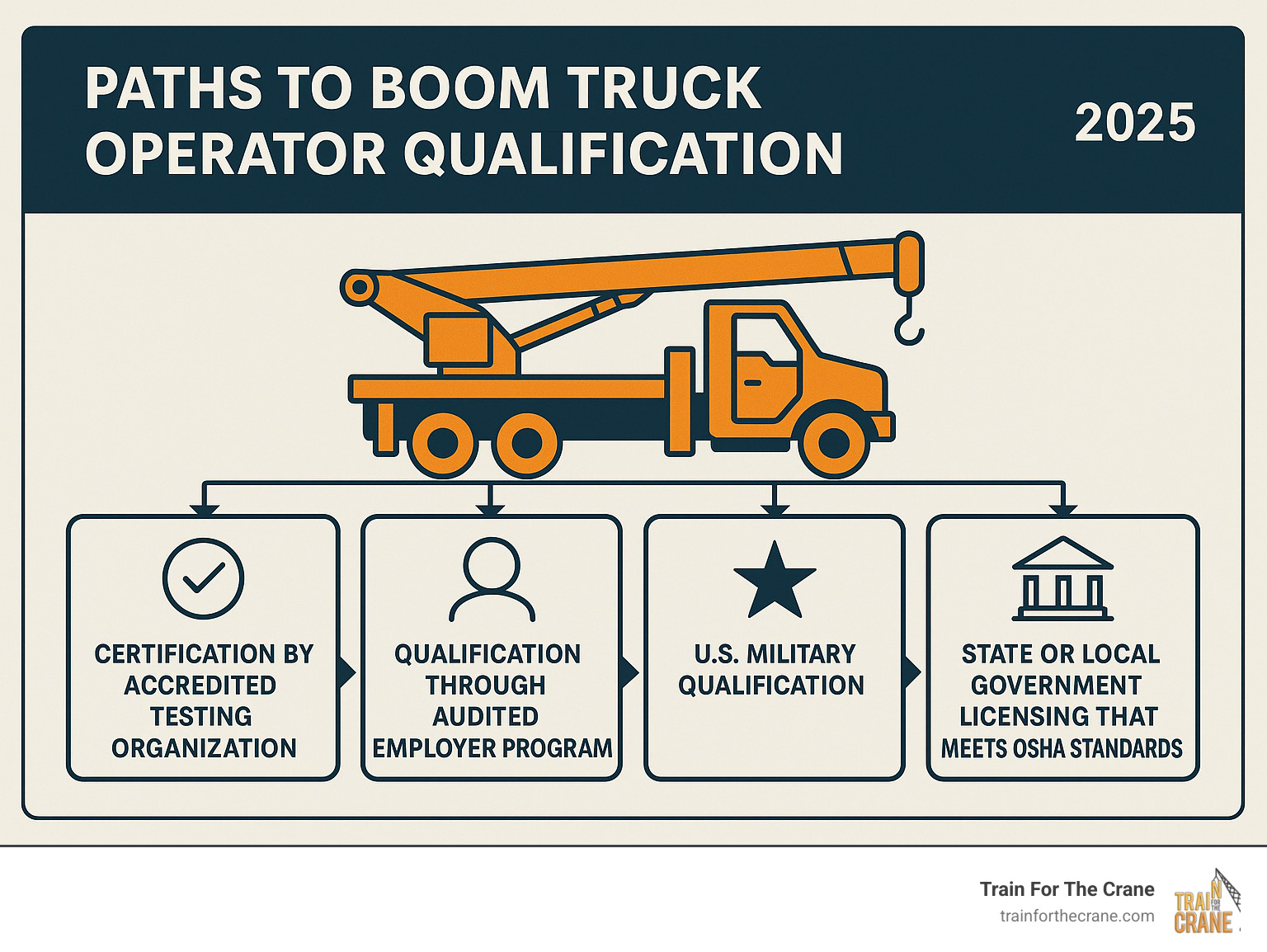
Effective November 10, 2018, this rule mandates that operators of most cranes with a lifting capacity over 2,000 pounds in construction must be certified. OSHA provides four ways to meet this requirement:
- Certification by an accredited testing organization: The most common path, involving exams from a nationally recognized body.
- Qualification through an audited employer program: A company’s internal training and testing program, which must be independently audited.
- U.S. military qualification: Training and qualification from the U.S. military is accepted.
- State or local government licensing: A license from a state or city program that meets or exceeds OSHA standards.
Some states have their own “OSHA-approved plans,” which may include stricter rules. Always check your specific state’s plan, which can be found on the official OSHA plans website.
Understanding OSHA’s Mandate
OSHA’s Cranes and Derricks Rule aims to prevent serious accidents by ensuring operators are not just certified, but also “qualified” for the specific crane and task. This places a significant responsibility on employers to verify competency.
Beyond the operator, the rule also mandates other key roles for a safe lift:
- Qualified Rigger: A person with the knowledge, training, and experience to handle rigging safely.
- Qualified Signalperson: Required when the operator’s view of the load or site is obstructed.
Ensuring all personnel are properly trained is essential for a safe job site. Train For The Crane provides comprehensive Crane Operator Certification to meet these standards.
Does This Apply to My Boom Truck?
OSHA’s rule applies to “power-operated equipment that, when used in construction, can hoist, lower and horizontally move a suspended load.” This definition covers most boom trucks used in construction with a capacity over 2,000 pounds.
- Telescopic Booms: If used to lift construction materials, operators require certification.
- Articulating (Knuckle) Booms: Certification is required if used to place materials (not just deliver them to the ground). Certification often depends on capacity, with a common threshold being 5 tons. If the crane is between 5 and 65 tons, certification is required.
- Digger Derricks: These are often exempt when used for their primary purpose of digging holes for poles. However, if used to lift suspended loads like a crane, they fall under the same certification rules.
Understanding these differences is crucial. For more details, review our guide on what you need to know about boom truck operator certification.
Navigating the Patchwork: Boom Truck Certification Requirements by State
While OSHA sets the federal baseline, the actual boom truck certification requirements by state create a complex patchwork. States can add their own regulations, meaning certification in one state doesn’t guarantee compliance in another.
The key difference is often “certification” vs. “licensure.”
- Certification usually means passing written and practical exams from a nationally accredited, third-party organization.
- Licensure means obtaining a state-issued credential, which often involves a state-specific application and exam process.
States with their own OSHA State Plans (like California or Washington) often have more stringent regulations than the federal standard.
States with Specific Operator Licensing
Some states, including Massachusetts, New York, New Jersey, Pennsylvania, and West Virginia, require operators to obtain a specific state-issued license. This involves passing state-administered exams and meeting requirements that are often more rigorous than federal guidelines. In New York City, for example, operators may need both a state and a city license. These state rules are in addition to OSHA standards. For detailed information, consult Your State Crane Regulations, Rules, and Licensing for Operators.
States Requiring Nationally Accredited Certification
Other states, such as California, Nevada, Utah, Washington, Maryland, and Minnesota, align with OSHA’s preferred approach by requiring nationally accredited certification. They accept credentials from recognized third-party testing organizations. This approach offers more standardization, making it easier for operators with a Crane Operator License from an accredited body to work across these states.
How to find the boom truck certification requirements by state
To find the exact requirements for your location, follow these steps:
- Start with your state’s Department of Labor or licensing board website for the most reliable information.
- Check for an OSHA State Plan if your state has one, as rules may be stricter.
- Investigate local rules. Major cities like New York City, Chicago, and Philadelphia often have their own operator requirements.
- Verify public vs. private sector rules, as some states have different requirements for government employees.
- Use industry resources as a starting point, but always confirm details with official government sources. Our resource on State-by-State Requirements for Boom Truck Certification can help guide your research.
How to Get Your Boom Truck Operator Certification
Once you understand your local boom truck certification requirements by state, the next step is getting certified. This credential proves your ability to operate powerful machinery safely and opens doors to better job opportunities.

The path to certification involves working with an accredited testing agency. Most programs combine classroom learning with hands-on training to prepare you for comprehensive written and practical exams. To learn about the full process, see our guide on How to Become a Crane Operator.
Choosing an Accredited Testing Organization
For nationally recognized certification, the National Commission for the Certification of Crane Operators (NCCCO) is the industry’s gold standard. Founded in 1995, NCCCO programs are ANSI accredited and recognized by federal OSHA as meeting compliance requirements.
NCCCO has administered over 800,000 exams to more than 130,000 operators across all 50 states. They offer a specific CCO Boom Truck—Fixed Cab (BTF) certification, developed in response to industry demand and OSHA’s crane rule. For more details, visit our page on Crane Operator Certification.
The Certification Exam Process
The certification process consists of two parts:
- Written Exams: You will take a core exam on general crane knowledge and a specialty exam for boom trucks. Key topics include Load Chart Knowledge, Site Operations, and Technical Knowledge of crane components and safety systems.
- Practical Exam: This is a hands-on test where you demonstrate your operating skills on a boom truck under the supervision of an examiner. You will perform various maneuvers to prove you can operate the equipment safely and efficiently.
For an idea of training costs, review our article on Crane Operator School Cost.
The Importance of Professional Training
While self-study is an option, professional training is the most effective path to certification. A quality program provides:
- Hands-On Experience: Crucial time in the cab to practice maneuvers in a safe, supervised setting.
- Expert Classroom Instruction: Experienced instructors clarify complex topics like load dynamics and regulations.
- Safety-First Mindset: Training instills a deep understanding of safe operating practices and hazard identification.
- Targeted Exam Preparation: Instructors who know the exams provide practice tests and targeted instruction to ensure success.
Our instructors have over 30 years of combined experience and a track record of high pass rates. Learn more about our comprehensive Crane Operator Training.
Staying Compliant: Renewals, Documentation, and Consequences
Earning your boom truck certification is a major step, but compliance is an ongoing process. It requires understanding renewal schedules, maintaining proper documentation, and knowing the consequences of non-compliance.

Failing to stay on top of boom truck certification requirements by state can lead to serious problems for skilled operators who miss a deadline or misplace paperwork.
Certification Renewal and Validity
Most nationally accredited certifications, including those from NCCCO, are valid for five years. This ensures operators remain current with evolving safety standards and regulations.
The recertification process typically requires passing written exams and providing proof of relevant work experience during your certification period. Some states or employers may also require continuing education. Start the renewal process well before your expiration date to avoid a lapse in your credentials. For cost insights, see our guide on Crane Operator Certification Cost.
Documentation You Must Have On-Site
OSHA and state inspectors require immediate access to specific documents on the job site. You must have:
- Your certification card with you at all times while working.
- Proof of training for specific equipment or safety protocols.
- A current medical evaluation if required by your certification or state.
Employers must also maintain accessible records, including copies of operator certifications, qualifications for riggers and signalpersons, and equipment inspection reports.
Penalties for Non-Compliance
Operating a boom truck without proper certification carries severe consequences:
- Fines: OSHA and state penalties can range from thousands to tens of thousands of dollars per violation.
- Legal Liability: In case of an accident, an uncertified operator creates serious legal and financial liability for both themselves and their employer.
- Insurance Complications: Many insurance policies are voided if an accident involves an uncertified operator.
- Work Stoppages: An inspector can shut down an entire project for certification violations, causing costly delays.
The risks of non-compliance far outweigh any benefit of cutting corners. Maintaining your certification protects your safety, your livelihood, and your professional reputation.
Frequently Asked Questions about Boom truck Certification
Navigating boom truck certification requirements by state can be complex. Here are clear answers to some of the most common questions we receive.
Do certification requirements change based on the boom truck’s capacity or type?
Yes. The federal OSHA rule applies to cranes used in construction with a capacity over 2,000 pounds. Beyond that, specific types have different rules:
- Knuckle Boom Cranes: Certification is often required for capacities between 5 and 65 tons, especially when used to place materials rather than just for delivery.
- Telescopic Boom Trucks: Generally fall under the 2,000 lb. rule and require certification for construction lifting.
- Service Truck Cranes: While a broader Telescopic Boom—Fixed Cab (TSS) certification covers these, a specific Service Truck Crane Operator (STC) certification is also available for smaller cranes (typically 1-7 tons).
- Digger Derricks: Are exempt when used only for digging holes. If used to lift suspended loads, they are subject to crane certification rules.
How often does my boom truck certification need to be renewed?
For most nationally recognized certifications, like those from NCCCO, your boom truck operator certification is valid for five years. You must complete the recertification process before your current certification expires to remain compliant.
What’s the difference between being “certified” and “qualified”?
This is a really common question, and it can be a bit confusing because these terms are often used interchangeably in everyday talk. But in OSHA and crane safety, they have distinct meanings!
Being “certified” means you’ve successfully passed a formal test. This usually involves written and practical exams given by an accredited, independent organization (like NCCCO) or a state licensing authority. When you’re certified, it shows that you’ve met a recognized standard of knowledge and skill for a specific type and capacity of crane. Think of it as getting your diploma for crane operation – it proves you know your stuff through testing!
Being “qualified”, on the other hand, is a broader term. It means that an employer has determined you have the necessary knowledge, training, and experience to safely operate a specific piece of equipment for a specific task on a particular job site. Your employer might “qualify” you for certain tasks, even if a formal certification isn’t absolutely required for that exact piece of equipment (for example, for cranes under that 2,000 lb. threshold, or for certain maintenance jobs). It’s about your employer designating you as competent for the work at hand, based on your overall abilities and the job’s demands.
Here’s the key connection: under OSHA’s rules for cranes over 2,000 lbs in construction, one of the main ways to become “qualified” is by being “certified.” So, while “certified” refers to passing the test, a “certified” operator is generally considered “qualified” for the crane types and capacities they’ve been certified for. The goal is always to have both: a certified operator who is also fully qualified for the specific work they’re doing. It’s all about ensuring safety on every job site!
Get Certified and Lift Your Career
You now understand the landscape of boom truck certification requirements by state. Getting certified is more than just meeting regulations—it’s an investment in your career that lifts you to a community of skilled professionals.
Certification builds a stronger safety culture, with operators who understand their responsibility to protect everyone on the job site. From a career standpoint, it opens doors to better jobs, supervisory roles, and major construction projects. Certified operators are in demand because they bring reliability, skill, and reduced liability to any operation.
As a certified professional, you provide immense value to employers by demonstrating a commitment to excellence, reducing their training burdens, and helping them qualify for larger, more profitable projects.
At Train For The Crane, our instructors have over 30 years of combined experience helping thousands of operators achieve their certification goals. We use proven methods to prepare you for success.
The path forward is clear: get the right training, pass your exams, and build a secure and growing career. Don’t let regulatory complexity hold you back. With the right support, you can master these challenges.
Ready to lift your career? Get started with our Mobile Crane Operator Training and find why so many professionals trust us to guide their certification journey.