

Why Crane Lift Planning is Critical to Construction Safety
Crane lift planning is a documented process ensuring every lift is safe, efficient, and compliant. This roadmap for crane operations covers everything from load analysis to personnel assignments.
Essential Elements of Crane Lift Planning:
- Load Analysis – Weight, dimensions, and center of gravity calculations
- Site Assessment – Ground conditions, clearances, and environmental factors
- Equipment Selection – Appropriate crane capacity and rigging gear
- Personnel Roles – Qualified lift director, operator, rigger, and signal person
- Risk Mitigation – Hazard identification and emergency procedures
- Documentation – Written plans for critical lifts (>75% capacity)
The stakes are high. Research shows crane incidents often stem from inadequate or non-existent planning. As one industry expert noted, “Without a plan, everyone thinks they know what needs to be done, which is inefficient and dangerous.”
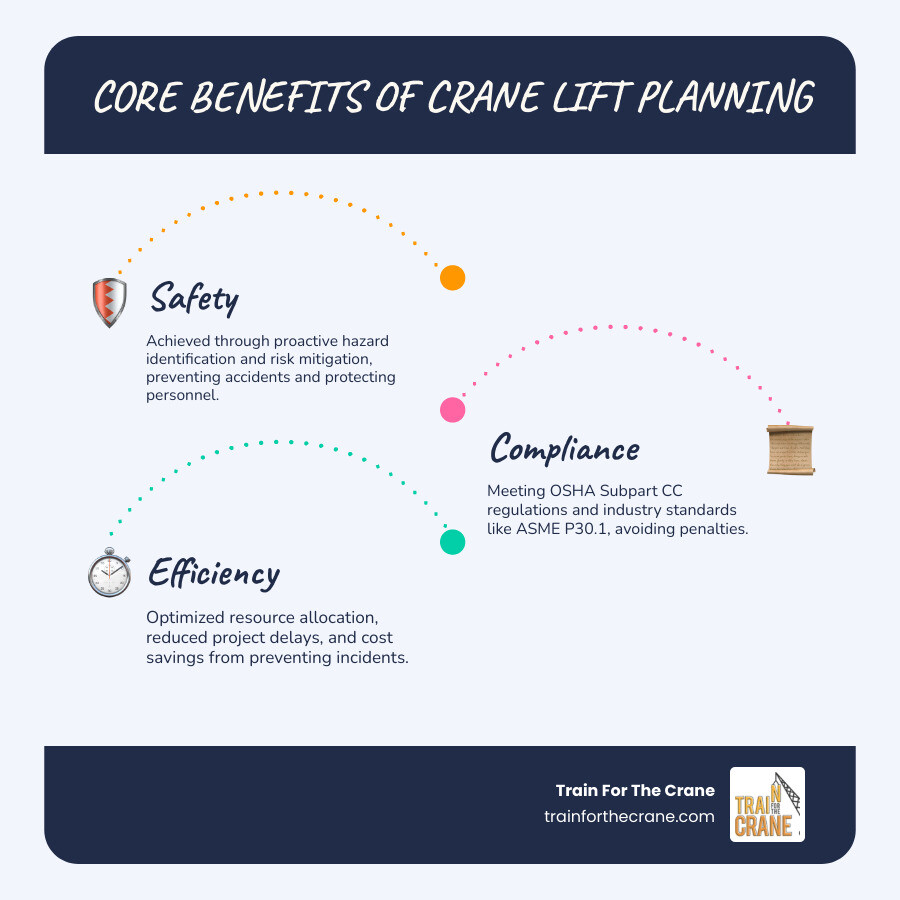
Effective lift planning isn’t just about checking regulatory boxes—it’s about preventing accidents, reducing costs, and increasing productivity by protecting both equipment and personnel.
The principles apply to both standard and critical lifts. The key is knowing when a verbal briefing is enough versus when a detailed, OSHA-compliant plan is required.
The Foundation of a Safe Lift: Why Planning is Non-Negotiable
Suggesting to “figure it out as we go” when moving a 10-ton load is a recipe for disaster. In heavy lifting, there’s no room for improvisation when lives and equipment are at stake.
Crane lift planning isn’t just good practice—it’s essential. Every lift carries risks that demand careful preparation. The difference between a successful operation and a catastrophic accident often comes down to the quality of the plan.
OSHA Subpart CC and the ASME P30.1 standard mandate proper planning for crane operations. These regulations aren’t just red tape; they are safety frameworks built from past accidents to prevent future tragedies.
Good planning saves money and keeps people safe. Thinking through problems upfront avoids costly emergencies and leads to better resource use and risk management. That’s why Crane Lifting Safety always starts with thorough preparation.
What is a Crane Lift Plan?
A crane lift plan is the GPS for your operation—a detailed roadmap for a safe lift from start to finish.
This documented procedure is a step-by-step guide detailing the crane, load, rigging, and personnel responsibilities. More than just paperwork, it’s a vital communication tool ensuring the entire team is on the same page. The plan creates a controlled, predictable process, acting as a safety blueprint that eliminates guesswork and boosts operational efficiency.
How a Plan Mitigates Risk
Crane lift planning offers a proactive approach to safety. Instead of reacting to problems, a solid plan helps you spot trouble before it starts.
This approach allows you to identify potential failures—such as crane overload, unstable ground, or collision hazards—and address them with solutions like ground mats or clear exclusion zones. By asking “what if” about wind, ground conditions, or visibility, the plan helps you protect personnel, prevent property damage, and ensure stability.
Smart planning creates a controlled environment, ensuring the crane’s power works for you, not against you. It’s about respecting the machine’s capabilities while never forgetting the consequences of getting it wrong.
The Anatomy of a Comprehensive Crane Lift Plan
Think of a well-crafted crane lift plan as the blueprint for a safe and successful operation. Just as you wouldn’t build a house without detailed architectural plans, you shouldn’t attempt a crane lift without proper documentation and preparation.
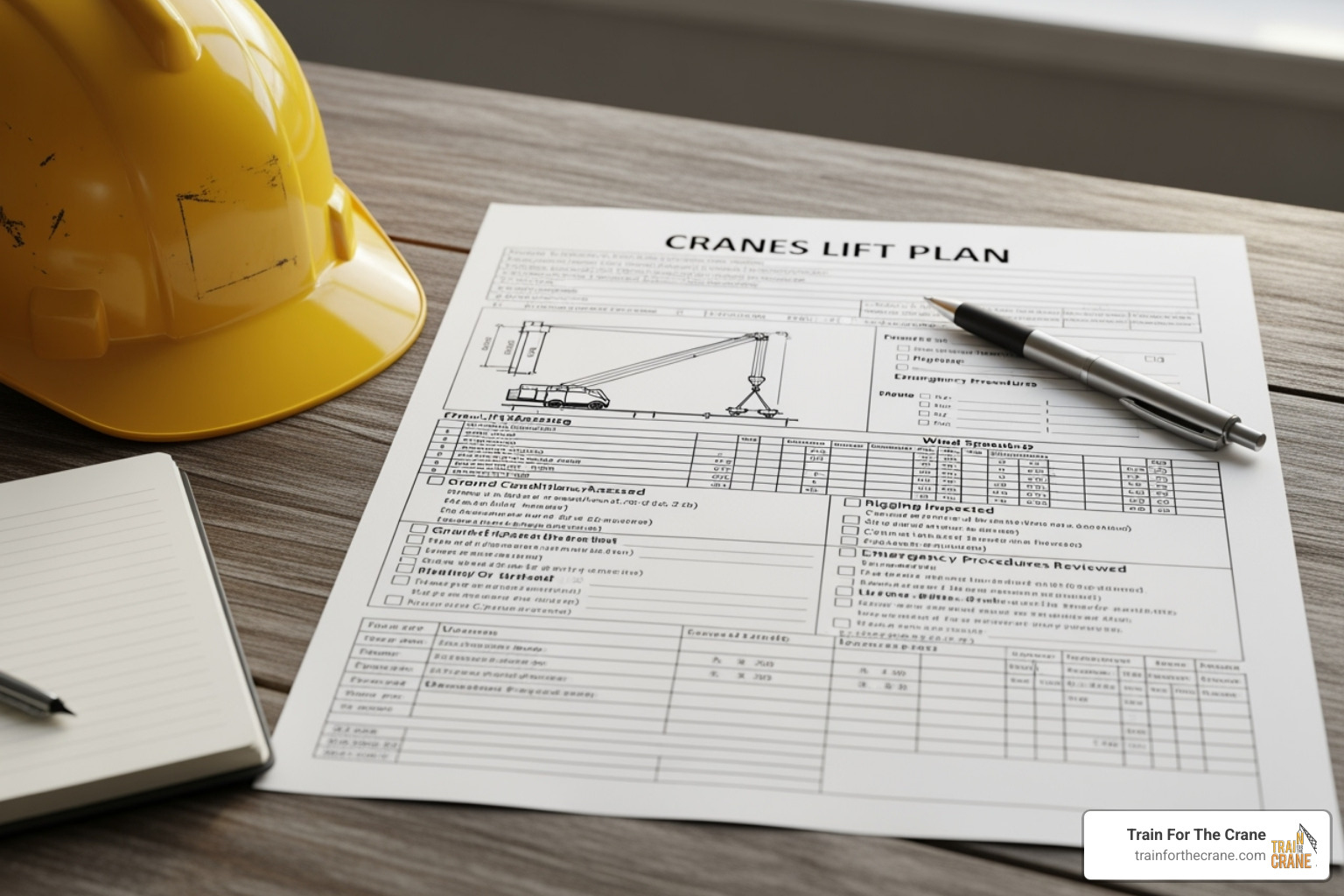
An effective lift plan must cover essential areas: project details, crane specifications, load description, rigging gear, site layout, assembly specs, crew roles, communication protocols, hazard identification, and documentation. This cohesive document transforms a potentially chaotic situation into a smooth, controlled process.
Essential Steps for Developing Your Crane Lift Planning
Creating an effective lift plan is a methodical process requiring attention to detail.
Step 1: Load Analysis is the foundation. You must know the total weight, including the load and all rigging. Critical lifts require detailed calculations. Accurately determining the center of gravity is vital to prevent unexpected load swings.
Step 2: Site & Environmental Assessment requires a site visit. Assess ground stability, overhead obstructions, underground utilities, and weather. A thorough walk-down can reveal soft ground needing mats or hidden power lines.
Step 3: Crane & Rigging Selection combines load and site data to choose the right equipment. Select a crane with an ample safety margin and ensure all rigging is inspected, rated, and compatible.
Step 4: Personnel & Roles defines responsibilities for the lift director, operator, rigger, and signal person. Clear communication protocols are essential to prevent confusion.
Step 5: Documentation & Review finalizes the plan for review and approval before work begins. This crucial step catches problems while they are still easy to fix.
Key Components to Include in Your Crane Lift Planning
Certain components directly impact safety and deserve extra attention:
- Load weight & dimensions: Calculate gross weight (load + rigging) and use dimensions to check clearances and potential collision points.
- Center of gravity (CoG): Crucial for preventing load tilt, especially with irregularly shaped objects.
- Crane capacity charts: Use these to confirm the crane can handle the load at the required configuration, always including a safety margin.
- Ground bearing pressure: Calculate to ensure the ground can support the crane, specifying mats or cribbing as needed.
- Travel path planning: Map the load’s entire path, identifying all potential hazards like power lines or buildings.
- Emergency procedures: Define clear steps for handling equipment malfunctions, weather changes, or other unexpected events.
These components create a comprehensive safety framework. When you’re ready to take your planning skills to the next level, understanding How to Create a Critical Lift Plan becomes essential.
Standard vs. Critical Lifts: Tailoring Your Planning Approach
Not every lift requires the same planning intensity. The principle is simple: match the level of planning to the complexity of the lift. Industry standards like ASME P30.1 categorize lifts as either standard or critical. This practical framework dictates the required level of planning and documentation.
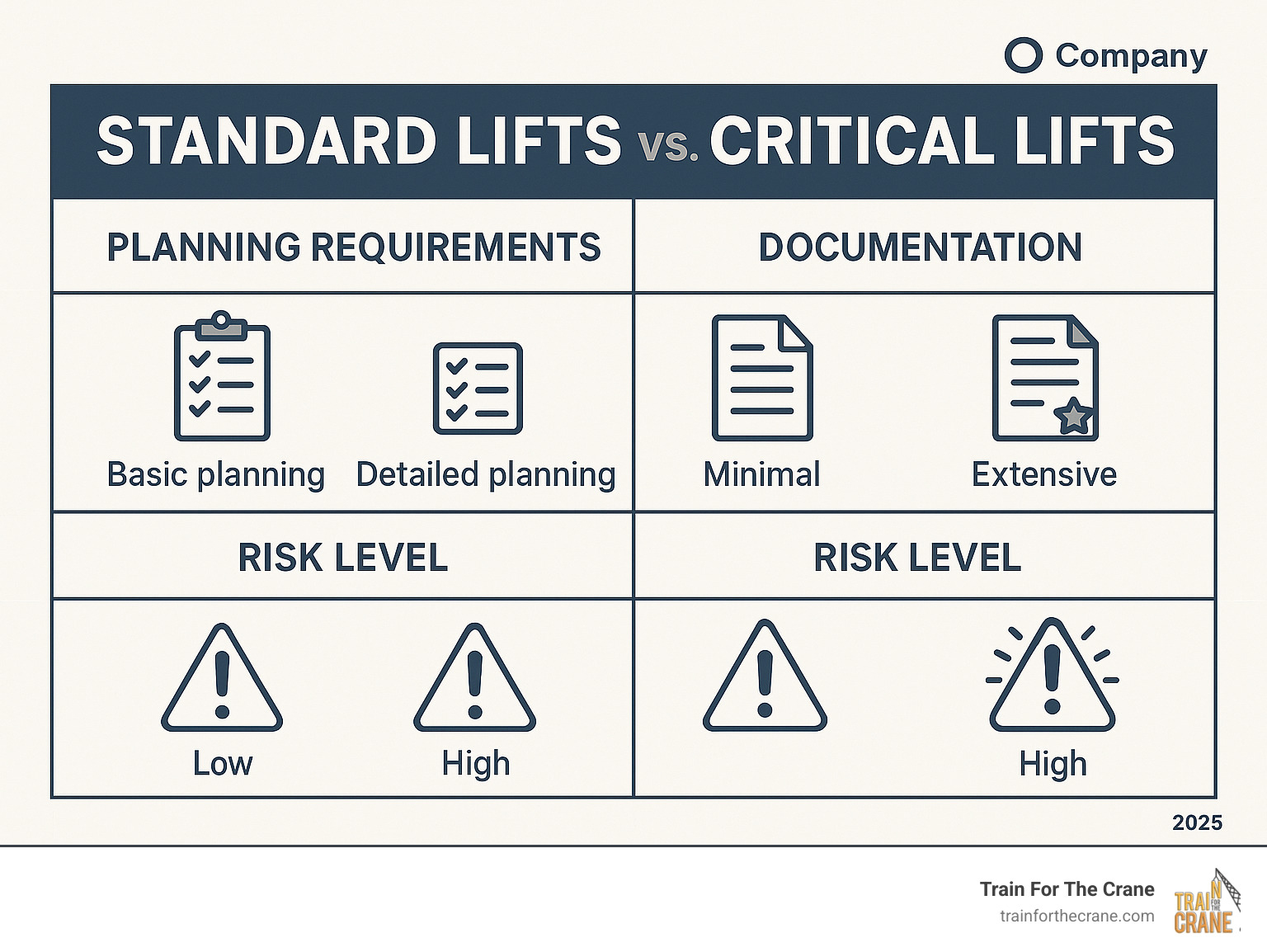
A key differentiator is OSHA’s 75% capacity rule: a lift exceeding this threshold is critical. However, operational complexity and potential consequences are also determining factors.
| Criteria | Standard Lifts | Critical Lifts |
|---|---|---|
| Definition | Straightforward, routine operations with no serious hazards to personnel or property; often repetitive. | High-risk operations due to load characteristics, site conditions, or operational complexity. |
| Capacity Relation | Typically well below 75% of the crane’s rated capacity. | Exceeds 75% of the rated capacity of the crane or derrick (as defined by OSHA). |
| Operational Scope | Single-crane operations, generally within established parameters. | May involve multiple cranes/derricks, personnel baskets, traveling with a load, lifting over public spaces, or loads that need “tripping” (upending). |
| Documentation | Can be verbal or a simple written checklist, depending on company policy. A mental checklist by experienced personnel might suffice for highly routine tasks. | Requires a detailed, documented, and often engineered lift plan. This plan must be formally reviewed and approved by qualified persons and, for certain criteria, a professional engineer may be required. |
| Risk Level | Lower inherent risk, assuming proper training and equipment. | Significantly higher inherent risk, with greater potential for severe injury, property damage, or fatalities if planning is inadequate. |
| Personnel | Experienced and qualified personnel are crucial, but the specific roles might be combined or less formalized than for critical lifts. | Requires a highly structured team with clearly defined roles, including a designated Lift Director, certified operators, riggers, and signal persons. |
| Training Needs | Standard crane operator training and safety briefings. | Specialized training in critical lift planning, advanced rigging, and specific hazard recognition. Our Lift Director Training covers these advanced scenarios. |
| Review Process | Often reviewed by the immediate supervisor or crane operator. If the plan doesn’t work, the operation must stop for re-evaluation. | Subject to rigorous review by multiple qualified individuals and potentially external engineers. Unplanned changes require immediate cessation of work and re-approval. |
Understanding Standard Lift Plans
Standard lifts are the routine workhorses of a job site, like unloading materials or moving small equipment. These simple, repetitive operations involve non-critical loads well below the crane’s capacity. Planning for these tasks is straightforward. A verbal briefing with an experienced crew may be sufficient, though a simple written plan is always a good safety practice. While flexible, standard lift planning has one non-negotiable rule: if the lift deviates from the plan, work must stop until a revised plan is established.
Defining a Critical Lift Plan
Critical lifts are high-risk operations with almost no margin for error. OSHA defines any lift exceeding 75% of the crane’s rated capacity as critical. Other triggers include multi-crane lifts, personnel lifting, and operating in hazardous environments like near power lines or over occupied buildings.
The planning for critical lifts is intensive, involving detailed calculations, hazard assessments, and formal reviews by qualified professionals. The ASME P30.1 standard provides the framework, but execution requires deep expertise.
This is where specialized training becomes invaluable. Our Lift Director Training program specifically addresses these complex scenarios, preparing professionals to handle the unique challenges that critical lifts present.
Assembling Your A-Team: Roles, Responsibilities, and Site Considerations
A great crane lift plan is useless without the right team. A successful lift is like an orchestra: each member knows their part, follows the conductor, and works together to ensure a safe, efficient operation.

The pre-lift “toolbox talk” is critical. The team reviews the plan, discusses concerns, and confirms roles. Clear communication and teamwork are the foundation of a successful lift.
Key Personnel and Their Duties
Building the perfect lifting team means understanding each role:
- The Lift Director leads the operation. As an OSHA-defined “qualified person,” they oversee all aspects, from site prep to critical safety decisions. Our Lift Director Training develops these essential skills.
- The Crane Operator must be certified and possess exceptional Crane Operator Skills to safely manage the machinery. They monitor stability, watch for changing conditions, and respond precisely to signals.
- The Qualified Rigger ensures the load is connected properly. They select and inspect rigging gear and attach it correctly, using their knowledge of sling angles and load limits to prevent accidents.
- The Certified Signal Person is the operator’s eyes on the ground. Using clear signals, they guide the load and ensure safe clearances, especially when the operator’s view is obstructed.
- The Site Supervisor manages the overall site, coordinating the lift with other activities, controlling access to the work area, and enforcing site-wide safety protocols.
Assessing Environmental and Site Conditions
Smart assessment of these factors prevents dangerous surprises:
- Ground conditions are fundamental. The ground must be firm and level enough to support the crane’s immense load. Planners calculate ground-bearing pressure to determine if mats or cribbing are needed to prevent the crane from tipping or sinking.
- Underground utilities are hidden dangers. All buried pipes, cables, and sewers must be located before setting up the crane to avoid catastrophic strikes.
- Overhead obstructions like power lines, buildings, and trees require constant vigilance. Planners must maintain minimum approach distances from power lines, coordinating with utility companies to de-energize them if necessary.
- Wind and weather can quickly turn a routine lift dangerous. High winds reduce capacity and cause load swing. Planners must set wind speed limits and monitor forecasts, postponing the lift if conditions are unsafe.
Modernizing Your Approach: Technology in Lift Planning
Crane lift planning has evolved far beyond manual calculations. Modern digital tools offer increased accuracy, improved visualization, improved safety, and efficiency gains, revolutionizing lift operations.
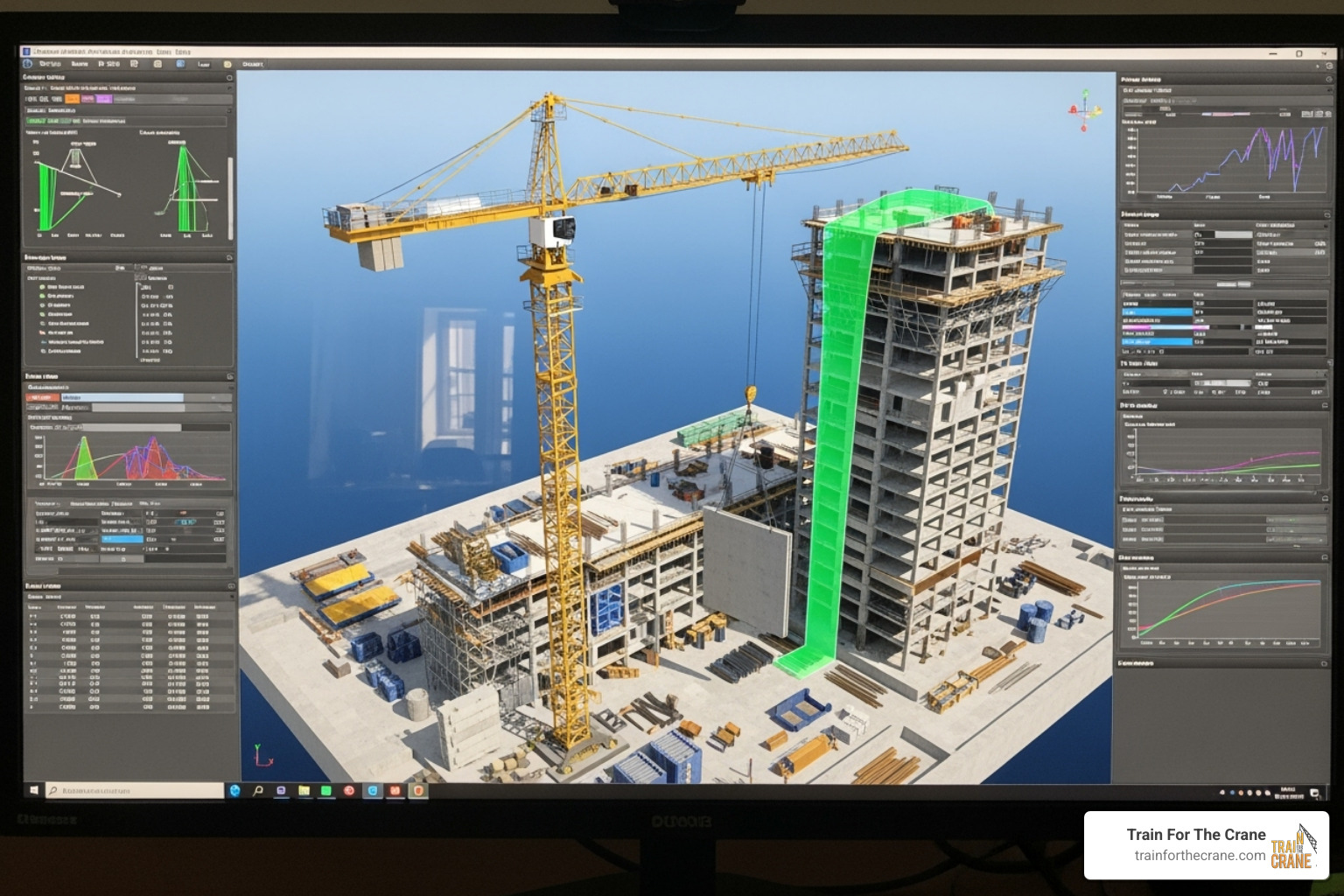
Just as GPS replaced paper maps, digital tools allow planners to create detailed 3D models of the entire lift scenario before arriving on site. These models help identify problems invisible in 2D drawings, like tight clearances or path conflicts, allowing for early adjustments.
Tools and Resources for Lift Planners
Digital lift planning tools create virtual environments to model the crane, load, rigging, and job site, revolutionizing how complex lifts are planned. Simulations allow planners to run through the entire lift virtually, identifying and fixing problems long before the actual crane is on site.
Other valuable resources include sophisticated load calculation tools for determining center of gravity, digital databases for streamlined crane selection, and software for fleet management to track maintenance and certifications. Our comprehensive resource on 3D Lift Planning Tools and Resources covers these modern approaches in detail.
The Role of Simulation in Training
Technology excels in training. Simulated lift scenarios offer a risk-free environment for personnel to practice skills without real-world danger. Crane simulators let trainees experience diverse scenarios, including rare critical lifts, where mistakes become learning opportunities.
Simulation is also highly effective for hazard recognition training, exposing trainees to dangers like power lines safely. It’s also ideal for emergency response practice, building muscle memory for handling crises.
Simulation allows for learning from mistakes without consequences, much like a flight simulator. Our Crane Operator Training uses these techniques for comprehensive, practical experience. Technology doesn’t replace skilled personnel; it empowers them. The combination of modern tools and experienced instruction creates the most effective training environment.
Frequently Asked Questions about Crane Lift Planning
Crane lift planning can seem complex with its regulations and technical details. We’re here to answer the most common questions we encounter in our training sessions.
Is a lift plan legally required for every single lift?
OSHA requires a documented lift plan for critical lifts—those exceeding 75% of the crane’s capacity, involving multiple cranes, or lifting personnel. While not legally mandated for standard lifts, planning is always a best practice. Even a brief team discussion or mental checklist improves safety. The key is to match the planning depth to the risk level.
Who is responsible for creating the lift plan?
The Lift Director is ultimately responsible. As an OSHA-defined “qualified person,” they have the experience to lead the planning process. While they gather input from operators, riggers, and supervisors, the Lift Director makes the final decisions and signs off on the plan. This significant responsibility highlights the need for proper training to make confident, informed decisions.
What is the most common cause of lift plan failure?
The most common cause is inadequate site assessment. Plans fail when they aren’t based on accurate, site information. Blueprints don’t show everything; a site walk is essential to identify poor ground conditions, hidden overhead obstructions, or underground utilities. As one of our senior instructors always says, “The site visit is where theory meets reality, and reality usually wins.”
Rushing this step can lead to disaster. A plan is only as good as the information it’s built on, which is why we emphasize thorough site assessment in our training programs.
Conclusion
As we’ve covered, crane lift planning is the foundation of safe lifting operations. It’s more than just paperwork; it’s the key to preventing disaster.
Thorough planning means understanding the load, assessing the site, and selecting the right equipment. The core principles—proactive planning, clear communication, and unwavering safety—apply to all lifts, from standard to critical.
Qualified personnel are essential. A skilled Lift Director, operator, rigger, and signal person work together to execute the plan. Without this expert team, a plan is just paper. While technology improves planning, it doesn’t replace the seasoned judgment of experienced professionals.
At Train For The Crane, we’ve seen how proper training from experienced instructors transforms good intentions into measurable results. Our instructors bring over 30 years of combined field experience to every training session. They understand that effective crane operations start with solid fundamentals and build toward advanced skills through proven methods that consistently deliver high pass rates for certification exams.
The stakes in our industry are simply too high for anything less than excellence. Every lift plan you create, every safety briefing you conduct, and every decision you make on site has real consequences. That’s why we’re passionate about ensuring your team has the knowledge and skills to execute plans safely and efficiently.
Ready to ensure your next project has expert oversight? Learn more about how to hire a qualified Lift Director who can bring the experience and expertise your operations demand.