

Why Rigger Certification is Essential for a Safe and Successful Career
Rigger certification training provides the essential knowledge and skills needed to safely handle heavy loads in construction, manufacturing, and warehousing environments. As OSHA regulations tighten and new ASME B30.5 standards require qualified riggers for mobile cranes of 1 ton or more, proper certification has become critical for both safety and career advancement.
Key rigger certification levels and requirements:
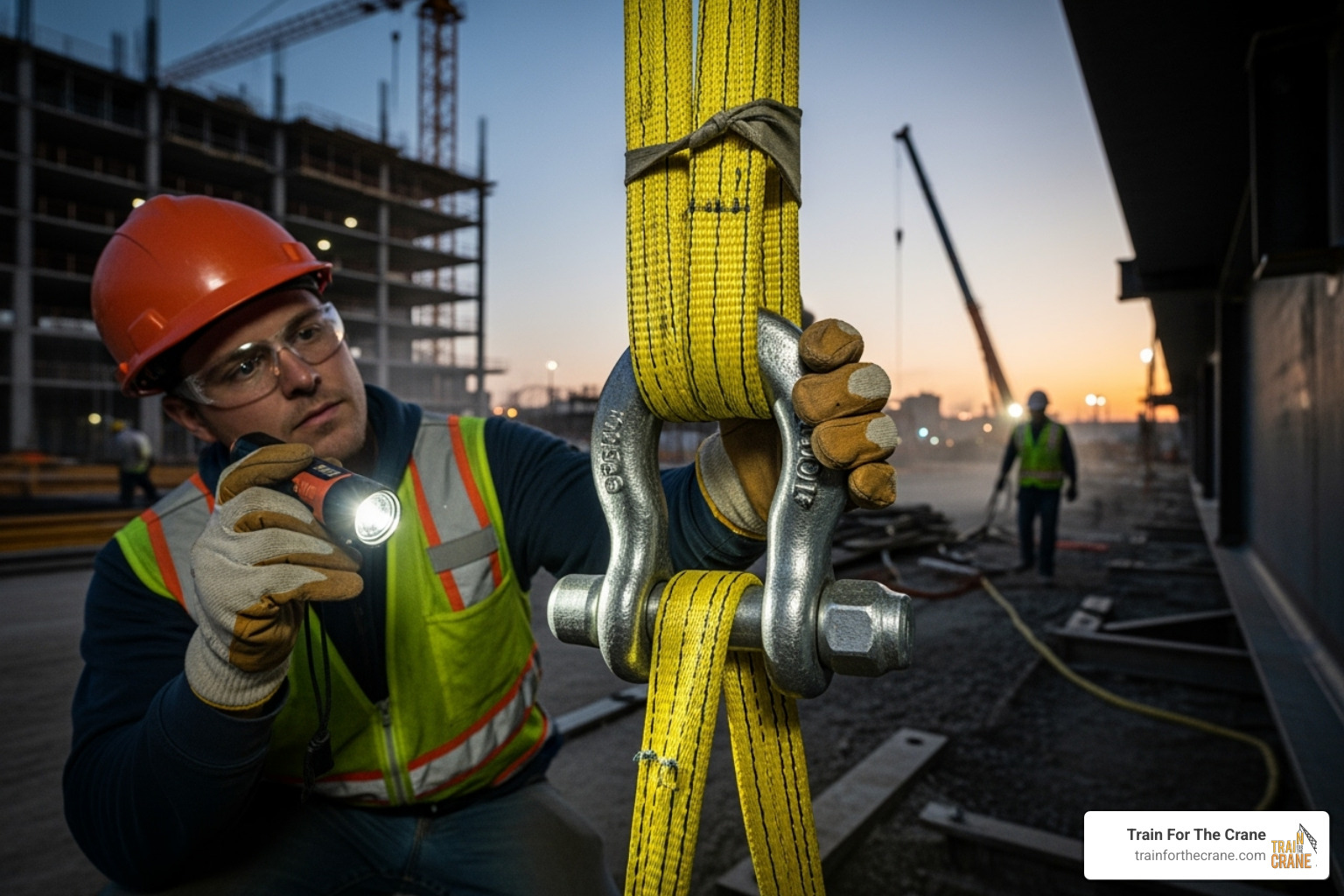
- Level 1 (Basic): Entry-level training covering rigging fundamentals, sling types, and basic load calculations
- Level 2 (Advanced): Complex rigging techniques, master rigging skills, and specialized equipment
- Prerequisites: No experience required for Level 1; 2+ years experience typically needed for advanced levels
- Duration: 8-16 hours for basic training, up to 95 hours for advanced programs
- Validity: Most certifications last 2-5 years before renewal required
- Standards: Must meet OSHA 29 CFR 1926 and ASME B30 safety requirements
Statistics show that well-trained riggers significantly reduce workplace injuries and fatalities. Without proper training, operators risk dropping loads, damaging equipment, or causing severe injury. New regulations effective December 17, 2022, now require certified riggers for most mobile cranes, meaning qualified riggers must pass both written and practical examinations to meet industry standards.
Beyond safety compliance, rigger certification opens doors to higher-paying positions and greater job security. Certified riggers demonstrate professional credibility and possess the technical skills that employers demand.
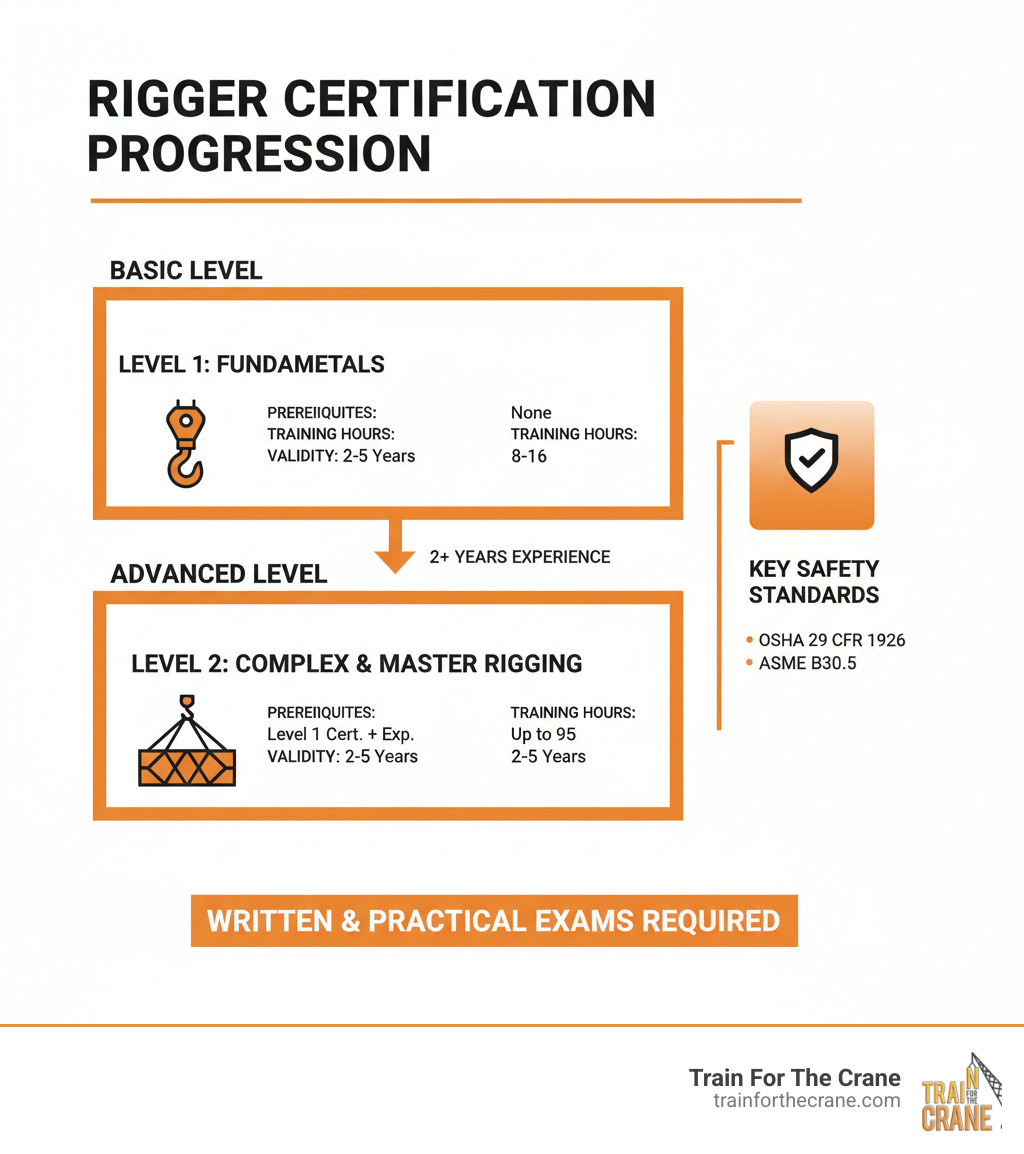
For anyone involved in lifting heavy materials, rigger certification training is an absolute necessity. Comprehensive training is the cornerstone of a secure and productive workplace. Our programs are designed to provide users with the knowledge they need to comply with relevant ANSI, CSA, and ASME standards, ensuring consistently safe and efficient operations. This dedication to safety helps safeguard lives, protect valuable assets, and foster a culture of professionalism on every job site.
Understanding Rigger Certification Levels and Pathways
When starting your journey in rigger certification training, it’s important to understand the terminology. The distinction between a “qualified” rigger and a “certified” rigger, while simple, has significant implications for your career.
A qualified rigger is someone an employer has deemed skilled enough for specific rigging tasks. A certified rigger, however, has passed both written and practical exams from an accredited body, providing third-party validation of their skills.
New OSHA and ASME B30.5 regulations that took effect on December 17, 2022, now require certified riggers for mobile cranes (including crawler, locomotive, and wheeled cranes) with a capacity of 1 ton or more. This shift from employer qualification to formal certification is a major change in the industry.
Our Basic Rigging Training is designed to meet these evolving requirements, preparing you for both employer qualification and formal certification.
Rigger Certification Levels
Rigger certification training follows a logical progression, with each level building on the last to develop skills for more complex operations.
Level 1 (Basic/Qualified Rigger) is the starting point. This foundational training covers safe rigging practices, equipment identification, basic load calculations, and communication protocols. No prior experience is required. You’ll learn to identify sling types, understand safety principles, and master the fundamentals.
Level 2 (Intermediate/Advanced Rigger) involves complex rigging techniques, advanced load calculations, multi-crane lifts, and lift planning. This level is for riggers who have mastered the basics and are ready for more responsibility. Our Training: Rigger Level I & II program guides you through this progression.
Master Rigger represents the highest level of expertise. Master riggers have extensive experience and a deep understanding of engineering principles for complex and unusual lifting challenges.
Many certification bodies are now transitioning to simpler 2-level systems, streamlining the career path from beginner to expert while maintaining rigorous safety standards.
Prerequisites for rigger certification training
Level 1 rigger certification training is highly accessible, with no prerequisites for getting started. This allows new talent to enter the industry and build a solid foundation in safety.
As you progress, the requirements become more specific. Level 2 training typically requires basic rigging knowledge and job-relevant experience. Some certification bodies require at least two years of documented work experience for full qualification.
Beyond knowledge, rigging demands certain physical abilities, such as good coordination, adequate strength, and sharp eyesight for spotting hazards. While not always formal prerequisites, they are essential for performing a rigger’s duties safely. Most programs also have an age requirement of 18 years or older due to the significant responsibility involved.
Core Curriculum: What You’ll Learn in Rigger Certification Training
Rigger certification training teaches you the principles of safe lifting. As a rigger, you must understand every phase of the operation, from load assessment to final placement.
Our comprehensive curriculum at Train For The Crane covers everything you need to become a competent rigger. Through our Training: Rigger Level I & II, you’ll master fundamental rigging principles, dive deep into load dynamics, and learn to make equipment inspection second nature. This training builds the confidence and expertise that comes from truly understanding your craft.
Load Calculation and Center of Gravity
Load calculation and center of gravity are the mathematical backbone of every safe lift. Our rigger certification training ensures you master these critical skills.
You’ll learn to determine load weights accurately. Understanding the center of gravity (CG) is also crucial; if you don’t account for a load’s balance point, a lift can become unstable.
Sling angles are critical to safe operations, as smaller angles dramatically increase the forces on your slings. You’ll master sling stress calculations to ensure your equipment can handle the load. We’ll also cover D/d ratios—the relationship between sling diameter and the object it’s wrapped around—to prevent premature wear on wire rope. Finally, you’ll become fluent in reading capacity charts for all rigging equipment.
Rigging Equipment and Inspection
Proper use and inspection of equipment are vital for safety. That’s why rigging equipment and inspection are a crucial part of any quality rigger certification training program.
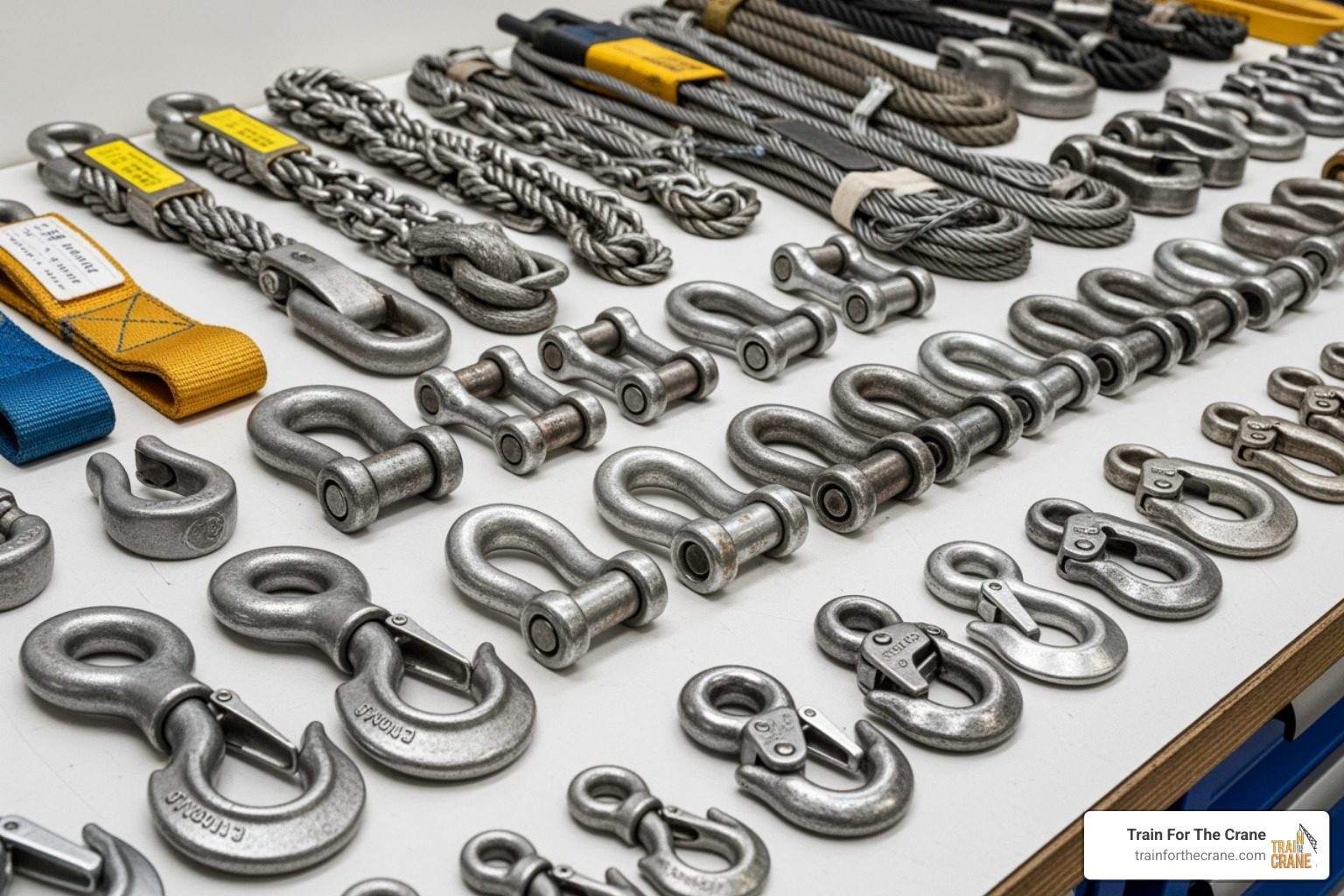
You’ll get hands-on experience with different sling types: durable wire rope slings for heavy-duty use, adjustable chain slings for high-temperature environments, and lightweight synthetic web slings for protecting delicate surfaces.
You’ll also learn about rigging hardware like shackles, eyebolts, swivel hoist rings, and various hooks. Specialized below-the-hook devices, such as spreader bars and magnetic lifters, expand your capabilities for unique lifting challenges.
Pre-use inspection procedures are your insurance against catastrophic failure. You’ll learn systematic inspection methods and even cover knot tying for fiber ropes, with an 80% score required on the practical knot assessment.
Crane Operations and Communication
Great rigging is a team effort between the rigger, crane operator, and signal person. Crane operations and communication training makes you an effective team player.
Crane safety and emergency procedures will become second nature. Communication is where precision matters most. Hand signals are the universal language of crane operations, which is why we require 100% accuracy on hand signal assessments. You’ll master ASME hand signals for mobile, overhead, and tower cranes.
When visual contact isn’t possible, clear voice commands and radio communications are critical. Our Crane Signal Person Training complements this knowledge. You’ll also learn essential safety procedures for working near power lines, where understanding clearance requirements is a matter of life and death.
Navigating Training Formats, Costs, and Regulatory Standards
After deciding to pursue rigger certification training, you’ll need to consider practical questions about training formats, costs, and regulatory standards. This section provides straightforward answers to help you decide.
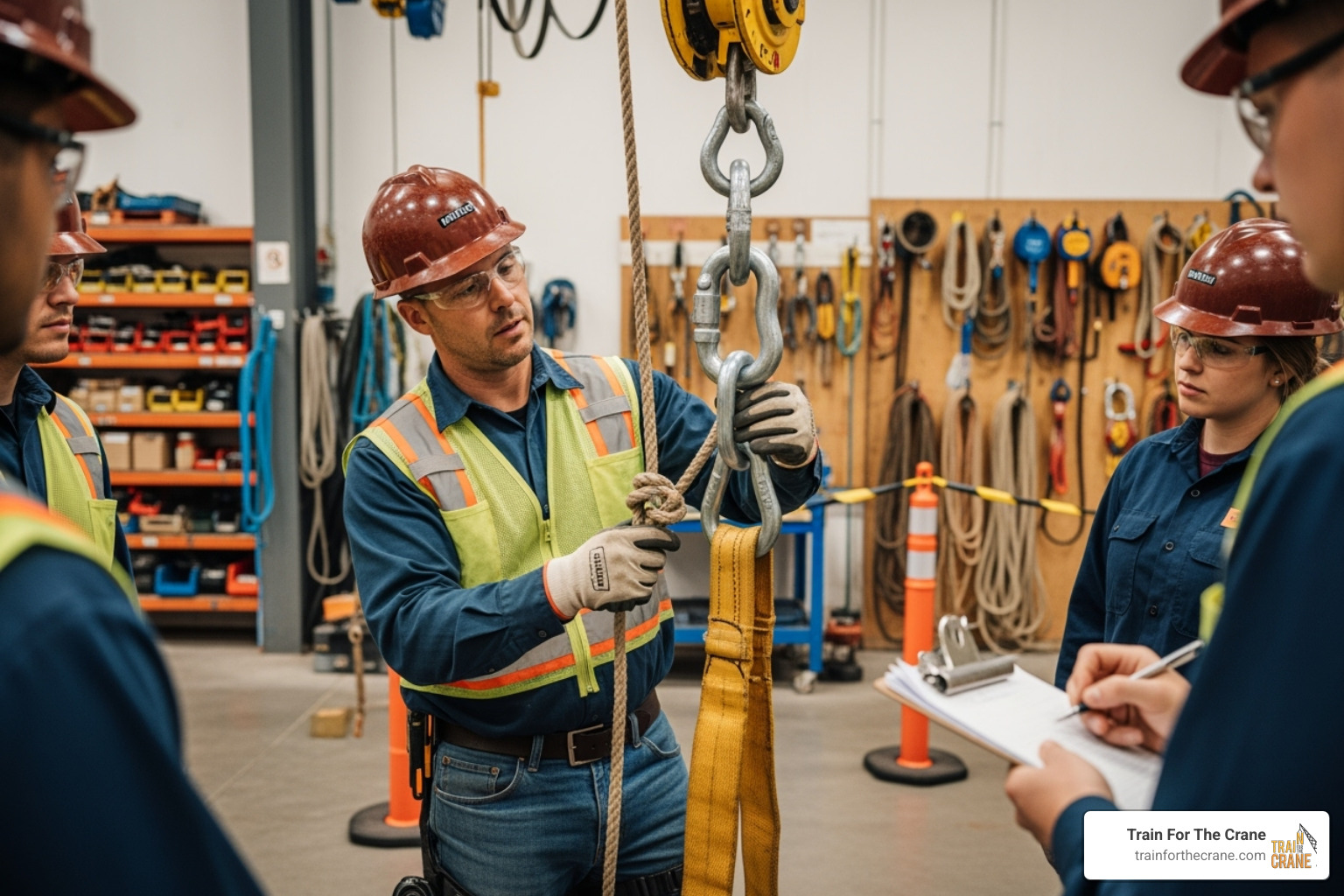
At Train For The Crane, we offer flexible options designed around your needs. Whether you prefer on-site training at your workplace or attending one of our dedicated training centers, our programs are designed for success. Our Certified Rigger Course combines proven teaching methods with hands-on practice. Many students benefit from blended learning that combines online theory with essential hands-on practice, allowing you to fit quality training into your schedule.
Online vs. In-Person Rigger Training
When choosing between online and in-person rigger certification training, it’s important to understand the benefits of each. Often, a combination of both is the most effective approach.
| Feature | Online Rigger Training | In-Person Rigger Training |
|---|---|---|
| Flexibility | High – self-paced, learn anytime, anywhere. | Fixed schedule and location. |
| Hands-on Practice | Limited; relies on videos and self-demonstration; often requires separate practical assessment. | Direct, supervised practice with real equipment and loads. |
| Instructor Interaction | Via forums, email, or scheduled virtual sessions. | Direct, real-time engagement and immediate feedback. |
| Self-paced Learning | Yes – pause, resume, and review modules as needed. | No – follows a set curriculum pace. |
| Practical Exams | Often requires separate, in-person practical evaluation. | Integrated into the course, with direct observation. |
Online training is excellent for delivering theoretical knowledge at your own pace. Research shows online courses significantly increase hazard awareness. However, rigging is a hands-on skill. In-person training provides the tactile experience of working with real equipment under expert guidance. Our 2-day Advanced Rigger courses combine classroom theory with hands-on training.
The most effective approach is often blended learning, which combines online convenience for theory with essential in-person practical application.
Costs associated with rigger certification training
Understanding the investment for rigger certification training is key to planning your career development. While exact prices vary, this guide outlines the typical expenses.
- Course fees are the biggest expense and vary by certification level, program duration, and delivery method (online vs. in-person).
- Exam fees for written and practical certification tests are typically separate from training costs.
- Travel costs (transportation, lodging, meals) should be factored in for in-person training. On-site training can be more cost-effective for companies training multiple employees.
- Renewal fees are an ongoing investment, as most certifications last 2-5 years and require refresher training or re-testing. For a detailed breakdown, see our guide on Rigger Certification Cost.
Governing Bodies and Standards
Governing bodies and standards exist to ensure safety and proper qualifications in the rigging industry.
- OSHA (Occupational Safety and Health Administration) sets the rules for safe construction practices in 29 CFR 1926. Our curriculum meets or exceeds these requirements.
- ASME (American Society of Mechanical Engineers) develops technical standards like the B30 series. The ASME B30.5 amendment, effective December 17, 2022, requires “Certified” riggers for mobile cranes of 1 ton or more, meaning you must pass written and practical exams.
- ANSI (American National Standards Institute) accredits many of these standards, while the CSA (Canadian Standards Association) serves a similar role in Canada.
Understanding these standards is about joining a profession that prioritizes safety and competence.
Frequently Asked Questions about Rigger Certification
This section answers the most common questions about rigger certification training to clarify the rules and requirements of the field.
How long is a rigger certification valid?
Most rigger certification training certifications are valid for 2 to 5 years. The exact duration depends on the issuing body and the certification level. Basic certificates might last 3 years, while more comprehensive certificates of competence can last 5 years. OSHA generally suggests recertification every three years for heavy machinery operators.
At Train For The Crane, our certifications are valid for 5 years. Renewal requirements are universal; when your certification expires, you’ll need refresher training and will likely have to pass recertification exams. This ensures you are always working with current knowledge and best practices as the industry evolves.
What’s the difference between a “qualified” and a “certified” rigger?
The difference between a “qualified” and “certified” rigger is a common point of confusion, especially with recent regulatory changes.
A “qualified” rigger is someone their employer has determined can perform the job safely. OSHA places the responsibility on employers to train and qualify their workers for specific tasks.
A “certified” rigger has passed both written and practical exams from an accredited third-party organization. This certification is portable and serves as an industry-recognized credential.
The ASME B30.5 update on December 17, 2022, was a game-changer. It now requires anyone working with mobile cranes of 1 ton or more to be “certified,” not just “qualified.” Our rigger certification training prepares you for these rigorous certification exams.
Can I get a job with just an online rigging course?
An online course alone is likely not enough to get a job, as rigging is a hands-on profession.
Online courses cover the classroom portion—theory, regulations, and book knowledge—and are a great starting point. However, it is the employer’s responsibility to determine if you are qualified for their specific job site. They will want to see you handle actual equipment and demonstrate real-world skills through a practical evaluation. Most job sites also require site-specific training to address unique hazards and equipment.
At Train For The Crane, we offer blended learning options that combine the flexibility of online theory with essential hands-on practice under the guidance of our experienced instructors. Think of online courses as building your foundation, but the practical component is necessary to land the job and perform safely.
Conclusion: Your Path to Becoming a Certified Rigger
Earning your rigger certification is more than getting a credential; it’s a commitment to joining a profession dedicated to safety and precision in every lift.
This guide has covered the key aspects of becoming a certified rigger: the distinction between qualified and certified status under new ASME B30.5 rules, the progression from Level 1 to Level 2, and the core curriculum covering everything from load calculations to hand signals.
Quality training makes all the difference. It transforms someone who can hook up a load into a rigger who can plan complex lifts and communicate effectively. While online courses provide excellent theoretical knowledge, there is no substitute for hands-on experience with actual equipment under expert guidance.
At Train For The Crane, our experienced instructors bring over 30 years of combined expertise to every class. We use proven methods that lead to high pass rates on certification exams and offer flexible training options that combine online theory with essential hands-on practice.
Your success is our mission. Whether you’re a beginner or an experienced rigger seeking advancement, we are here to guide you. The construction, manufacturing, and warehousing industries need skilled riggers, and with proper certification, you will be in high demand.
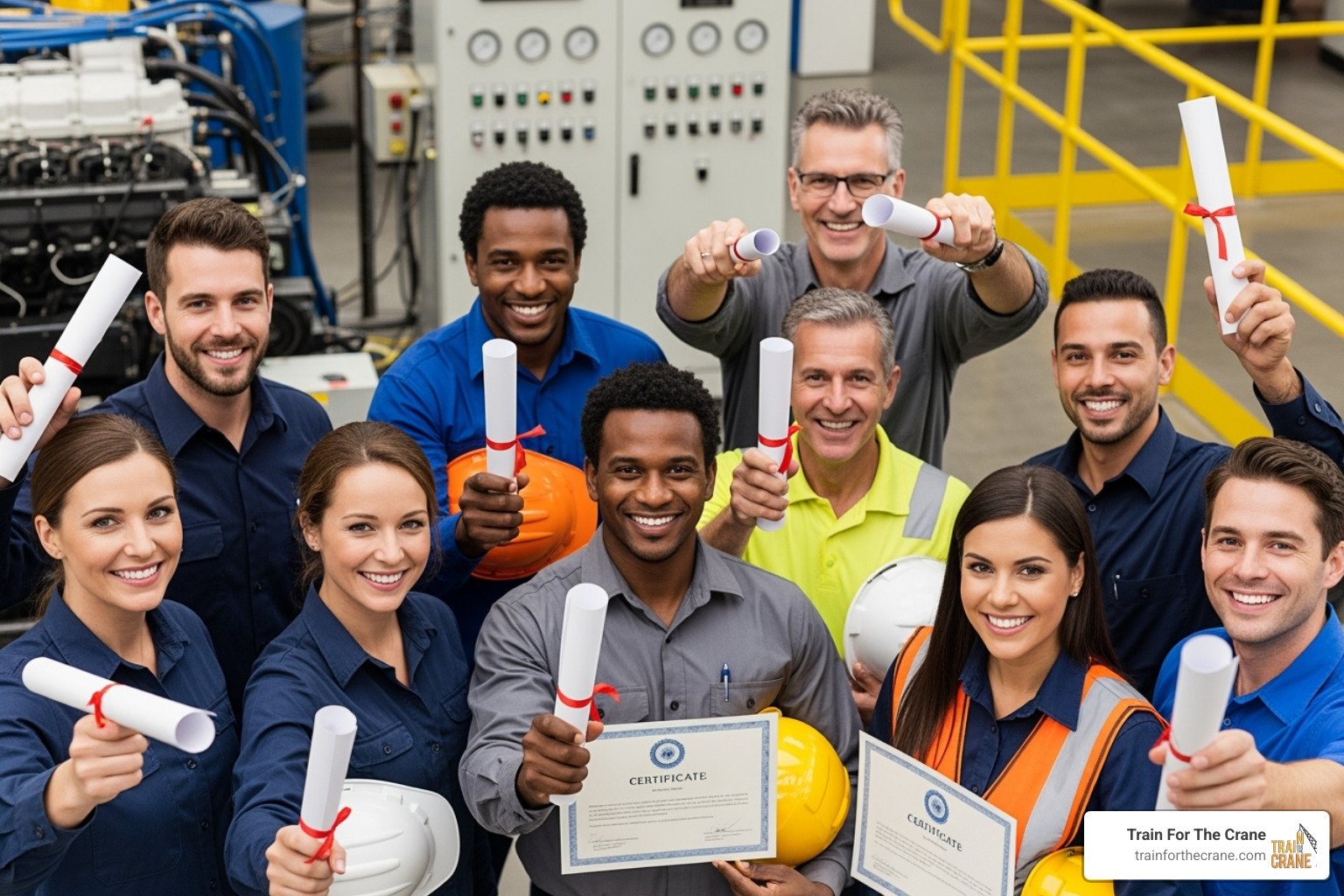
Commit to comprehensive training that includes both theoretical knowledge and practical skills. With dedication and the right training partner, you’ll not only achieve your certification but also help create safer, more efficient workplaces.
Ready to transform your career? Your future in this essential, rewarding field starts today.
Take the next step in your rigging career with our expert-led courses