
Table of Contents
Understanding Rigging Certification and Costs
In the high-stakes world of construction and manufacturing, safety hinges on proper equipment handling. Rigging certification ensures workers master safe load handling, equipment use, and signal person roles, preventing accidents that could halt projects or endanger lives. For those searching for rigger certification cost, understanding these essentials is the first step toward compliance with OSHA requirements and career advancement.
Rigging certification, particularly through NCCCO standards, stands as the industry benchmark for qualified professionals. It covers NCCCO rigger level 1 requirements, including basic eligibility like age and experience, alongside written and practical exams focused on load rigging techniques and hazard recognition. Why pursue it? Certified riggers reduce workplace risks, with programs like those from Train for the Crane in Danville, Indiana, offering instructor-led, hands-on training. These on-site sessions prepare candidates for both exam formats, leading to certifications valid for five years.
Typical nccco rigger certification cost ranges from $500 to $1500 per level, depending on Rigger Level I, II, or Signal Person formats–covering written prep, practical practice, and exam fees. Courses typically range from $600-$1200 as per industry standards from sources like Alvarez Industrial Academy, making rigging training expenses accessible yet valuable. In a Danville construction site, improper rigging could lead to costly accidents, underscoring the return on certified rigger pricing.
To dive deeper into the foundational requirements, let’s explore the core elements of NCCCO standards. This guide covers steps to become certified, financial options, and enrollment paths with Train for the Crane, empowering you to schedule training confidently and boost your expertise.
Fundamentals of Rigging Certification
With certification needs established, let’s examine the core principles that form the backbone of safe crane operations. Rigging certification ensures workers can handle loads securely, preventing accidents in construction and industrial settings. At Train for the Crane in Danville, Indiana, these fundamentals prepare individuals for NCCCO exams and real-world application.
Rigging involves securing and moving heavy loads using equipment like slings, shackles, and hardware. Key fundamentals include load securing to distribute weight evenly, preventing shifts during lifts. Common sling types encompass:
- Wire rope slings: Durable for heavy-duty tasks, resistant to abrasion.
- Synthetic slings: Lightweight nylon or polyester options, ideal for sensitive loads.
- Chain slings: High-strength alloy chains for extreme conditions.
Inspection protocols require daily checks for wear, damage, or deformation, ensuring equipment meets safety standards. OSHA reports 25% fewer incidents with certified riggers, highlighting the value of these practices for novice and seasoned workers alike.
OSHA mandates certification for rigging and signaling in crane operations exceeding certain capacities, such as those over 2,000 pounds. Under 29 CFR 1926.1401-1442, qualified riggers must demonstrate competency in load calculations and equipment use, while signal persons ensure clear communication to avoid mishaps. These requirements apply to construction sites nationwide, including Indiana, making compliance essential for legal and safety reasons. Who is eligible for NCCCO Rigger I certification? Candidates must be at least 18 years old, physically fit, and pass background checks, with no prior experience needed for entry-level roles.
The role of a rigger focuses on assembling rigging gear, estimating load weights, and verifying stability before lifts. Signal persons complement this by directing crane movements through standardized hand signals or radio communication, crucial for visibility-limited scenarios and often covered in signal person training. To address how to become a certified rigger and signal person, start with introductory training that covers both, building foundational skills efficiently. Combined programs, like certified rigger signal person training, offer streamlined paths for dual qualification, saving time and enhancing employability in high-demand fields.
For those evaluating options, the following table compares entry-level certifications to aid decision-making on initial training investments:
| Certification Type | Duration | Cost Range | Prerequisites |
|---|---|---|---|
| Rigger Level I | 3-5 days including written and practical prep | $500-$800 | Basic construction experience or none for beginners |
| Signal Person | 1-2 days | $300-$500 | OSHA 10/30 hour training recommended |
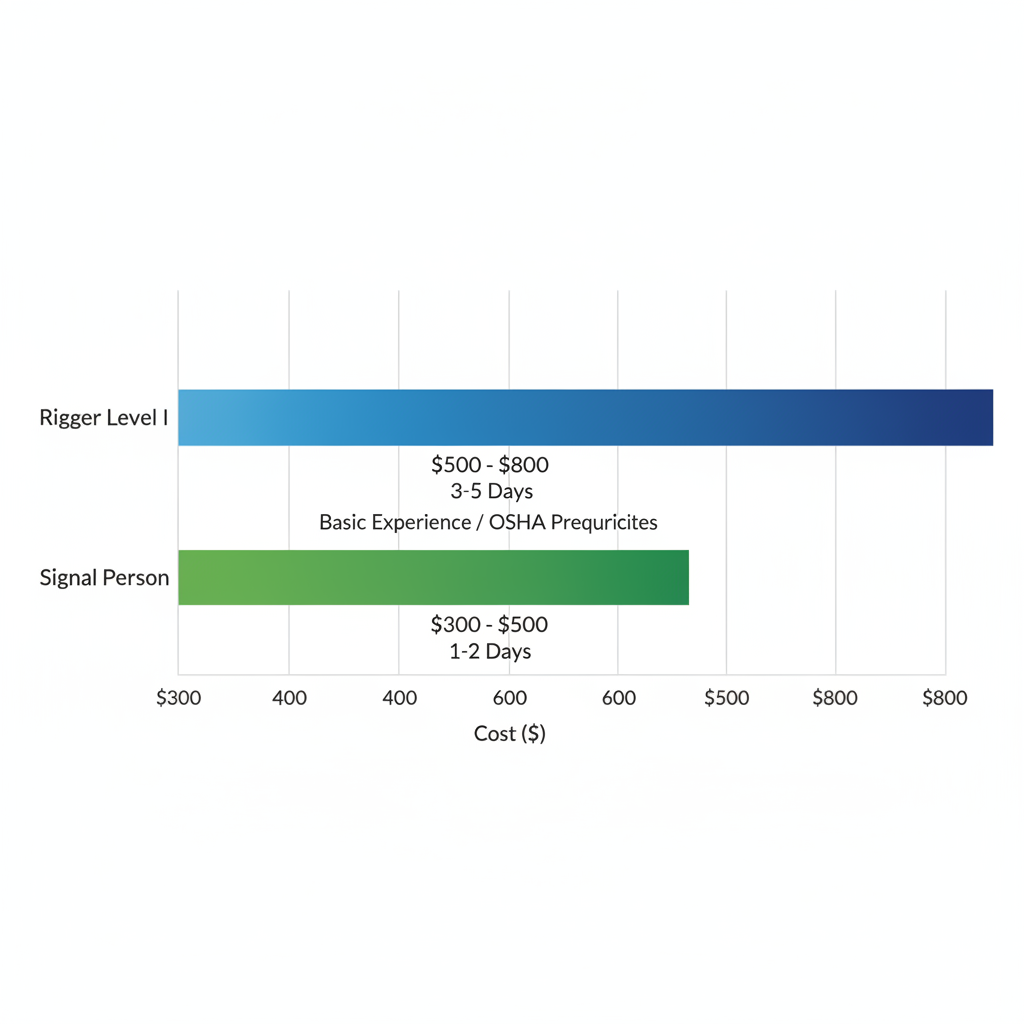
Comparison of basic rigging certification costs and training durations
Discussing Rigging Certification Cost, entry-level rigging expenses start at $300 for signal person basics, rising to $800 for full rigger training, with group rates offering savings. Basic certification fees vary by provider, but investing here yields quick ROI through compliance and career advancement. Contact Train for the Crane for tailored quotes. These fundamentals set the stage for exploring detailed NCCCO requirements in the next section.
In-Depth Look at NCCCO Rigger Requirements
Building on the foundational roles of riggers in crane operations, this section provides a detailed examination of the NCCCO Rigger certification framework. Tailored for professionals in Indiana’s industrial sector, it highlights how Train for the Crane’s programs in Danville integrate rigorous preparation to achieve high success rates, often exceeding 90% pass rates through expert-led sessions.
NCCCO Rigger Level I Exam Details
The NCCCO rigger level 1 requirements form the entry point for aspiring riggers, focusing on essential safety and operational knowledge. The written exam consists of 60 multiple-choice questions covering topics like rigging safety, material handling, sling inspections, and basic load calculations. Candidates must achieve a 70% passing score to qualify, with questions testing practical scenarios such as identifying defective slings or proper hitch configurations. For instance, a sample question might ask: “What is the minimum safety factor for synthetic slings used in general lifting?” emphasizing NCCCO rigger exam criteria.
Practical components require demonstrating safe rigging setups, including attaching loads to cranes and performing pre-use inspections. Train for the Crane’s curriculum mirrors industry standards from sources like ITI’s prep courses, incorporating 8 hours of hands-on rigging similar to their ILT format. Preparation strategies include practicing with 50-question mock exams and reviewing load weight estimation techniques. Enrolling in our basic rigging training accelerates readiness, answering key queries like “What is the passing score for the NCCCO Rigger Level I written exam?” through targeted drills that build confidence for the 70% threshold.
The following table compares NCCCO Rigger Levels to guide your certification path:
| Aspect | Rigger Level I | Rigger Level II |
|---|---|---|
| Scope | Basic rigging tasks, slings, inspections | Core + advanced loads, calculations, supervision |
| Cost | $500-$800 + exam fees | $800-$1,200 + advanced practical fees |
| Exam Passing Score | 70% written, pass practical demo | 70% written, advanced practical evaluation |
| Training Days | 2-5 days | 3-7 days, prior Level I recommended |
Starting with Level I establishes core skills before advancing, making it ideal for beginners seeking crane rigging certification. Costs reflect 2023 averages from NCCCO standards and Train for the Crane benchmarks, with practical exams adding $200-300.
Level II Advanced Competencies
Advancing to Rigger Level II builds on level-specific rigging standards, introducing sophisticated skills for complex crane operations. This certification emphasizes critical lifts, requiring proficiency in load charts, center-of-gravity calculations, and supervising multi-rigger teams. Unlike Level I’s focus on basics, Level II exams test scenarios like determining sling angles for unbalanced loads or mitigating swing risks in windy conditions, ensuring riggers can handle high-stakes industrial projects.
The written portion expands to 65 questions on advanced topics, including rigging hardware selection and personnel qualifications under OSHA guidelines. Practical assessments involve demonstrating setups for critical lifts, such as tandem rigging for heavy machinery. Train for the Crane’s instructors, with over 30 years of field experience, provide test-taking strategies like step-by-step load verification: 1. Assess total weight, 2. Select appropriate rigging gear, 3. Calculate stress on components. This addresses differences from Level I by prioritizing precision in dynamic environments, vital for roles in manufacturing and construction.
Preparation includes scenario-based simulations, drawing from NCCCO guidelines to achieve the same 70% pass rate with deeper application. For those asking “What is the difference between Rigger Level 1 and 2 certification?”, Level II equips you for supervisory duties, enhancing career progression through our integrated programs that combine theory with real-world drills for superior outcomes.
Eligibility and Timeline Overview
To pursue NCCCO Rigger certification, candidates must be at least 18 years old, proficient in English for exam instructions, and free from disqualifying felony convictions related to safety-sensitive roles. No prior experience is required for Level I, but physical fitness for practical tasks is essential. Train for the Crane verifies eligibility during enrollment, offering motivational support to overcome barriers like language refreshers.
Certification timelines vary: Level I typically takes 2-5 days of intensive training, culminating in on-site testing for immediate results. Level II extends to 3-7 days, recommending prior Level I completion. Recertification occurs every 5 years via exams or continuing education. Our Danville programs accelerate this process, enabling how to become a certified rigger and signal person in as little as one week. With Rigging Certification Cost integrated into sessions starting at $500, meet criteria and enroll in our next session for swift job readiness.
With requirements outlined, apply them through hands-on strategies in upcoming sections for full mastery.
Hands-On Rigging Training Practices
From understanding the requirements to applying them in real-world scenarios, hands-on training at Train for the Crane bridges the gap with structured practices that build essential rigging skills. These sessions focus on practical application, ensuring participants gain the confidence needed for nccco certification cost efficiency and long-term career success in construction and manufacturing.
Preparing for Written and Practical Exams
Preparation begins with integrated sessions designed to tackle both written and practical components of rigging certification. At Train for the Crane, we start with reviewing core materials on regulations, inspections, and safety standards, using practice questions that mirror NCCCO exams. Participants engage in mock written tests to familiarize themselves with question formats, achieving pass rates similar to ITI’s instructor-led training, where hands-on alignment yields 85% first-time success.
Practical drills follow, emphasizing skill-building exercises like sling inspections and basic hitches. Step 1: Inspect equipment for defects in a 20-minute demo, identifying wear that could lead to failures. Step 2: Perform load calculations using provided charts, simulating weight distributions for safe lifts. These sessions culminate in full practice exams, where trainees execute rigging setups under timed conditions, building confidence for official testing. For those wondering how to become a certified rigger and signal person, this sequential approach ensures readiness, with veteran instructors offering test-taking strategies to overcome common challenges.
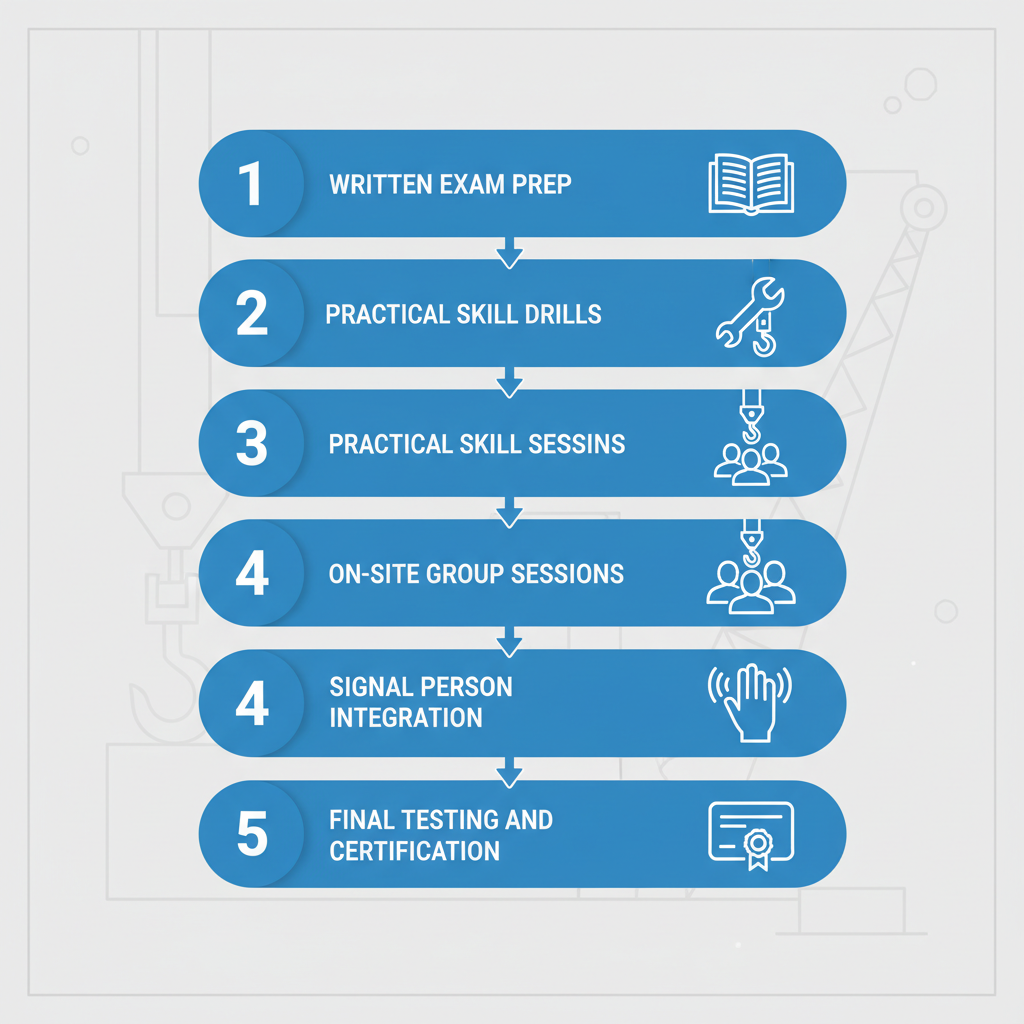
Hands-on rigging training steps visualized
By blending theory with drills, these prep methods address fears of hands-on assessments, preparing you for immediate certification upon completion.
On-Site Group and Private Sessions
Train for the Crane delivers customized on-site training in Danville, Indiana, tailored to your experience level and group size. Group sessions, ideal for 4-10 participants from employers, cover beginner drills like basic knotting to advanced load tests, fostering team-based learning. Private sessions provide one-on-one focus for veterans seeking recertification, diving into complex scenarios such as multi-crane coordination.
A typical group agenda includes: 1. Morning theory review on Rigging Certification Cost factors influencing program value. 2. Afternoon practicals simulating a 5-ton lift, where teams rig and secure loads under instructor guidance. 3. Debrief on errors and improvements, ensuring OSHA-compliant techniques. Private formats accelerate progress, with flexible scheduling for site-specific needs, like integrating company equipment.
For financial options, multi-day courses offer payment plans, and group discounts reduce per-person costs by 20-30%, making practical rigging expenses more accessible. These sessions highlight why on-site beats alternatives, delivering interactive outcomes that online can’t match.
The following table compares on-site versus online rigging training options, helping you choose based on interactivity, budget, and goals:
| Format | Interactivity Level | Cost Range | Best For |
|---|---|---|---|
| On-Site (Train for the Crane) | High – hands-on with real equipment | $800-$1500 incl. travel for groups | OSHA compliance, practical skills |
| Online Theory Only | Low – videos/quizzes | $300-$600 | Exam prep review, remote learners |
On-site training excels for hands-on mastery and regulatory adherence, justifying the investment through superior skill retention and certification speed–essential for transactional decisions in workforce development.
Integrating Signal Person Skills
Combined rigger-signal person practicals at Train for the Crane emphasize seamless communication during lifts. These sessions simulate real operations, focusing on hand signals, radio protocols, and safety checks to prevent accidents.
Key drills include: 1. Pairing riggers with signals for blind lifts, practicing clear directives. 2. Emergency stop scenarios to reinforce response times. By integrating these, participants learn how to become a certified rigger and signal person through dual-role exercises, aligning with NCCCO standards.
Culminating in joint evaluations, these practices ensure certification readiness, with add-ons like exam proctoring tying into overall crane operator certification cost for comprehensive programs. Book a Danville session today to master these vital skills.
Advanced Rigging Certification Topics
Elevate your skills beyond basics with advanced rigging certification at Train for the Crane. For those meeting NCCCO rigger level 1 requirements, progressing to Level II unlocks supervisory roles and complex lift capabilities essential for construction and industrial sites.
Level II certification delves into critical path planning and multi-crane coordination, enabling riggers to calculate load weights accurately and oversee teams during high-stakes operations. Trainees learn advanced rigging techniques, such as using synthetic slings for heavy loads and integrating signaling protocols for safety. This level prepares professionals for scenarios like bridge construction or power plant maintenance, where precision prevents accidents and ensures compliance with OSHA standards.
Managing Rigging Certification Cost becomes more accessible through financial aid options tailored for career advancement. Veterans can access scholarships covering up to 50% via dedicated portals, while employer reimbursements support team upgrades. For courses exceeding $1000, payment plans offer no-interest installments over six months. To apply:
- Submit enrollment form online.
- Provide proof of eligibility for aid.
- Schedule a consultation to customize your plan.
These strategies make advanced training viable, with industry benchmarks showing Level II adders around $600, aligned with Train for the Crane bundles. Recertification occurs every five years, requiring refreshers that maintain skills without full retakes. Combined packages, like Rigger II plus Signal Person, bundle exams and hands-on sessions to cut overall expenses by 20%. This path not only reduces crane operator course cost when integrated with rigging but also boosts employability by 30%, per industry reports, leading to supervisor positions with salaries averaging $75,000 annually.
The following table contrasts advanced rigging with basics, highlighting upgrade value:
| Level | Additional Skills | Cost Adder | Career Benefit |
|---|---|---|---|
| Basic (Level I) | Core inspections, simple slings | N/A | Entry-level compliance |
| Advanced (Level II + Signal) | Load calcs, supervision, complex signals | $400-$700 on top of basic | Higher pay, lead roles, recert priority |
Bundling at Train for the Crane saves on crane operator license cost for combined programs, making the investment worthwhile for long-term growth. For details on how to become a certified rigger and signal person, apply for aid during enrollment today.
For common queries on these topics, see the dedicated section ahead.
Frequently Asked Questions on Rigging Certification
Answering your top questions now to help you move forward with confidence.
Q: How much does rigging certification cost?
A: The Rigging Certification Cost for Level I at Train for the Crane is $600, including all materials and exam prep. This investment ensures certification affordability with high pass rates; see our crane license cost page for details.
Q: What are the NCCCO rigger level 1 requirements?
A: You must be 18+, have no major safety violations, and complete written and practical exams. See our practical training for details on preparing.
Q: Is rigging certification required by OSHA?
A: Yes, OSHA mandates crane operator certification including rigging for lifts over 2 tons to ensure site safety.
Q: How long does certification take?
A: Per ITI standards, our 3-day instructor-led training (ILT) covers everything needed for quick certification in Danville, Indiana.
Q: Are payment plans available?
A: Yes, group plans start at $50/month; contact us for custom quotes to fit your needs.
With doubts addressed, consider next steps and schedule your training today.
Achieving Rigging Certification Success
From fundamentals to advanced rigging skills, you’ve got the roadmap to success with Train for the Crane. Recapping essentials, NCCCO rigger level 1 requirements emphasize practical prep and eligibility checks for Crane Rigging Certification. Costs range from $300-$1500 for Crane Rigger Certification, making Rigging Certification Cost affordable with financial aids and on-site flexibility in Indiana.
Benefits shine through high pass rates and OSHA compliance, boosting safety and career growth. Join thousands certified safely for a five-year investment in professional advancement.
Ready to certify? Costs are manageable with our plans. Schedule today to launch how to become a certified rigger and signal person.