
Table of Contents
Understanding Crane Rigger Certification
In the construction industry, crane-related accidents claim hundreds of lives annually, underscoring the urgent need for rigorous safety measures. Crane Rigger Certification emerges as a vital safeguard, equipping workers with the expertise to handle heavy loads without catastrophe.
This nationally recognized credential validates essential knowledge in rigging techniques, precise load calculations, and stringent safety protocols, directly aligning with OSHA regulations to prevent mishaps in high-risk environments. As per NCCER standards, certified riggers reduce incident rates by up to 30%, fostering safer worksites and enhancing operational efficiency. It complements roles like Signal Person Certification, ensuring seamless team coordination during lifts. Prerequisites include being at least 18 years old with basic industry experience, while the certification remains valid for five years, requiring recertification to maintain compliance. The NCCCO, as the leading certifying body, sets the benchmark for these rigging credentials for cranes, emphasizing hands-on training over purely online options to build real-world proficiency.
This comprehensive guide explores Crane Rigger Certification from the ground up:
- Fundamentals of rigging and safety basics
- In-depth exam preparation for NCCCO Rigger Level 1
- Practical training pathways and advanced topics
- FAQs and key takeaways for success
Whether you’re a beginner eyeing vocational entry or a veteran seeking renewal, programs like those from Train for the Crane, backed by over 30 years of expertise, deliver high pass rates through expert-led instruction and certified rigger signal training. Gain certified rigging practices that propel career advancement while prioritizing uncompromised safety–start with a solid foundation before tackling exams and skills development.
Fundamentals of Crane Rigger Certification
Crane rigger certification establishes the foundational skills needed for safely attaching loads to cranes in construction and manufacturing environments. This credential ensures workers can handle rigging tasks, from selecting slings and hardware to signaling crane operators during lifts. Essential for preventing accidents, crane rigger certification has become a standard requirement on job sites, particularly for loads exceeding 2,000 pounds. It integrates knowledge of load dynamics, equipment inspection, and team coordination to maintain workplace safety.
The regulatory history of crane rigger certification traces back to voluntary industry standards in the early 2000s, evolving into mandatory requirements following OSHA’s updates. In 2010, OSHA’s Final Rule on Cranes and Derricks in Construction (Subpart CC of 29 CFR 1926) mandated qualified riggers for operations involving cranes, emphasizing certification to verify competency. This shift addressed rising incidents in load handling, where improper rigging contributed to over 80% of crane-related injuries pre-regulation. Drawing from NCCER’s Crane Rigger Signal Person Accreditation, which aligns with OSHA standards, accredited programs must include hands-on training and assessments to meet federal guidelines. These regulations ensure uniformity across states, with certifications like NCCCO’s recognized nationally for compliance.
Different certification bodies set varying entry barriers, as shown in the table below.
| Certification Body | Age Requirement | Experience Needed | Training Hours | Exam Format |
|---|---|---|---|---|
| NCCCO Rigger Level I | 18 years | None | 40 hours recommended | Written + Practical: Multiple choice + hands-on demo |
| NCCER Basic Rigger | 18 years | 6 months related work | 24 hours minimum | Written only: Theory-based test |
| CIC Rigger | 21 years | 1 year rigging | 16 hours | Written + Observation: Knowledge assessment |
This comparison highlights how NCCCO Rigger Level I offers the most accessible entry for beginners due to no experience prerequisite and its practical exam focus, making it ideal for field workers despite slightly longer training.
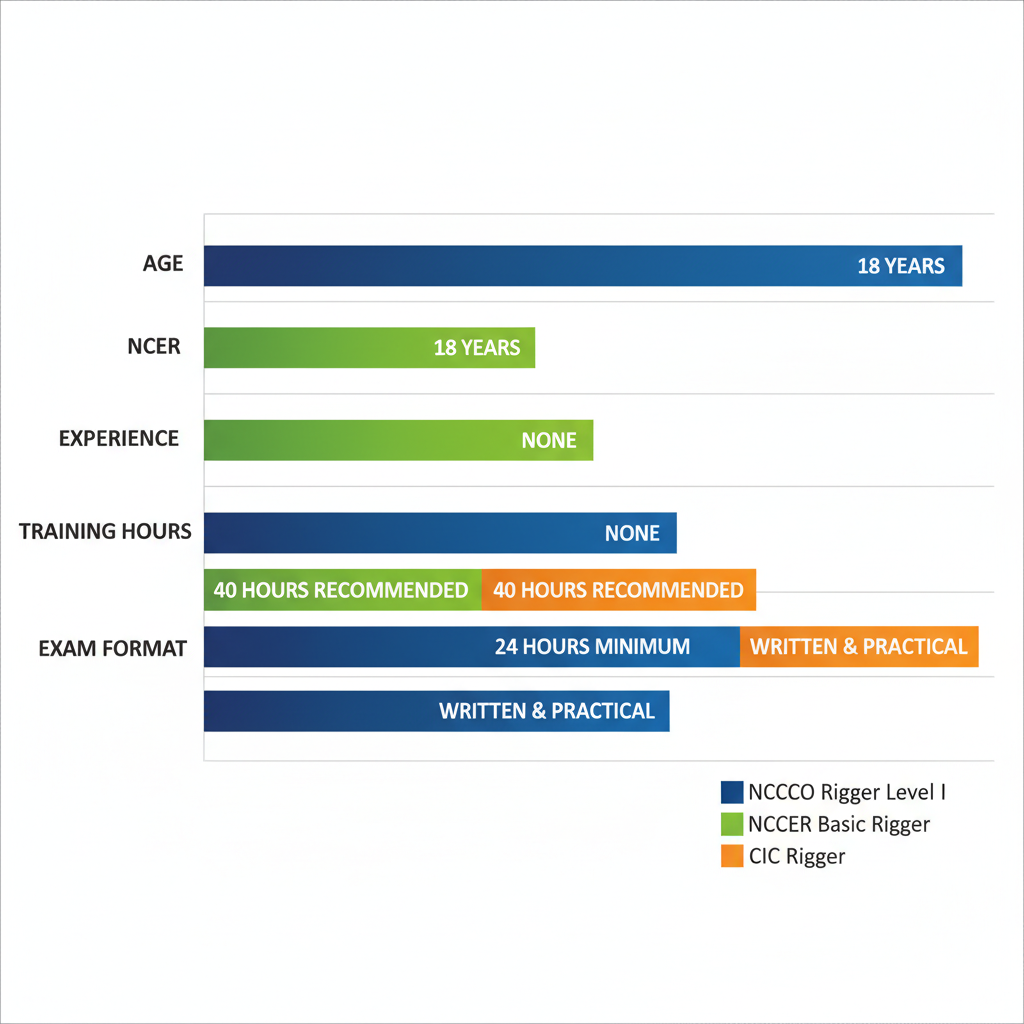
Comparison of basic rigger certification requirements for major standards
Core components of certification include site assessment, load weight calculation, and hazard recognition. Riggers must evaluate terrain stability and overhead obstacles before lifts, using formulas to determine safe working loads for slings and hardware. Physical demands require lifting 50 pounds or more, ensuring candidates can manage equipment on sites like residential builds or commercial high-rises. In the third paragraph on prerequisites, aspiring riggers often begin with crane operator training programs to build foundational knowledge before advancing to rigging specifics. Level I covers basic signal integration, where riggers communicate with operators using hand or voice signals, sometimes requiring separate signal person rigger certification for complex operations.
Benefits include enhanced career mobility and safety, with certified riggers seeing 30% fewer incidents per OSHA data. Certifications remain valid for five years, necessitating recertification through exams. While on-site training excels for hands-on practice, online options limit physical simulations. This foundation prepares for advanced exams, teasing deeper topics like knot tying and load charts ahead.
In-Depth Exploration of Rigger Exam Preparation
The NCCCO Rigger Level I certification stands as a cornerstone for professionals in construction and heavy lifting operations, ensuring safe and efficient rigging practices. This Crane Rigger Certification process tests both theoretical knowledge and hands-on skills, preparing candidates for real-world demands. With a focus on NCCCO Rigger Level 1 standards, this section breaks down the exams to guide your preparation effectively.
Written Exam Topics and Strategies
The written exam for the NCCCO Rigger Level I covers essential knowledge areas critical to safe rigging operations. Key topics include rigging math, such as calculating center of gravity and sling angles to determine load weights accurately; safety codes aligned with OSHA standards and proper use of personal protective equipment (PPE); inspection procedures for identifying hardware defects like cracks or wear in slings and hooks; and communication signals for coordinating with crane operators. According to NCCER program outlines, safety topics account for about 25% of the exam, emphasizing compliance to prevent accidents.
To prepare, start by reviewing the official NCCCO handbook, which outlines core competencies. Practice rigging math problems daily, focusing on formulas for tension and balance. For safety and inspections, memorize key OSHA regulations and use flashcards for defect recognition. In the signals section, integrate Signal Person Certification principles to understand hand and verbal cues clearly.
Effective strategies boost your performance. 1. Manage time wisely: With 60 questions in 70 minutes, allocate about one minute per question. 2. Eliminate wrong answers first to narrow choices. 3. Use the open-book policy judiciously, but prepare with limited references in mind. For retests, follow the crane operator certification guide, which allows retakes after 30 days with a 70% passing score required; appeals are possible within 30 days of results. These tips, drawn from instructors with over 30 years of experience, reduce test anxiety and improve retention through consistent review sessions. (198 words)
When choosing between certifications, understanding format differences helps align with your career goals. The following table compares NCCCO and NCCER Rigger exams:
| Aspect | NCCCO Rigger Level I | NCCER Rigger |
|---|---|---|
| Written Test Length | 60 questions, 70 min | Open book: Yes, but limited references |
| Practical Components | 4 rigging tasks demo | Observed performance: Site-based evaluation |
| Passing Score | 70% written, pass/fail practical | 75% overall: Theory focus |
NCCCO’s structure prioritizes field-ready skills, making it ideal for hands-on roles in construction.
Practical Skills Assessment Breakdown
The practical exam evaluates your ability to apply rigging knowledge in simulated scenarios, focusing on safe load handling. Core criteria include assembling basic rigging setups, such as attaching slings and hardware correctly; controlling load transfer to ensure stability during lifts; and performing pre-use checks on equipment for defects. Common pitfalls involve improper sling angles leading to overloads or neglecting tag lines for swing control. Physical demands require stamina for maneuvering heavy mock loads, often in varied weather conditions.
Preparation drills are key to success. Simulate setups with scaled models to practice center of gravity calculations on-site. Run timed exercises for inspections, checking for wear per OSHA guidelines. Role-play signal scenarios with a partner to refine coordination, tying into Signal Person Certification best practices.
To highlight differences, consider task complexities between levels. Level I focuses on fundamentals, while Level II advances to multi-crane operations.
| Task | Level I (Basic) | Level II (Advanced) |
|---|---|---|
| Rigging Assembly | Single sling attachments | Complex bridle systems with multiple points |
| Load Control | Basic lifts under 5 tons | High-risk lifts over 10 tons with offsets |
| Inspection Checks | Visual hardware exam | Load testing and dynamic assessments |
Trainers at accredited programs simulate these tasks through mock exams, helping candidates avoid errors and build confidence for the observed performance evaluation. Post-certification, expect a 10-15% salary increase, averaging $5,000 annually for certified riggers. Emphasize hands-on practice over online prep alone, as virtual simulations lack the tactile feedback essential for passing. (202 words)
Role of Accredited Providers in Success
Certified trainers play a pivotal role in elevating pass rates for the NCCCO Rigger Level I, offering structured programs that blend theory with practice. Providers like Train for the Crane deliver tailored prep, including mock written exams and full rigging simulations that mirror test conditions. Their instructors, with decades of field experience, share insights on tricky topics like sling tension math, achieving pass rates over 90% through targeted feedback.
The national crane certification process benefits immensely from such accreditation, ensuring compliance and credibility. By focusing on weak areas via personalized drills, these programs address common challenges like time pressure in practicals. Ultimately, investing in expert guidance accelerates your path to certification and enhances on-site safety. (128 words)
(Total: 528 words)
Hands-On Training and Skill Development for Riggers
Hands-on training forms the cornerstone of effective rigger preparation, transforming theoretical knowledge into Crane Rigger Certification that ensures safe and efficient crane operations. At Train for the Crane, programs emphasize practical rigging skills through instructor-led sessions, drawing on over 30 years of field experience to simulate real construction environments. This approach not only builds confidence but also reduces workplace incidents by reinforcing muscle memory and decision-making under pressure.
Essential Rigging Techniques and Tools
Mastering essential rigging techniques begins with site assessment to identify hazards, followed by load weight calculations using precise scales and formulas. Riggers learn sling capacity evaluations to match material strength–such as wire rope or synthetic slings–to load demands, preventing overload failures. Key hitch types include the choker hitch for tight grips on cylindrical loads and the basket hitch for balanced, wider support; each requires secure knot tying like the bowline or clove hitch to avoid slippage.
Hardware inspections are critical: check shackles for cracks, hooks for deformities, and turnbuckles for thread wear before every lift. Tools play a vital role in safe load handling. Common items include:
- Spreader beams to distribute weight evenly across multiple slings.
- Come-alongs and chain hoists for fine adjustments during setup.
- Load levelers and tag lines to control swing and rotation mid-air.
These practical rigging skills are practiced in controlled settings, with instructors providing tips like double-checking sling angles to minimize stress points. One veteran trainer recalls a near-miss on a bridge project averted by routine hardware scans, underscoring the life-saving impact of diligent prep. Safety warnings abound: never exceed 80% of rated capacity, and always wear PPE including gloves and hard hats.

Step-by-step rigging techniques for crane operator certification
The following table compares training program options for rigger certification, highlighting why on-site formats like those from Train for the Crane promote better skill retention–studies show hands-on practice boosts long-term recall by up to 75% compared to passive learning.
| Provider Type | Duration | Hands-On Focus | Cost Range | Pass Rate |
|---|---|---|---|---|
| On-Site (e.g., Train for the Crane) | 3-5 days | High (full simulations) | $800-$1500 | 95%+ |
| Online Only | Self-paced, 20-40 hrs | Low (videos only) | $200-$500 | 70-80% |
| Hybrid NCCCO Accredited | 2 days + online | Medium | $600-$1200 | 85-90% |
On-site options excel in building practical rigging skills through immersive drills, justifying the investment for career starters eyeing $45,000 to $65,000 annual salaries.
On-Site Training Scenarios and Simulations
On-site training at facilities like Train for the Crane immerses participants in realistic scenarios, starting with mock lift operations where teams rig mock steel beams using actual cranes. Simulations incorporate variables like wind gusts or uneven terrain, teaching riggers to adjust slings dynamically– for instance, recalculating center of gravity mid-setup to prevent tipping. Emergency response drills cover load drops or entanglement, with participants practicing quick-release techniques and evacuation signals to minimize harm.
Tailored programs focus on on-site certification drills, including team exercises that evaluate accuracy, speed, and safety via rubrics aligned with NCCCO standards. Drawing from NCCER mobile crane modules, these sessions quote a 40% incident reduction through scenario-based training, as validated by industry safety metrics. Group versus private sessions allow customization; groups foster teamwork, while privates accelerate personal pacing, including physical conditioning like core strengthening for handling heavy gear.
A construction anecdote illustrates: during a simulated high-rise lift, a trainee’s prompt hitch adjustment averted a swing hazard, mirroring real-site challenges. Post-training support includes recertification prep materials valid for five years, preparing for NCCCO Rigger Level 1 evaluations.
In scenarios, comparing Level I and II practical tasks reveals progression: Level I emphasizes basic hitches and inspections, while Level II adds complex multi-load rigging and signal integration. Simulations prepare for both by scaling difficulty–basic for entry-level, advanced for veterans–ensuring comprehensive readiness.
| Task Category | Level I (Basic) | Level II (Advanced) |
|---|---|---|
| Hitch Assembly | Single sling choker/basket | Multi-sling bridle configurations |
| Load Handling | Up to 5-ton static lifts | Dynamic lifts over 10 tons |
| Emergency Response | Basic untangle protocols | Full crisis management with teams |
This structured buildup via simulations directly ties to higher pass rates and safer fieldwork.
For cost considerations in these immersive programs, explore a detailed crane certification cost breakdown to align with budget needs.
Integrating Signal Person Skills
Rigger training overlaps significantly with Signal Person Certification duties, as both roles ensure seamless crane coordination–riggers attach loads securely, while signals direct precise movements to avoid collisions. Programs integrate communication protocols like standardized hand signals for stop, hoist, or swing, and radio etiquette to relay clear instructions amid noise.
Team coordination drills emphasize overlap: a rigger might signal for a slight adjustment during hookup, blurring lines for efficiency. NCCCO Rigger Level 1 evaluations include hybrid assessments testing both attachment accuracy and directive clarity, valid for five years like signal certs. Accredited sites for practical exams, such as NCCCO centers, host these integrated tests.
The difference? Riggers focus on load prep, signals on guiding operators–yet combined training yields versatile pros. For group sessions, factor in nccco rigger certification cost which often scales down per participant, enhancing affordability for teams.
Ongoing support, including refresher webinars, sustains these integrated skills, bridging to advanced topics like complex lifts in specialized operations.
Advanced Topics in Crane Rigging and Compliance
Experienced riggers often seek deeper expertise to handle intricate challenges in construction and industrial settings. Building on foundational skills like those from NCCCO Rigger Level 1, advanced training introduces dynamic load calculations and environmental factors. For instance, wind effects can shift loads unpredictably, requiring precise math to predict sway and ensure stability during lifts over 100 tons. A case study from a Chicago high-rise project illustrates how ignoring these dynamics led to a near-miss; subsequent training emphasized vector analysis for safer outcomes. Specialty rigging, such as personnel baskets for elevated work or derricks for heavy modular lifts, demands Crane Rigging Certification to master rigging hardware selection and load distribution.
Compliance remains paramount for advanced operations, aligning with ASME B30 standards for cranes and rigging equipment. These guidelines, supported by NCCER resources, mandate rigorous inspections and documentation. Key aspects include:
- Recertification audits every five years, involving practical demonstrations and written exams on updated codes.
- Protocols for multi-employer sites, where coordination prevents conflicts during shared lifts.
State variations in the U.S., such as California’s stricter seismic considerations versus Texas’ focus on oil rig durability, require tailored approaches. Integration with inspector training enhances oversight, while Signal Person Certification bolsters team communication in high-risk scenarios. Ongoing education, including annual refreshers, mitigates risks and upholds advanced rigging compliance.
Career progression rewards specialization with elevated responsibilities and compensation. From supervising complex lifts to roles as Lift Directors, advanced credentials like Level II open doors to $60,000-$80,000 annual salaries, per NCCER progression guidelines. For example, a certified Lift Director in manufacturing oversees risk assessments, boosting site safety and earning premiums. These paths integrate with specialized crane credentials, previewing FAQs on training costs around $1,500-$3,000 for advanced programs.
The following table outlines certification pathways, serving as a career ladder from entry to leadership:
| Level | Focus Areas | Additional Training | Recert Frequency | Career Impact |
|---|---|---|---|---|
| Rigger Level I | Basic rigging, inspections | 40 hrs initial | Every 5 years | Entry-level roles, $50k avg salary |
| Rigger Level II | Complex loads, cranes >100 tons | 80 hrs + experience | Every 5 years | Supervisor positions, $70k+ salary |
| Lift Director | Planning, risk assessment | 100+ hrs specialized | Every 5 years | Management/consulting, $90k+ |
Pathways per NCCCO advance safety and pay, with Level II offering supervisory leverage and Lift Director roles commanding top earnings through strategic expertise.
Common Questions on Crane Rigger Certification
Q: How to get crane rigger certification online?
A: Online courses for Crane Rigger Certification focus on theory, including math and safety topics. Practical training and exams require in-person sessions at accredited facilities. Prerequisites include being 18+ with basic experience.
Q: What are the requirements for Signal Person certification?
A: Requirements mirror rigger standards: 18+, basic rigging knowledge, passing a written exam at 70%, and practical demonstration. NCCCO programs ensure national compliance.
Q: Where can I find accredited Signal Person practical exam sites?
A: Use the NCCCO locator tool for certified sites. NCCER accredits programs, confirming validity for five years across the US.
Q: What is the salary expectation for a certified Signal Person in the US?
A: Certified Signal Persons earn $50,000+ annually, depending on location and experience. Factor in Rigging Certification Cost as a worthwhile investment for career growth.
Q: What is the difference between Rigger and Signal Person roles?
A: Riggers handle load securing and inspections, while Signal Person Certification equips individuals to direct crane operations safely via signals.
Q: Is NCCCO Rigger Level 1 accepted in all US states?
A: Yes, NCCCO Rigger Level 1 holds national acceptance, valid for five years, and meets OSHA requirements everywhere.
Key Takeaways for Aspiring Certified Riggers
- Achieving Crane Rigger Certification guarantees OSHA compliance while building skills from basic load handling to advanced rigging techniques.
- Start with NCCCO Rigger Level 1 for foundational expertise, valid for five years.
- Hands-on training significantly improves exam pass rates and integrates roles like Signal Person Certification.
- Competitive salaries await certified riggers, enhancing career advancement in construction.
These insights underscore the path to safer, more efficient operations. To achieve your certification efficiently, connect with experienced providers like Train for the Crane today. Their expert-led programs, backed by over 30 years of instruction, offer easy enrollment and proven high success rates for NCCER and NCCCO prep.